We saved more than $1 million on our spend in the first year and just recently identified an opportunity to save about $10,000 every month on recurring expenses with PLANERGY.
A business budget acts as a financial roadmap, helping forecast revenue, control expenses, and guide strategic decision-making.
Choosing the right budget type and approach—such as cash, operating, or zero-based budgeting—ensures alignment with your business goals and structure.
Regular monitoring and variance analysis are essential to keep your budget accurate and adaptable to changing conditions.
Leveraging budgeting software improves data accuracy, collaboration, and forecasting, making financial management more efficient and scalable.
Creating a business budget is one of the best decisions you can make as a business owner.
Whether you’re a small business owner or a multinational corporation with multiple locations, creating a budget is a critical step towards managing your financial well-being.
What Is a Business Budget?
In its simplest terms, a business budget helps you forecast how much money you expect to receive, how much money you’ll spend, and how much money is needed for future expenses.
In a broader sense, a business budget is a roadmap for your business, providing a spending strategy for the future.
This detailed financial plan enables businesses to forecast future revenue and expenses, allocate resources to achieve set goals, and make more informed business decisions, both now and in the future.
From the simplest cash budget to capital budgets for long-term investments, there are a variety of budget types to choose from.
Why Is Business Budgeting Important?
Budgeting provides the roadmap a business needs to manage both business income and business expenses, fund future growth and expansion, keep spending in check, improve the decision-making process, and prepare for unexpected challenges.
If you’re looking for a few good reasons to prepare a budget, here are a few.
Better Financial Control
Creating and following a budget helps you stay on track financially by monitoring revenues, controlling spending, and maintaining positive cash flow.
Goal-Setting
Whether a company’s business goals and objectives are high-level and long-term, like opening a new location, or are as simple as hiring an additional employee, a budget can help you attain your goals.
Efficient Resource Allocation
Whether you’re looking to fund essential operations or add a new location, creating a budget can help you effectively allocate your resources in the right areas.
Prepares for Issues Before They Arise
Building a safety net into your budget helps you better handle economic issues and market instability.
Measures Performance Against Estimates
Reports like the budget vs. actual report provide details on what you’ve budgeted versus actual revenues or expenses. Having this information handy allows you to make adjustments in real-time to have a better financial outcome.
Attracts Investors
Potential investors want to know that a company is in a solid financial position before investing. A well-prepared, transparent budget provides them with the details they need to invest in your business.
What Are the Key Types of Budgets?
There are numerous types of budgets available to create for your business using a variety of approaches.
Master Budget
The master budget is the most comprehensive, providing a company-wide financial overview that includes departmental budgets. When creating a master budget, you may want to consider which approach will work best for your business.
Cash Budget
A cash budget is used to forecast cash inflows and outflows and works best when coupled with a cash flow statement, which provides a historical report of cash movement in your business.
Creating a cash budget helps forecast potential cash shortages while allowing you to better manage cash surpluses.
Operating Budget
An operating budget forecasts projected revenue and operating expenses from day-to-day operations, such as revenue from sales, production costs, and overhead, along with projected shortfalls and potential overspending.
Financial Budget
A financial budget uses financial statements to project future assets, liabilities, and owner’s equity.
Capital Expenditures Budget
If you’re planning on purchasing machinery, property, or equipment of any kind, creating a capital expenditures budget can help during the planning stages.
Static Budget
A static budget is a budget that does not change, regardless of any financial changes that may take place.
Flexible Budget
A flexible budget, also known as a working budget, remains fluid throughout the year, with adjustments made as business activity changes.
What Are the Various Budget Approaches?
Once you decide what type of budget you want to create, you’ll need to determine which approach to use during the creation process.
Choosing the right approach to create your budget can be tricky, since they all have their own advantages and disadvantages.
Top-Down Budgeting
Smaller businesses or startups may find top-down budgeting a good fit. When using this method, the budget is set by senior management based on company-wide strategic goals, with funds then filtered down to each department for distribution.
Bottom-Up Budgeting
Bottom-up budgeting works best for companies with multiple departments or divisions with diverse projects in the pipeline. Using this method, budgets are created by department heads and then submitted to upper management for approval.
Zero-Based Budgeting
Zero-based budgeting requires each department to start with a zero baseline, which requires every expense listed on the budget to be justified. Zero-based budgets work well for startups and newer businesses that don’t have a lot of historical data to utilize.
Rolling Forecast
A rolling forecast is similar to a working budget, since updates are completed regularly. A rolling forecast is updated monthly to reflect any changing market conditions.
Businesses using a rolling forecast usually forecast expense and revenue projections for the upcoming twelve months, dropping the completed month and adding a new month at the end of the forecast.
What-If Scenario
One budgeting feature that a lot of accounting software applications have today is the what-if scenario. This allows you to create various budgets based on a variety of scenarios to determine which one would be most beneficial for your business.
Driver-Based Budgeting
Driver-based budgeting uses a cause-and-effect approach that connects financial budgets to specific operational activities rather than using historical data. For instance, you can use units sold as a driver to determine sales revenue.
What Is Budget Planning and Processes?
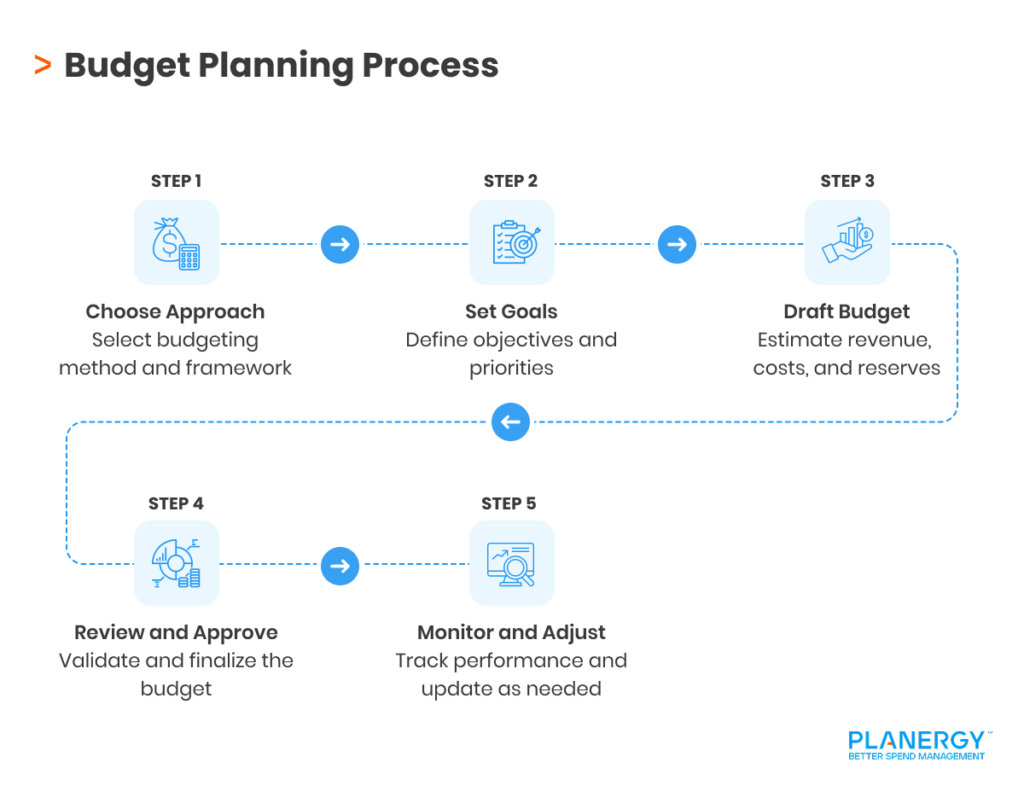
Budget planning and processes are a set of step-by-step processes that are followed when creating a budget.
While the steps may vary, depending on the type of budget you’re creating and the approach you choose to use, the processes remain the same.
1. Determine the Budget Approach You Wish to Take
Do you want to set high-level organizational goals or have your employees weigh in on the budget? Do you want to plan for different scenarios or start from scratch, with everyone at the same baseline?
Do you want a static budget that will remain untouched throughout the year, or do you want a working budget that is updated regularly?
Whatever your preferences, setting your budget approach helps determine what information you need to gather before getting started.
2. Set Long-Term Goals and Objectives
Setting SMART (specific, measurable, achievable, relevant, and time-bound) goals and objectives should be completed before starting the budgeting process.
This allows you to set the period the budget will cover (monthly, yearly, etc.), along with establishing organizational priorities for the upcoming year.
Next, you’ll begin to gather all necessary financial data, which may include last year’s budget numbers, departmental budgets provided by managers, and information on upcoming revenue and expenses.
At this early stage, you may want to consider using the what-if scenario (described above) that allows you to explore various scenarios during the planning stages to create a more accurate budget.
3. Begin Drafting the Budget
Whether you’re employing a top-down budget with top management setting budget numbers or a bottom-up budget with all departments contributing to the budget, creating a draft of the budget will include:
Calculating all revenue streams for the upcoming year including revenue from product or services sales, investment revenue, and rental income, if any.
Identifying all costs, including fixed costs such as rent and salaries, along with any variable costs such as production costs and raw materials.
Calculating a safety net for unexpected costs or one-time expenses that may crop up.
Creating the first draft of the budget.
4. Review the Completed Draft and Send It to Upper Management for Input
The revision process may take the longest during the budget preparation process, particularly if the bottom-up budget approach is used. Once the budget is approved, it’s ready to be put to use in the new year.
5. Evaluate and Adjust the Budget Regularly
Creating a budget is a good first step, but financial performance can only be managed if the budget is regularly monitored, with actual revenue and spending tracked against the budget.
Variance analysis (the difference between the budgeted amount and the actual amount) allows you to identify trouble spots and make any adjustments when necessary.
Why Are Business Budgets Important for Startups?
Because startups often have up-front funding, they must create a business budget along with their business plan.
A startup budget helps businesses manage funds for the upcoming year, allocating funds to areas that need it and keeping uncontrolled spending in check.
While creating a startup budget may be time-consuming, since there’s no historical data to draw from, having a financial plan in place helps a fledgling business stay on track during the important first year.
How do I Create a Budget Plan for My Business?
The easiest way to create a budget for your business is to follow the steps above. While the process may seem daunting, using historical data can streamline the budget workflow process considerably.
For startups without historical data, start with general estimates and adjust as the year goes on.
What Is the 50/30/20 Budget Rule?
The 50/30/20 budget framework is used to allocate available funds into three distinct areas:
50% for Operations – This includes your rent or mortgage, wages and salary expenses, inventory, utilities, insurance, and technology needs.
30% for Growth and Expansion – This includes marketing and advertising expenses, professional development, product research and development, equipment upgrades, and acquiring new customers.
20% for Saving and Investment – This includes creating an emergency fund, investing in stocks, land, or buildings, and future business expansion.
What Is the 70/20/10 Budget Rule?
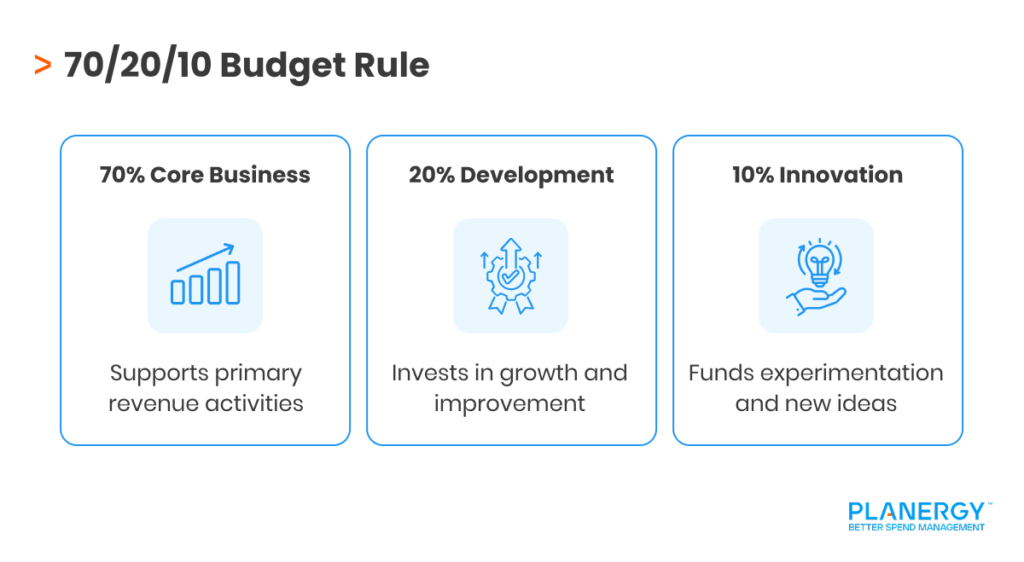
The 70/20/10 budget rule is similar to the 50/30/20 budget rule, but concentrates more on general operating costs, with less used for growth and expansion.
70% of your budget is allocated towards maintaining your core business, including improving core products and services that are responsible for generating the majority of revenue.
20% of your budget would be allocated towards new development, such as introducing a new product or expanding operations to a new location. It could also be used to shore up an area that needs improvement.
10% of your budget funds are allocated towards innovations or ‘what-ifs.’ This could be anything from trying out a new production method or creating an entirely new business model for your current or future business.
How Often Should You Revise a Budget?
How often you revise a budget is highly dependent on the type of budget you create in the first place. For instance, a startup may only revise its budget a few times a year, while those using a rolling budget or working budget will likely be updating the budget monthly.
Many organizations create multiple budgets, with one budget used for meeting long-term strategic goals while others are used to manage revenue and expenses each month.
What Software Tools Help with Business Budgeting?
Creating a budget for your business doesn’t have to be difficult. While businesses commonly use business budget templates or Microsoft Excel spreadsheet, utilizing a software application like PLANERGY, a spend management software, is a much better option, providing you with:
Streamlined Access to Accurate Data
A budget is useless if the data collected is inaccurate. Using an application like PLANERGY provides reassurance that the information included in your budget is accurate. In addition, by automatically importing data from various sources, you’ll reduce errors by eliminating data entry.
More Accurate Forecasting
The ability to analyze historical spending patterns leads to more accurate data forecasting. While you can still analyze data manually, there’s no guarantee that the information is valid.
Better Control
Are your budgets currently stored on spreadsheets in multiple locations? Using software tools, you can store all of your budgets in a single location to expedite access while increasing control.
Improved Collaboration
Creating multiple budgets for multiple departments can be time-consuming, and when created manually, can be error-prone. Using a software application like PLANERGY allows departments to collaborate on budget creation and review.
Improved Income and Expense Tracking
The right software tools can automatically categorize spending into the proper categories in real-time so that financial reports are always accurate and up-to-date.
Successful business owners understand that business budgeting is crucial for managing company finances, making more informed decisions, and achieving financial goals.
Regardless of the type of budget you wish to create, utilizing the proper tools can help you create accurate budgets that are an essential component for your business’s long-term financial health.
What’s your goal today?
1. Use PLANERGY to manage purchasing and accounts payable
We’ve helped save billions of dollars for our clients through better spend management, process automation in purchasing and finance, and reducing financial risks. To discover how we can help grow your business:
2. Download our guide “Preparing Your AP Department For The Future”
Download a free copy of our guide to future proofing your accounts payable department. You’ll also be subscribed to our email newsletter and notified about new articles or if have something interesting to share.
3. Learn best practices for purchasing, finance, and more
Browse hundreds of articles, containing an amazing number of useful tools, techniques, and best practices. Many readers tell us they would have paid consultants for the advice in these articles.
We use cookies to personalise content and ads, to provide social media features and to analyse our traffic. We also share information about your use of our site with our social media, advertising and analytics partners who may combine it with other information that you’ve provided to them or that they’ve collected from your use of their services.
The technical storage or access is strictly necessary for the legitimate purpose of enabling the use of a specific service explicitly requested by the subscriber or user, or for the sole purpose of carrying out the transmission of a communication over an electronic communications network.
Preferences
The technical storage or access is necessary for the legitimate purpose of storing preferences that are not requested by the subscriber or user.
Statistics
The technical storage or access that is used exclusively for statistical purposes.The technical storage or access that is used exclusively for anonymous statistical purposes. Without a subpoena, voluntary compliance on the part of your Internet Service Provider, or additional records from a third party, information stored or retrieved for this purpose alone cannot usually be used to identify you.
Marketing
The technical storage or access is required to create user profiles to send advertising, or to track the user on a website or across several websites for similar marketing purposes.