We saved more than $1 million on our spend in the first year and just recently identified an opportunity to save about $10,000 every month on recurring expenses with PLANERGY.
Budget forecasting blends budgeting and financial forecasting to project future revenue and expenses using historical data, economic conditions, and market trends.
Budgeting is short-term, structured, and expectation-driven, while forecasting is long-term, dynamic, and continuously updated.
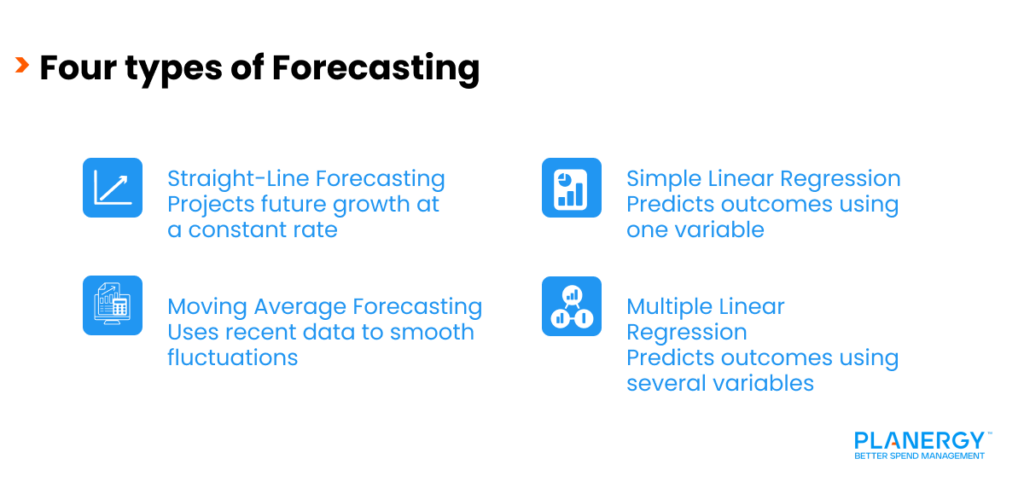
Four quantitative forecasting methods—straight-line, moving average, simple linear regression, and multiple linear regression—help predict performance depending on the available data and complexity of factors.
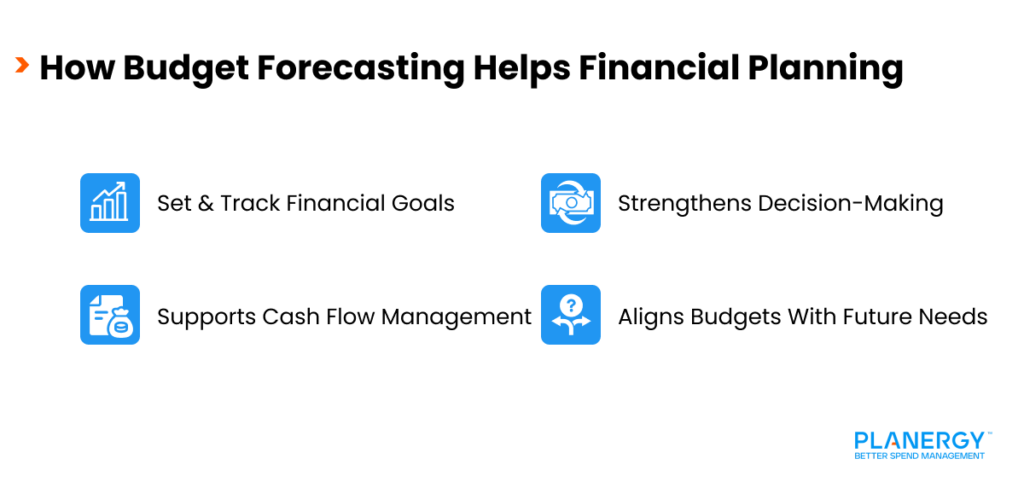
Effective financial planning relies on accurate forecasting to set goals, manage cash flow, guide decision-making.
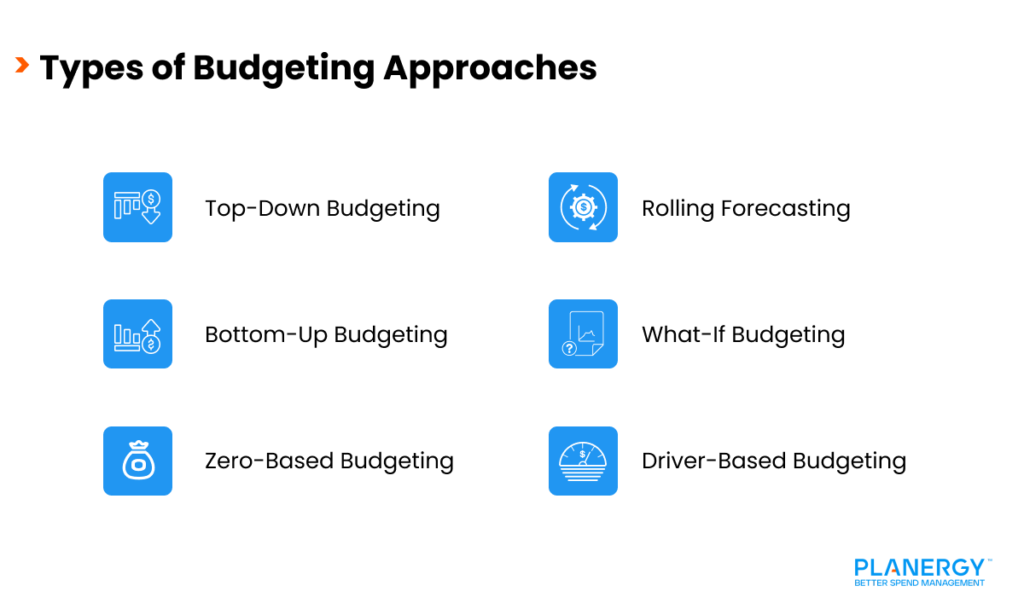
Budget forecasting uses both quantitative and qualitative methods, supported by budgeting approaches like top-down, bottom-up, zero-based, rolling forecasts, and what-if scenarios.
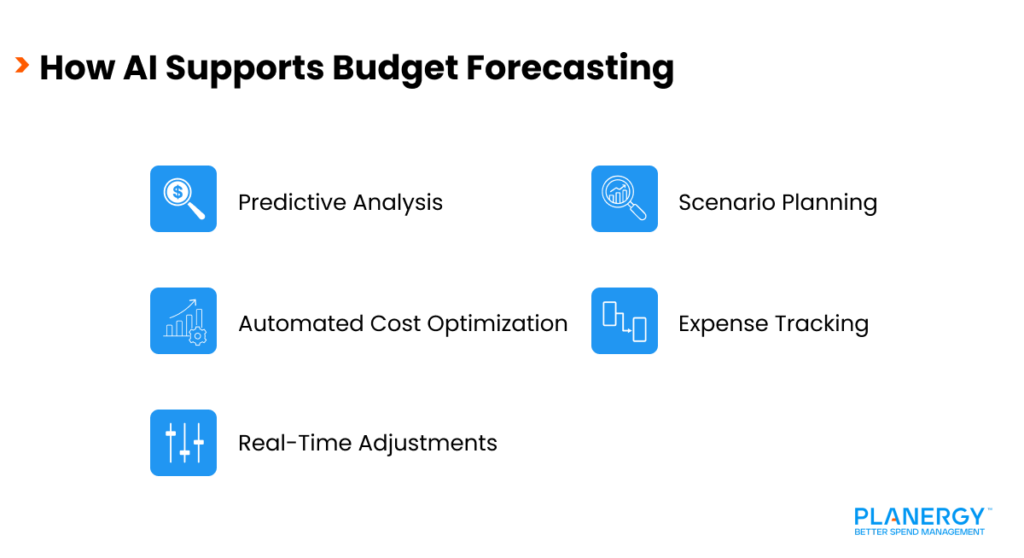
Automation and AI tools enhance forecasting through real-time data, predictive analytics, automated cost optimization, scenario planning, delivering faster insights and greater financial accuracy.
Setting both short and long-term goals is an essential part of running your business. To track their progress in meeting those goals, companies typically use various budgeting and forecasting methods.
But budgeting and that, when combined, become budget forecasting.
So, what is budget forecasting? In this article, we’ll explain the difference between budgeting and forecasting, what steps are involved in the budget forecasting process, and how to use the latest tools, including AI, to make the process easier.
What is a Budget Forecast?
A budget forecast, commonly known as a financial forecast, evaluates financial performance and economic conditions to better project future revenue and expenses.
A combination of a forecast and a budget, the budget forecast uses historical data, current economic conditions, and market trends for strategic planning and enhanced decision-making.
When used together, the budget forecast helps project more accurate revenue and expenses, better manage cash flow, and help companies reach their short-term and long-term goals.
What Are the Key Differences Between Budget Planning and Forecasting?
Though related, budget planning and forecasting are two different financial tools.
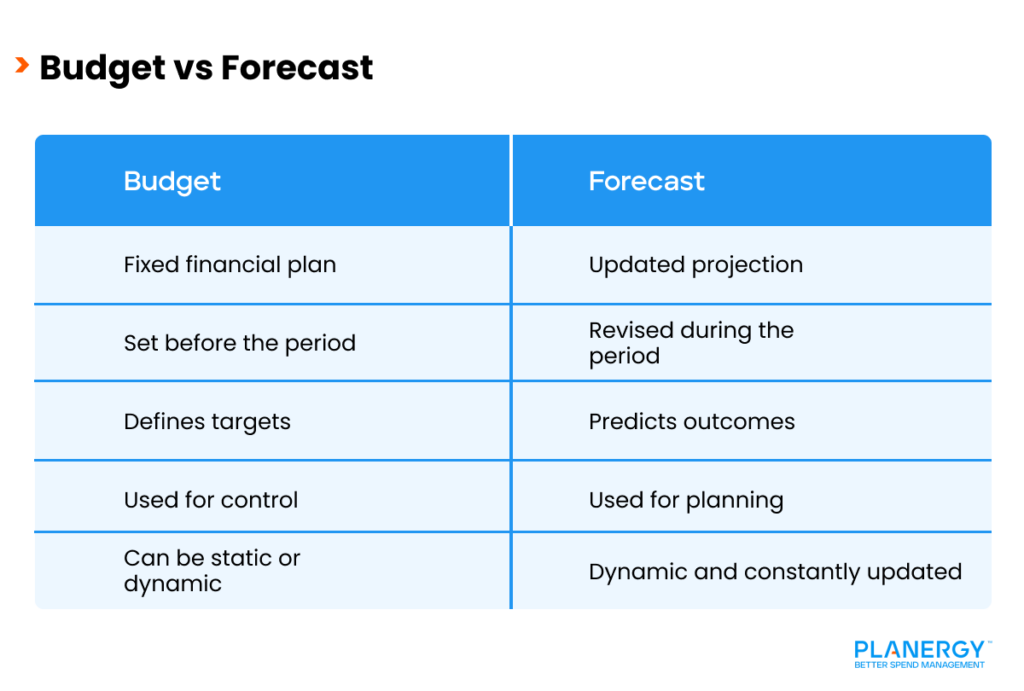
Budgeting is more rigid, concentrating on the near future, while forecasting looks at the big picture, studying trends, current economic issues, and making long-term predictions based on those estimates.
Budgeting
Forecasting
Provides an outline of expectations for a specific period of time – usually a single fiscal year
Is used to provide a big-picture view of the company’s financial health
Quantifies revenues and expenses expected for that particular timeframe
Uses historical data and outside economic factors to determine revenue and expenses
Creates a baseline to compare actual revenue and expenses to
Looks at trends and overall outcomes
Can be static or dynamic
Is always dynamic and constantly updated as historical and outside factors change
Is used in conjunction with a financial plan, including setting goals
Is used to adjust financial expectations
When you create an annual budget, revenue and expenses are estimated for the upcoming year based on historical data, along with the impact from changing circumstances.
For instance, if you’re adding additional product lines, it makes sense to base your budget revenue for the upcoming year on historical data, with an increase in revenue to reflect the additional product line.
With forecasting, you’re predicting future trends and using that information to create a long-term forecast for your business.
For example, when you create a five-year strategic plan, you’re using historical data from your business as well as information derived from economic drivers and trends to forecast future financial performance.
Unlike a budget, a forecast can change as conditions change.
What are the Four Common Types of Forecasting?
The four most common types of forecasting are all quantitative, meaning that they rely on data that can be measured and analyzed, such as historical data from previous periods.
1. Straight-Line Forecasting Method
The straight-line forecasting method is the least complicated approach, using prior performance to estimate future results.
This method is typically used by established businesses with years of data to reference.
To use this method, start with current performance, such as revenue or cost of goods sold (COGS) totals, and forecast future performance using your company’s current growth trends.
For instance, if your company has regularly grown at 3% annually, and your current annual revenue is $5 million, you would use the following calculation to forecast revenue for the next five years.
Year 1: $5,000,000 x (1 + 0.03) = $5,150,000
Year 2: $5,000,000 x (1 + 0.03) = $5,304,500
Year 3: $5,304,500 x (1 + 0.03) = $5,463,635
Year 4: $5,463,635 x (1 + 0.03) = $5,637,544
Year 5: $5,637,544 x (1 + 0.03) = $5,806,670
Straight-line forecasting’s biggest advantage is its simplicity.
Unfortunately, if your company has not seen consistent growth or has not been in business for a significant amount of time, using this method may not prove useful.
2. Moving Average Forecasting Method
Instead of using average performance over a year, the moving average forecasting method uses average performance over a much shorter period of time, such as days, weeks, or months.
This lets you identify short-term patterns, such as revenue for a single month or sales growth over three months.
For this example, a retailer has sold 512 units in January and 725 units in February, and can calculate the moving average by adding the two months’ totals and then dividing them by 2 to project what sales will be in March.
(515 + 725) / 2 = 620
While the moving average forecasting method is helpful if product sales vary widely, it may not be the most accurate projection for companies whose product sales follow an established pattern, such as increased seasonal sales.
It’s also not a useful method for long-term projections, but it can work well for short-term operational forecasting.
3. Simple Linear Regression Forecasting Method
The simple linear regression method looks at how one variable, such as product sales, directly impacts another variable, like profit. Because product sales volume has a direct impact on profit, using this method can help identify pricing or valuation issues.
Using a simple model, you can see how much profit is created by increased sales. If the model shows that for every $10,000 increase in sales, you’re earning a $3,300 increase in profit, you can project that for every sales dollar received, you’ll earn $0.33 in profit.
This makes it easy to predict profit after each sale. For instance, if you have a $20,000 sale, you can calculate how much profit you’ll earn.
($20,000 x ($ / $3,300 / $10,000) = $6,600.
The simple linear regression method does a good job of quantifying the relationship between two related variables, such as product sales and profit, but it doesn’t take any other factors into consideration.
4. Multiple Linear Regression Forecasting Method
The multiple linear regression method is the most complex of all of the forecasting methods, using more than two independent variables when making projections.
For instance, a farmer may want to better understand how rainfall, temperature, and fertilizer affect crop growth.
Multiple linear regression uses a complicated formula that requires statistical knowledge and the use of built-in forecasting capability in your accounting or financial software.
How Can Accurate Forecasting Help with Financial Planning?
Accurate forecasting allows businesses to track their spending habits, manage revenue, and project financial challenges. It also provides new business owners with the information necessary to complete a business plan.
Below are four distinct advantages of effective forecasting:
Allows You To Set and Track Financial Goals
A budget allows you to account for increasing (or decreasing) revenues, planned and unplanned expenses, and profit goals.
Helps Manage Cash Flow
Creating a budget helps you manage cash flow through challenging times, such as slow months or after a large expenditure, or when a large influx of cash is received, ensuring there is enough cash available for both scenarios.
More Informed Decision-Making
An accurate budget allows management to make better decisions. For instance, knowing when sales are slower can allow management to cut costs in anticipation of lower revenue.
Assists With Future Forecasting
An accurate budget created today helps facilitate better forecasting in the future, since accurate financial data is key to better forecasting.
What Are the Methods of Budget Forecasting?
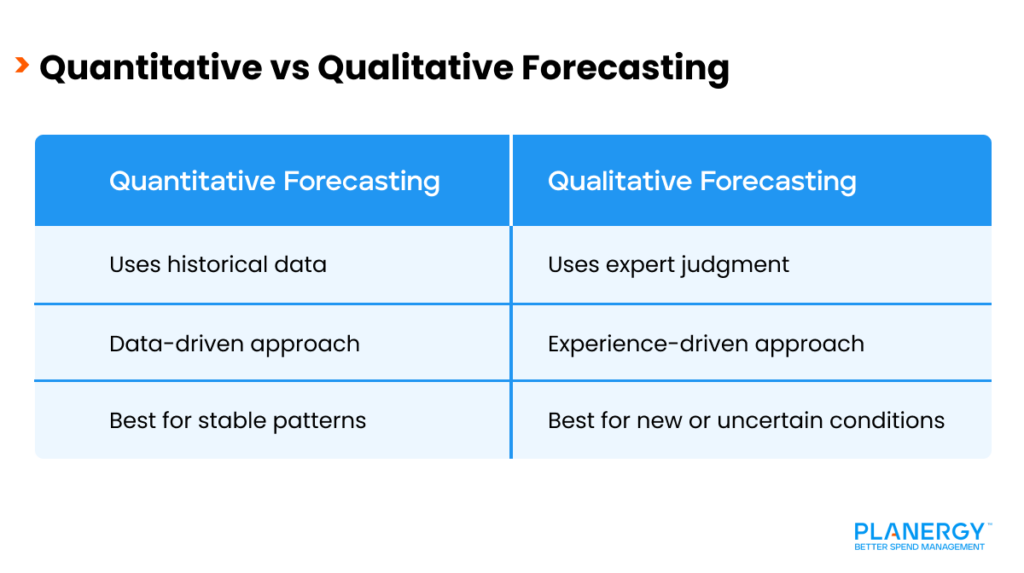
Budget forecasting uses one of two methods: quantitative and qualitative. Quantitative methods rely on measurable data that can be statistically analyzed. Qualitative methods, such as external business conditions, opinions, and market conditions, are often subjective and cannot be quantified.
Quantitative Methods
Including:
Historical data analysis
Moving averages
Regression analysis
Financial modeling
Qualitative Methods
Including:
Top-down
Bottom-up
Qualitative forecasting
Other budgeting methods can be used as well, including incremental budgeting, zero-based budgeting, and activity-based budgeting.
Businesses may also opt for a working budget, which, like a forecast, is updated regularly instead of remaining as a static document.
What Are the Steps of the Budgeting Process?
To start preparing a budget, you’ll need access to your financial statements, such as your balance sheet and income statement.
If this is the first budget you’ve prepared, you’ll need to rely on estimates, but those who have already prepared a budget in the past can use those numbers as a baseline and adjust them up and down as needed.
Assess last year’s budget for accuracy and make any needed adjustments. You’ll also want to adjust for changes made during the year such as moving to a less expensive building or adding staff members.
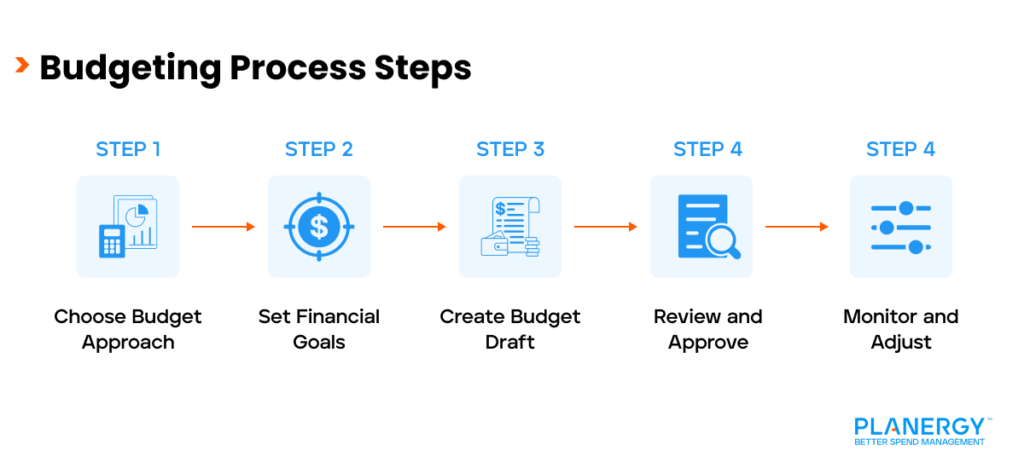
When you’re ready to get started, you can follow this roadmap:
Determine Which Budget Approach To Use Before starting your budget, determine the type of budget approach you wish to use.
Common budget approaches include:
Top-down budgeting
Bottom-up budgeting
Zero-based budgeting
Rolling forecast
What-if scenario
Driver-based budget
Once you determine the approach you wish to use, you can get started on your budget.
2. Set Goals and Objectives
Next, you’ll need to establish your company’s goals and objectives using SMART goals, This means goals which are specific, measurable, achievable, relevant, and time-bound.
By setting SMART goals, you’re able to set the timeframe that the budget will cover, along with establishing the specific metrics you wish to achieve.
3. Draft the Budget
To start drafting your new budget, you’ll need to:
Calculate all revenue streams from product and/or service sales, investment income, and any other income that is expected.
Identify both fixed costs, such as rent and salaries, along with variable costs like commissions and raw materials.
Identify and include a safety net for any unexpected expenses that may crop up throughout the year.
Obtain departmental input if creating a bottom-up budget or project revenue and expenses to coincide with stated goals.
4. Review the Completed Draft
Depending on the type of budget you’re creating, the revision process may be quick, or it may be the longest part of the creation process, with the CFO and other interested stakeholders approving the budget.
5. Monitor and Adjust the Budget Regularly
Regularly monitor your budget and make adjustments as needed. Variance analysis is an important part of the budget management process, allowing you to view budgeted amounts versus actual results to see where your projections are most accurate, while identifying areas that need adjusting.
What Tools are Available for Effective Budget Forecasting?
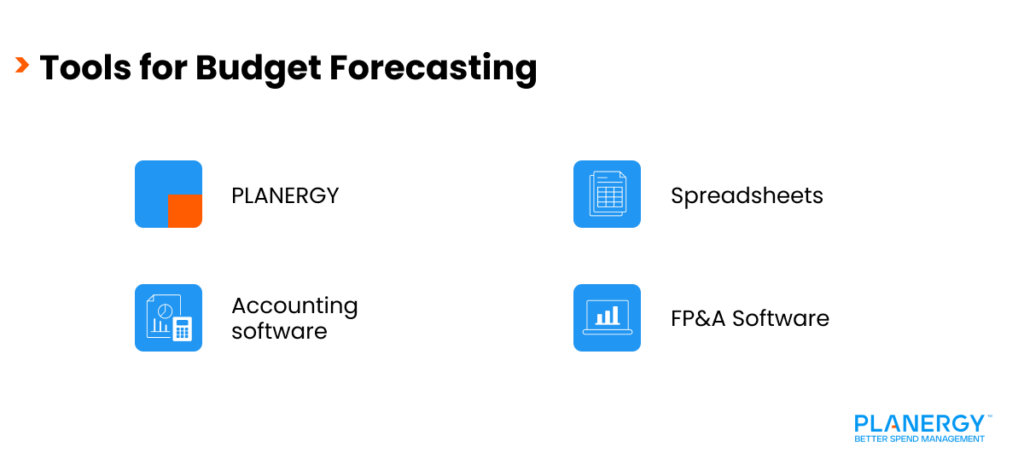
Automation is the best tool you can use for effective budget forecasting, starting with PLANERGY, a comprehensive spend management software that provides the tools you need to create accurate budget forecasts and financial statements.
like PLANERGY provide real-time expenditure versus budget data, while giving visibility and standardizing data exchange. This offers the transparency a business needs to generate accurate reports and forecasts.
Integrated accounting software applications like QuickBooks, Xero, and Sage also offer solid budgeting and forecasting capabilities. to keep data aligned.
Spreadsheet software like Microsoft Excel can also be used when creating budgets, but doing so increases the risk of manual data entry errors.
Finally, there are specialized financial planning and analysis (FP&A) platforms available that offer advanced capabilities such as financial modeling.
Extremely powerful, this type of forecasting software is better suited to larger organizations with more complex needs.
How to Use AI in Budget Forecasting
The introduction of automation and machine learning in cloud-based applications has helped reduce the burden of time-consuming, repetitive tasks.
But AI can also be used to streamline budget planning processes using the following:
Predictive Analysis
AI can quickly identify patterns, seasonal shifts, and external circumstances, and make budget adjustments accordingly.
Automated Cost Optimization
Who doesn’t need an easier way to manage costs? AI can easily identify red flags such as inflated pricing or increased labor costs.
Real-time Budget Adjustments
Instead of making manual budget adjustments periodically, AI can update budgets automatically based on live data.
Scenario Planning
An economy in flux or market saturation can quickly impact a business. AI allows you to easily incorporate multiple scenarios into your planning, so you’ll be prepared for all possibilities.
Improved Expense Tracking
The best way to manage expenses is in real time. AI allows you to quickly flag inappropriate expenses to ensure compliance with spending rules, while simplifying the receipt management and reporting.
Budget Forecasting is a Must for All Businesses
Business owners understand that budget forecasting is essential for keeping company finances on track. Regardless of the type of budget you’re creating, using the proper tools streamlines the entire budget creation process, improves financial outcomes, and provides the most accurate, up-to-date view of your company’s financial health.
1. Use PLANERGY to manage purchasing and accounts payable
We’ve helped save billions of dollars for our clients through better spend management, process automation in purchasing and finance, and reducing financial risks. To discover how we can help grow your business:
2. Download our guide “Preparing Your AP Department For The Future”
Download a free copy of our guide to future proofing your accounts payable department. You’ll also be subscribed to our email newsletter and notified about new articles or if have something interesting to share.
3. Learn best practices for purchasing, finance, and more
Browse hundreds of articles, containing an amazing number of useful tools, techniques, and best practices. Many readers tell us they would have paid consultants for the advice in these articles.
We use cookies to personalise content and ads, to provide social media features and to analyse our traffic. We also share information about your use of our site with our social media, advertising and analytics partners who may combine it with other information that you’ve provided to them or that they’ve collected from your use of their services.
The technical storage or access is strictly necessary for the legitimate purpose of enabling the use of a specific service explicitly requested by the subscriber or user, or for the sole purpose of carrying out the transmission of a communication over an electronic communications network.
Preferences
The technical storage or access is necessary for the legitimate purpose of storing preferences that are not requested by the subscriber or user.
Statistics
The technical storage or access that is used exclusively for statistical purposes.The technical storage or access that is used exclusively for anonymous statistical purposes. Without a subpoena, voluntary compliance on the part of your Internet Service Provider, or additional records from a third party, information stored or retrieved for this purpose alone cannot usually be used to identify you.
Marketing
The technical storage or access is required to create user profiles to send advertising, or to track the user on a website or across several websites for similar marketing purposes.