What's PLANERGY?

Modern Spend Management and Accounts Payable software.

Helping organizations spend smarter and more efficiently by automating purchasing and invoice processing.

We saved more than $1 million on our spend in the first year and just recently identified an opportunity to save about $10,000 every month on recurring expenses with PLANERGY.

King Ocean Logo

Cristian Maradiaga

King Ocean

Download a free copy of "Indirect Spend Guide", to learn:

  • Where the best opportunities for savings are in indirect spend.
  • How to gain visibility and control of your indirect spend.
  • How to report and analyze indirect spend to identify savings opportunities.
  • How strategic sourcing, cost management, and cost avoidance strategies can be applied to indirect spend.

Download a free copy of "Indirect Spend Guide", to learn:

  • Where the best opportunities for savings are in indirect spend.
  • How to gain visibility and control of your indirect spend.
  • How to report and analyze indirect spend to identify savings opportunities.
  • How strategic sourcing, cost management, and cost avoidance strategies can be applied to indirect spend.

Best Practices for Purchase Order Management

PO Management Title Image

KEY TAKEAWAYS

  • Purchase order (PO) management is essential for controlling spend, preventing budget overruns, and ensuring accurate, efficient procurement operations.

  • An effective PO process follows a structured workflow—from requisition right through to payment—providing control, consistency, and audit-ready documentation.

  • Choosing the right type of purchase order flexibility, and accuracy depending on purchasing needs and supplier relationships.

  • Common PO challenges, such as manual processing, poor visibility, maverick spending, and matching errors, hinder efficiency and increase financial risk.
  • Automation enhances PO management by accelerating approvals, improving accuracy, enforcing policies, enabling real-time tracking, and reducing processing costs.
  • Modern PO management software (including PLANERGY) delivers end-to-end benefits through centralized control, integration, analytics, and scalable digital workflows.

Controlling spend and optimizing procurement are top priorities for any successful enterprise. At the heart of effective procurement lies purchase order management, a systematic approach that can make or break your company’s operational efficiency.

When handled well, the purchase order (PO) process is a powerful tool for financial control, supplier relationship management, and operational streamlining.

When neglected, it can lead to budget overruns, supply chain disruptions, and missed opportunities for savings.

Understanding Purchase Orders: Your Foundation for Procurement Control

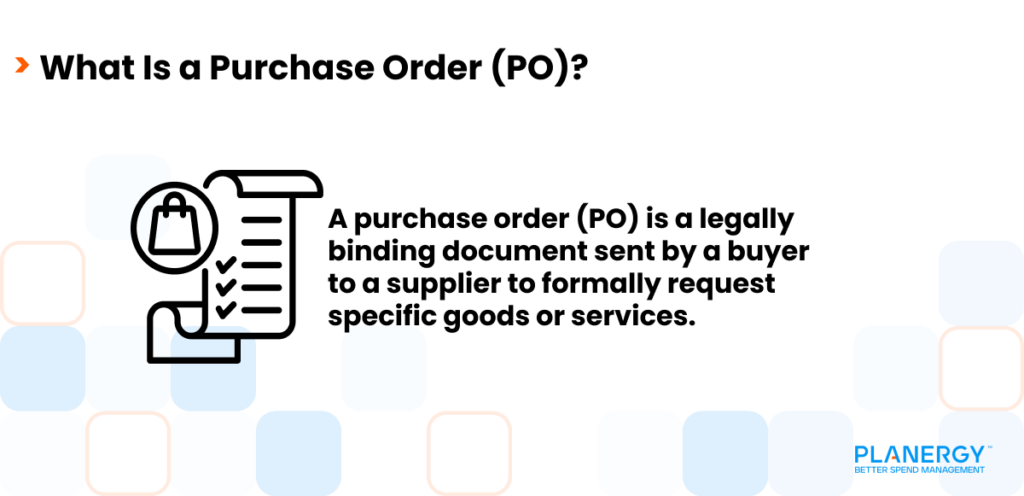
What is a Purchase Order Definition Card

A purchase order (PO) is a legally binding document issued by a buyer to a vendor that authorizes a purchase transaction. It specifies the types, quantities, and agreed-upon prices for products or services the buyer wishes to purchase.

Once the seller accepts the PO, it becomes a contract between both parties, protecting both the buyer and seller in the transaction.

Key information included: PO number, buyer/seller details, itemized goods or services, quantities, prices, delivery dates, and payment terms.

Building Your Purchase Order Management System

The purchase order management process involves creating, reviewing, approving, and tracking purchase orders throughout their entire lifecycle.

It encompasses everything from the initial purchase request to final payment processing and includes monitoring order fulfillment, supplier management, and maintaining accurate financial records.

An effective PO management system serves as the backbone of procurement operations, ensuring that organizations maintain proper spend management, comply with budgetary constraints, and optimize their purchasing processes.

Getting the Sequence Right: PR Before PO

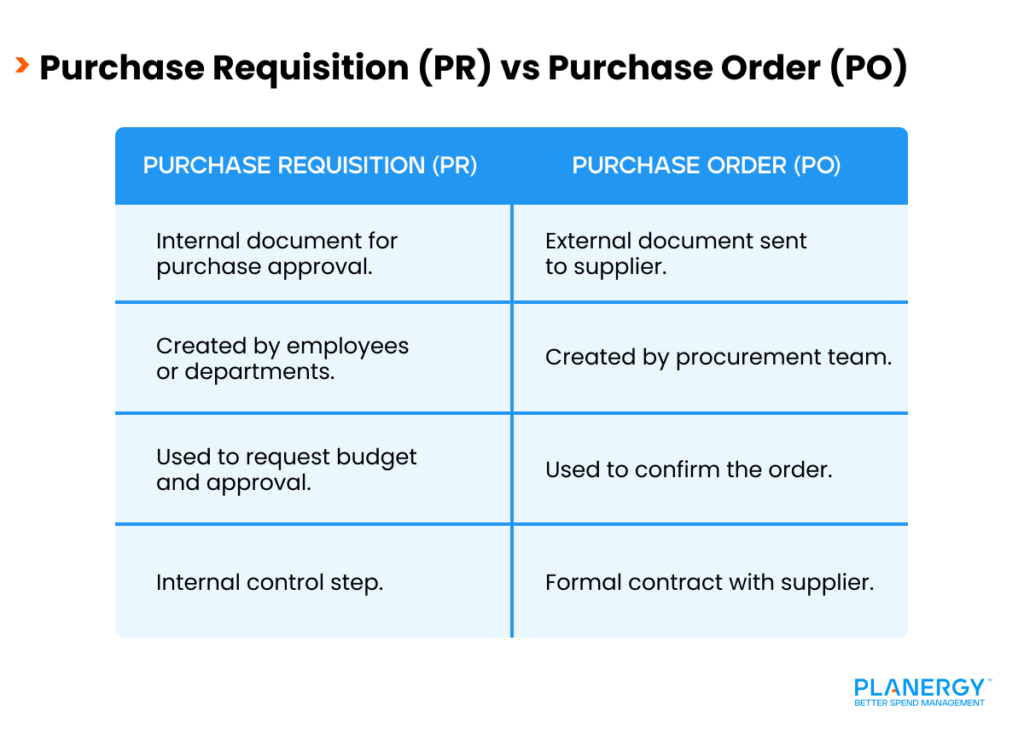
The purchase requisition (PR) comes before the purchase order (PO). Here’s how the sequence works:

Purchase Requisition (PR): An internal document created by an employee or department requesting the purchase of goods or services based on business needs. It’s submitted for internal approval and budget verification.

Purchase Order (PO): Created after the PR is approved, this external document is sent to the supplier to formally order the goods or services.

Purchase Requisition (PR) vs Purchase Order (PO)

Think of the PR as the internal “ask” and the PO as the external “order.” This two-step process ensures proper internal authorization before committing company funds to external vendors.

How Your Purchase Order Management System Actually Works

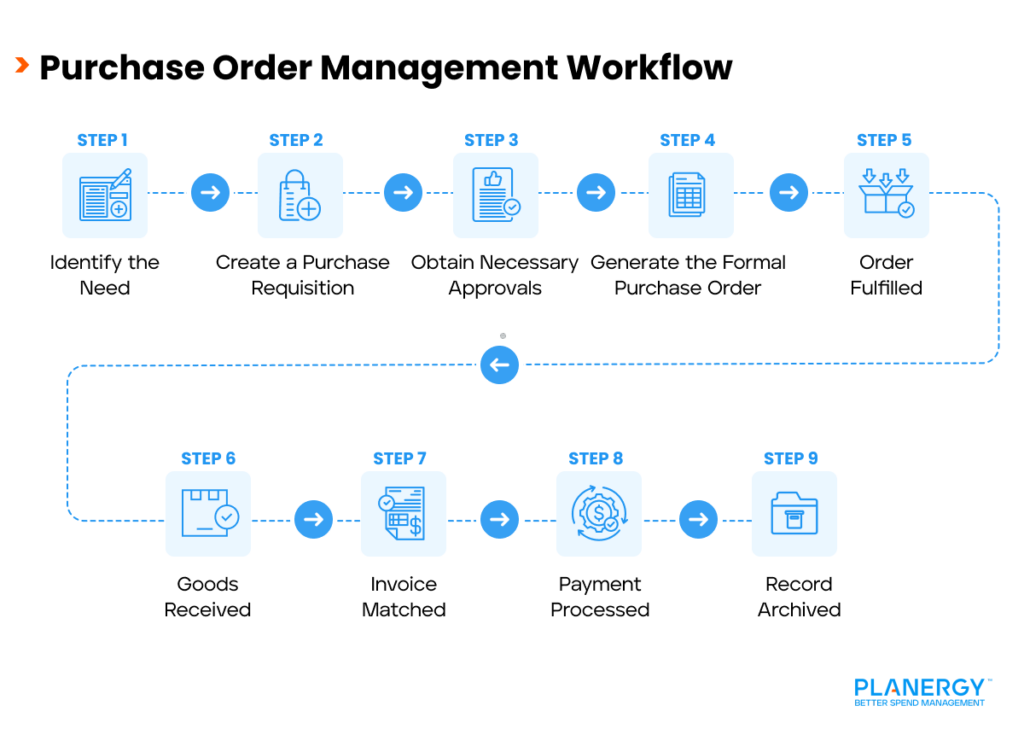
Purchase order management operates through a structured workflow: requisition creation, review and approval, PO generation, vendor submission, order tracking, receipt verification, three-way matching, payment processing, and record keeping.

This order processing approach ensures financial control and operational efficiency throughout the procurement lifecycle.

Mastering Your Purchase Order Process: A Step-by-Step Guide

Purchase Order Management Workflow

The purchase order process follows these critical steps:

  1. Identify the need
  2. Create a purchase requisition
  3. Obtain necessary approvals
  4. Generate the formal purchase order
  5. Order Filled
  6. Accept delivery of goods or services
  7. Match all documentation (PO, receipt, and invoice)
  8. Process payment
  9. Archive the record of the activity

Each step includes built-in checks to maintain financial control and ensure accuracy throughout the procurement cycle.

Choosing the Right Type of Purchase Order for Every Situation

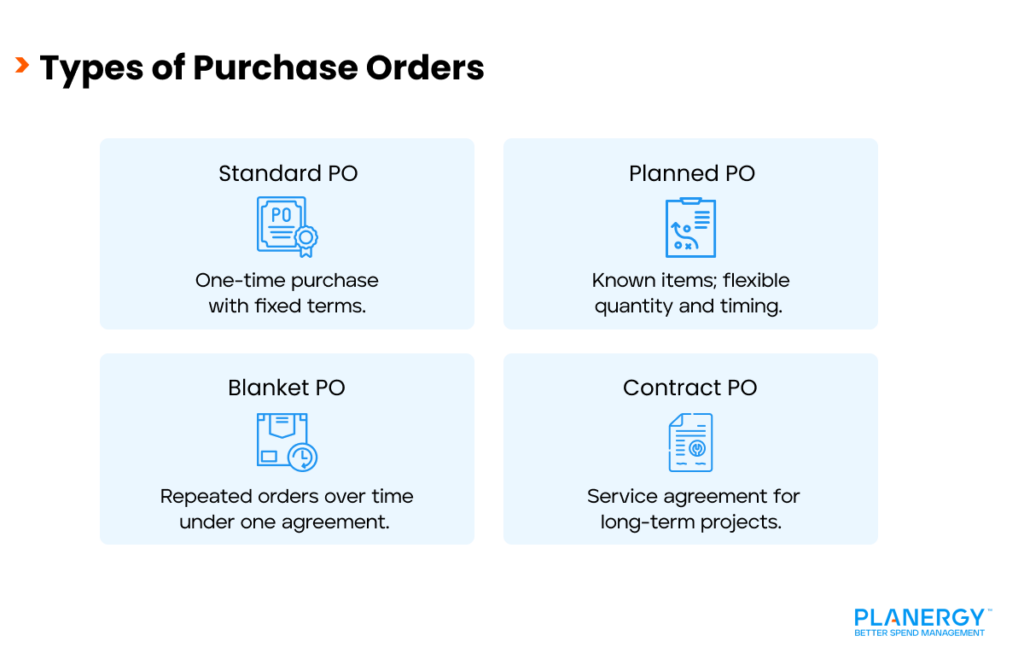
Types of Purchase Orders

Understanding different PO types helps organizations choose the most appropriate format for various purchasing scenarios:

1. Standard Purchase Order

The most common type, used for one-time purchases with clearly defined quantities, prices, and delivery dates. Ideal for straightforward transactions where all terms are known upfront.

2. Planned Purchase Order

Used when the buyer knows they’ll need specific items over a period, but the exact quantities and delivery schedules aren’t finalized. This type establishes pricing and terms while allowing flexibility in ordering specifics.

3. Blanket Purchase Order

A long-term agreement with a supplier for recurring purchases over a specified period (typically a year). It establishes negotiated prices for repeated orders without requiring a new PO for each transaction, ideal for frequently ordered items like office supplies.

4. Contract Purchase Order

Used for service agreements or ongoing relationships where work is performed over an extended period. Rather than specifying goods, it outlines the scope of services, milestones, and payment schedules, common for consulting, maintenance, or construction services.

Strategic Approaches to Purchasing Management


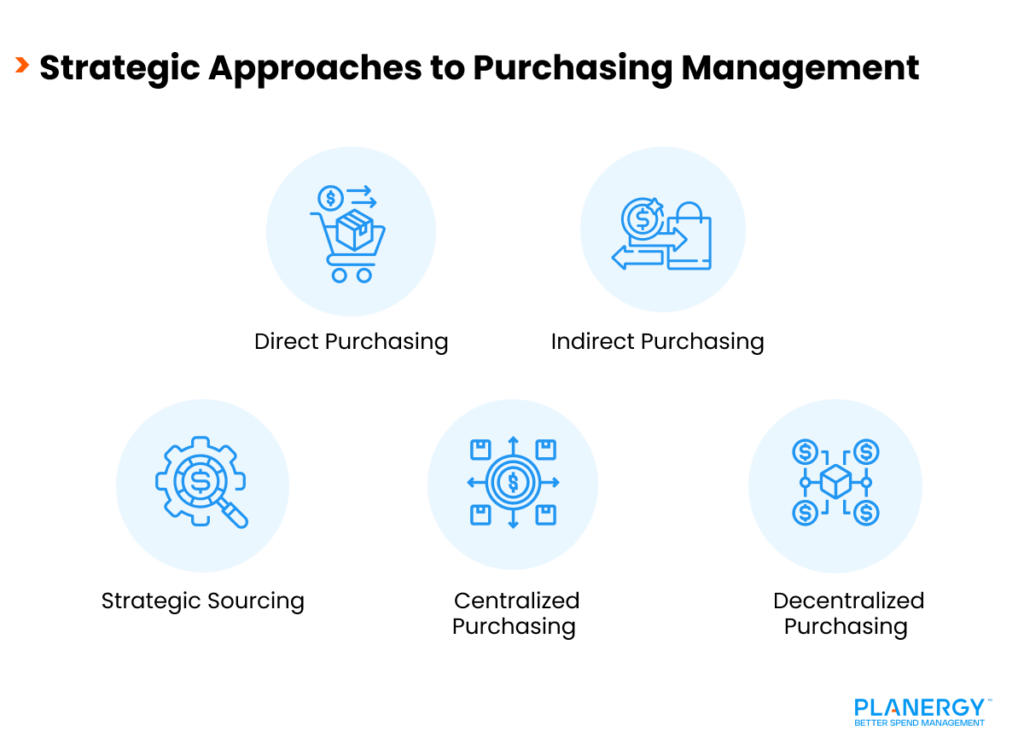
Strategic Approaches to Purchasing Management

Purchasing management encompasses several procurement strategies depending on organizational needs:

Direct Purchasing: Procurement of raw materials and components for finished products, critical for manufacturing.

Indirect Purchasing: Acquisition of goods and services that support operations, such as office supplies or IT equipment.

Strategic Sourcing: Comprehensive approach analyzing spending patterns, consolidating suppliers, and building long-term partnerships.

Centralized Purchasing: Consolidating purchasing activities to leverage volume discounts and maintain consistency.

Decentralized Purchasing: Allowing departments to manage their own purchasing for flexibility and faster response.

Following the Money: From PO to Payment

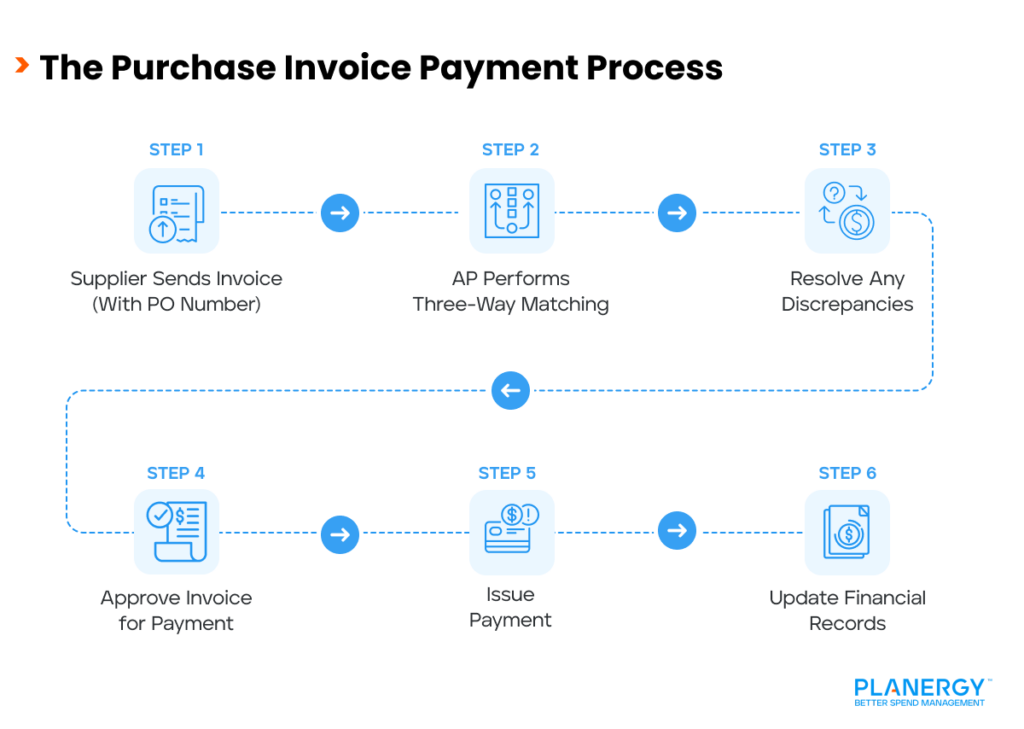
The Purchase Invoice Payment Process

The payment process involves seven key steps:

  1. The supplier sends an invoice referencing the PO number
  2. Accounts payable performs three-way matching (comparing the PO, receiving

Report, and supplier’s invoice)

  1. Any discrepancies are investigated and resolved
  2. The invoice is approved for payment
  3. Payment is issued according to agreed terms
    and financial records are updated

    This rigorous process protects organizations from overpaying, billing errors, and unauthorized charges.

Overcoming the Biggest Obstacles in Purchase Order Management

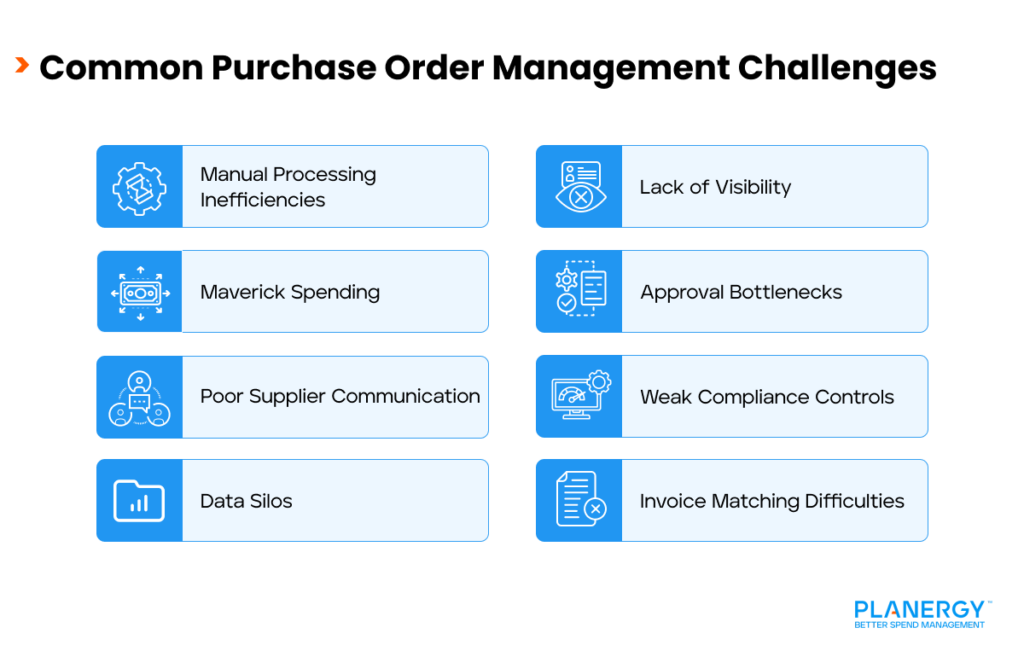
Common Purchase Order Management Challenges

Organizations frequently encounter several obstacles in managing their purchase order processes:

Manual Processing Inefficiencies

Paper-based or spreadsheet-driven PO systems create bottlenecks, slow approval times, and increase the risk of lost documents. Manual data entry is time-consuming and prone to errors that can delay procurement.

Lack of Visibility

Without centralized tracking systems, organizations struggle to know the status of purchase orders, leading to duplicate orders, missed deliveries, or budget overruns that aren’t discovered until it’s too late.

Maverick Spending

Employees sometimes bypass the official PO process to make urgent purchases, creating unauthorized spending that’s difficult to track and control. This “rogue spending” undermines budget management (cash flow) and supplier negotiations.

Approval Bottlenecks

When approvals depend on specific individuals, vacations or busy schedules can bring procurement to a standstill. Complex approval hierarchies without clear delegation create unnecessary delays.

Poor Supplier Communication

Miscommunication about specifications, delivery dates, or payment terms leads to wrong deliveries, missed deadlines, and strained supplier relationships.

Inadequate Compliance Controls

Without proper checks and balances, organizations risk non-compliance with internal policies, industry regulations, or contractual obligations, potentially resulting in audit failures or legal issues, which can spell trouble for small businesses.

Data Silos

When purchasing data exists in disconnected systems, organizations lack comprehensive insights into spending patterns, making strategic sourcing and cost optimization difficult.

Invoice Matching Difficulties

Manually matching POs, receipts, and invoices is tedious and error-prone, particularly when dealing with partial deliveries, price changes, or complex orders.

Taking Control: How PO Management Protects Your Bottom Line

Benefits of Effective PO Management

Solid PO management serves as a critical financial control mechanism:

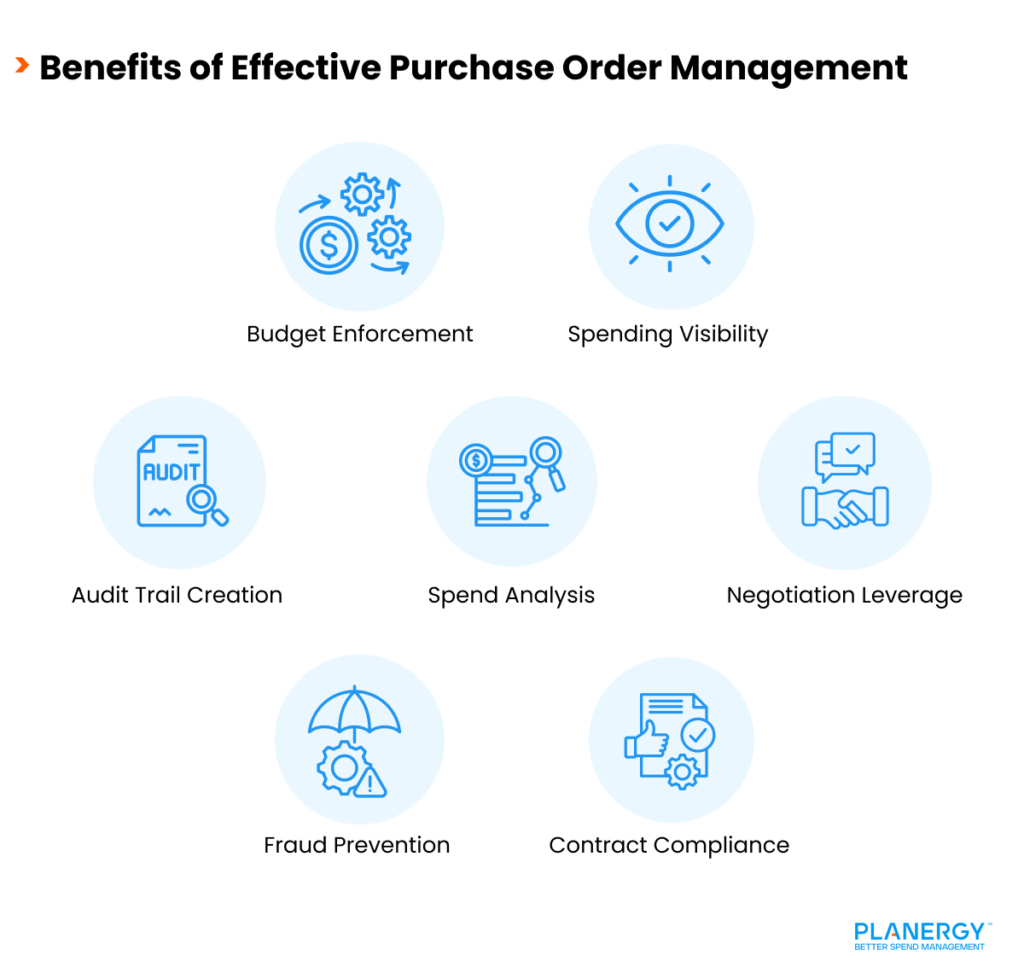
Budget Enforcement

PO software can automatically check purchase requests against available budgets before approval, preventing overspending and ensuring financial discipline across departments.

Spending Visibility

Centralized PO management provides real-time visibility into committed and actual spending, enabling managers to make informed decisions and course-correct before budget problems escalate.

Audit Trail Creation

Complete documentation of every purchase—who requested it, who approved it, what was ordered, and what was paid—creates accountability and deters unauthorized spending.

Spend Analysis

Consolidated purchasing data reveals patterns that inform strategic decisions, such as which suppliers to consolidate, where volume discounts could apply, or which departments consistently exceed budgets.

Negotiation Leverage

Understanding total purchasing volumes across the organization strengthens negotiating position with suppliers for better pricing, terms, or service levels.

Fraud Prevention

Formal approval workflows and three-way matching reduce opportunities for fraudulent activities like fictitious vendors, duplicate payments, or kickback schemes.

Contract Compliance

PO management ensures purchases adhere to negotiated contracts and preferred supplier agreements, capturing negotiated discounts and avoiding off-contract spending at higher prices.

Revolutionizing Procurement: The Power of Automation

Automation transforms end-to-end purchase order management from an administrative burden into a strategic advantage.

How Automation Improves Purchase Order Management

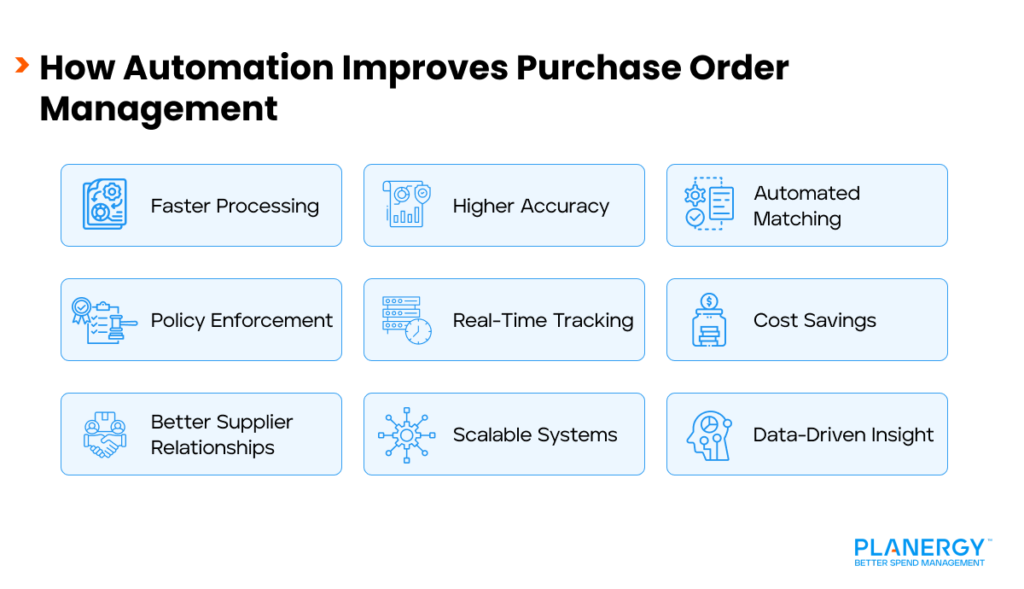
Accelerated Processing

Automated workflows route purchase requests to appropriate approvers instantly based on predefined rules, reducing approval cycles from days to hours and eliminating paper chase.

Enhanced Accuracy

Automation eliminates manual data entry errors, automatically populates PO fields from approved vendors’ lists and catalogs, and ensures consistency across documents.

Intelligent Matching

Automated three-way matching instantly compares POs, receipts, and invoices, flagging discrepancies for review while approving matching invoices without human intervention, reducing the risk of errors.

Policy Enforcement

Automated rules ensure compliance with purchasing policies, spending limits, and approval hierarchies without relying on manual oversight, reducing maverick spending.

Real-Time Tracking

Automated systems provide instant visibility into PO status, from requisition through payment, enabling proactive management of deliveries and vendor performance.

Cost Savings

By reducing processing time and manual labor, automation lowers procurement administrative costs significantly, often reducing cost-per-PO by 50% or more.

Better Supplier Relationships

Faster processing and accurate payments improve vendor satisfaction and can lead to better pricing, priority service, or preferential terms.

Scalability

Automated systems handle increased transaction volumes without proportional increases in staff, supporting business growth efficiently.

Data-Driven Insights

Automation captures and structures purchasing data, enabling sophisticated analytics that identify savings opportunities, vendor performance issues, or process inefficiencies.

Why Modern Software is Essential for Purchase Order Success

Why Modern PO Software Is Essential

Modern purchase order management software delivers comprehensive advantages:

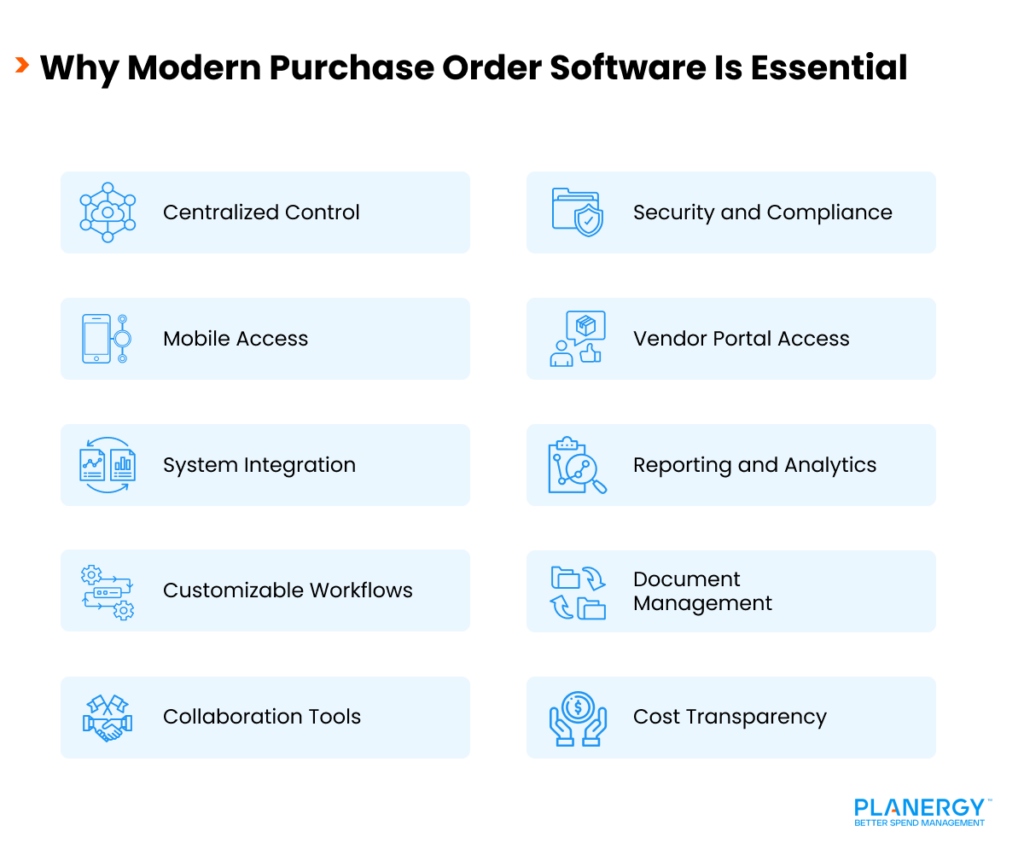
Centralized Control

A single platform for all purchasing activities eliminates data silos, provides consistent processes across the organization, and simplifies training and adoption.

Mobile Accessibility

Cloud-based PO software enables approvals and requisitions from anywhere, preventing delays caused by approvers being out of office and supporting today’s hybrid work environments.

Integration Capabilities

PO software integrates with ERP, accounting, inventory, and supplier systems, ensuring data flows seamlessly across business functions and eliminating duplicate entry.

Customizable Workflows

Software adapts to your organization’s unique approval hierarchies, purchasing policies, and business rules, rather than forcing you to change processes to fit the tool.

Enhanced Collaboration

Stakeholders can communicate within the platform about specific POs, attaching clarifying documents or notes that become part of the permanent record.

Compliance and Security

Role-based access controls ensure users only see and do what they’re authorized for, while comprehensive audit logs track all actions for compliance purposes.

Vendor Portal Integration

Suppliers can receive POs electronically, confirm acceptance, provide shipment updates, and submit invoices through integrated portals, improving communication and reducing manual coordination.

Reporting and Analytics

Pre-built dashboards and custom reports provide insights into spending patterns, supplier performance, processing times, and budget utilization, supporting continuous improvement.

Document Management

All related documents—requisitions, quotes, POs, receipts, invoices—are stored together in a searchable repository, eliminating lost paperwork and simplifying audits.

Cost Transparency

Software tracks not just purchase prices but total acquisition costs, including shipping, taxes, and processing expenses, revealing the true cost of goods and services.

Best Practices for Purchase Order Management

Best Practices for Purchase Order Management

Implementing these best practices maximizes the effectiveness of your PO management process:

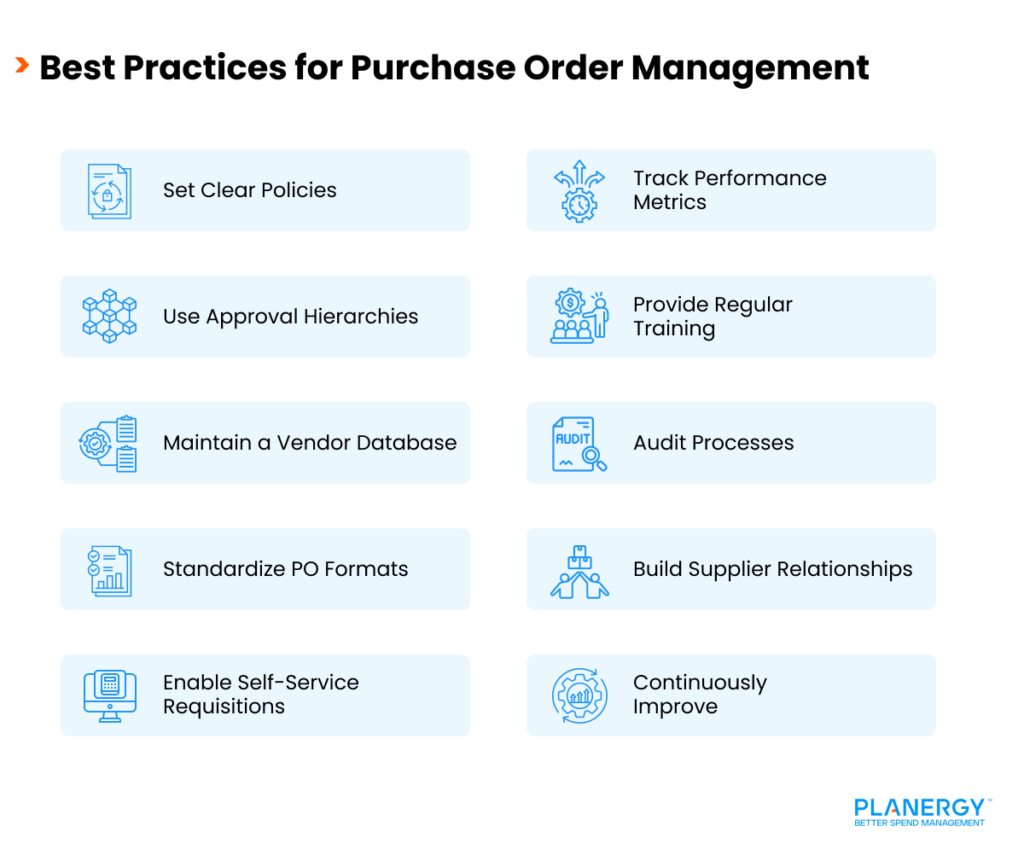
Establish Clear Policies

Document comprehensive purchasing policies that define spending authorities, approval requirements, preferred suppliers, and procurement procedures. Ensure all employees understand when and how to use the PO process.

Implement Approval Hierarchies

Create tiered approval levels based on purchase amounts and categories, with clear delegation protocols to prevent bottlenecks during absences.

Maintain a Centralized Vendor Database

Keep an up-to-date repository of approved suppliers with current contact information, negotiated terms, performance history, and compliance documentation.

Standardize Purchase Order Formats

Use consistent templates for purchase order creation that include all necessary information, reducing errors and making processing more efficient for both your team and suppliers.

Enable Self-Service Requisitioning

Provide user-friendly tools that allow employees to submit purchase requests easily while guiding them toward approved suppliers and preferred items.

Monitor Key Metrics

Track performance indicators such as PO processing time, cost per transaction, percentage of POs processed without issues, and supplier on-time delivery rates to identify improvement opportunities.

Conduct Regular Training

Ensure all stakeholders—requesters, approvers, receivers, and AP staff—understand their roles in the PO process and receive updates on policy changes or system enhancements.

Perform Periodic Audits

Regularly review purchasing activities to ensure compliance with policies, identify process weaknesses, and verify that controls are operating effectively.

Foster Supplier Relationships

Treat vendors as partners, communicate clearly about expectations, process orders and payments reliably, and provide feedback that helps them serve you better.

Continuously Improve

Regularly solicit feedback from process participants, analyze performance data, and implement refinements that streamline operations and reduce friction.

How PLANERGY Can Transform Your Purchase Order Management

PLANERGY procurement software offers a comprehensive solution that addresses the full spectrum of purchase order management challenges while delivering measurable business value.

Streamlined Procurement Workflows

PLANERGY automates the entire PO lifecycle from requisition through payment, dramatically reducing processing time and administrative burden.

Intelligent routing ensures requests reach the right approvers instantly through a streamlined approval process, while predefined templates and catalogs make order creation fast and error-free.

Complete Spending Visibility

Real-time dashboards provide executives and managers with instant insight into purchasing activities, committed budgets, and spending trends.

Drill-down capabilities allow you to analyze spending by department, category, supplier, or project, revealing opportunities for cost optimization.

Powerful Automation Features

PLANERGY’s automation engine handles routine tasks that traditionally consume significant staff time.

Automated three-way matching processes invoices without manual intervention when everything aligns, while intelligent alerts notify stakeholders of exceptions requiring attention.

Seamless Integration

PLANERGY integrates with your existing ERP, accounting, and business systems, eliminating data silos and ensuring information flows smoothly across your technology ecosystem.

This connectivity provides a single source of truth for financial and operational data.

Mobile-First Design

Approvers can review and authorize purchase requests from their smartphones or tablets.

This ensures that procurement doesn’t grind to a halt when decision-makers are traveling or working remotely. The intuitive mobile interface makes approvals fast and convenient.

Advanced Analytics

PLANERGY’s built-in analytics capabilities transform purchasing data into actionable insights.

Identify your top suppliers, discover spending patterns, benchmark processing times, and uncover savings opportunities through its comprehensive reporting tools.

Compliance and Control

Sophisticated approval workflows enforce purchasing policies automatically, ensuring all transactions receive appropriate authorization. Comprehensive audit trails document every action, providing the documentation needed for internal audits or regulatory compliance.

Supplier Collaboration

PLANERGY’s supplier portal enables vendors to receive POs electronically, acknowledge orders, provide shipment tracking, and submit invoices digitally, creating a seamless collaboration environment that reduces errors and improves relationships.

Scalable Architecture

Whether you’re processing dozens or thousands of purchase orders monthly, PLANERGY scales to meet your needs without degradation in performance, supporting your business growth trajectory.

Rapid Implementation

PLANERGY’s configuration-based approach means you can be operational quickly, avoiding lengthy development projects.

The platform adapts to your existing processes while providing guidance on best practices drawn from successful implementations across diverse industries.

Take Control of Your Procurement Management Process Today

Effective purchase order management is far more than an administrative function—it’s a strategic capability that directly impacts financial performance, operational efficiency, and supplier relationships.

Organizations that excel at PO management gain control over spending, reduce processing costs, improve compliance, and free procurement professionals to focus on strategic sourcing rather than transactional tasks.

The challenges of manual and disconnected PO processes are real and costly, but modern solutions like PLANERGY provide a clear path forward.

By automating workflows, providing comprehensive visibility, and enabling data-driven decision-making, the right software transforms procurement from a bottleneck into a competitive advantage.

As businesses face increasing pressure to control costs while maintaining agility, strong purchase order management becomes not just beneficial but essential.

Organizations that invest in streamlining their PO processes position themselves for sustainable success in an increasingly competitive marketplace.

Ready to transform your purchase order management? Discover how PLANERGY can help your organization achieve procurement excellence with powerful automation, complete visibility, and measurable results.

What’s your goal today?

1. Use PLANERGY to manage purchasing and accounts payable

We’ve helped save billions of dollars for our clients through better spend management, process automation in purchasing and finance, and reducing financial risks. To discover how we can help grow your business:

2. Download our guide “Indirect Spend Guide”

Download a free copy of our guide to better manage and make savings on your indirect spend. You’ll also be subscribed to our email newsletter and notified about new articles or if have something interesting to share.

3. Learn best practices for purchasing, finance, and more

Browse hundreds of articles, containing an amazing number of useful tools, techniques, and best practices. Many readers tell us they would have paid consultants for the advice in these articles.

Business is Our Business

Stay up-to-date with news sent straight to your inbox

PLANERGY LOGO

Sign up with your email to receive updates from our blog