We saved more than $1 million on our spend in the first year and just recently identified an opportunity to save about $10,000 every month on recurring expenses with PLANERGY.
Category management has evolved from a retail-focused discipline into a strategic imperative across industries.
Organizations that master this approach don’t just optimize the procurement process; they streamline purchasing activities and transform procurement into a competitive advantage, aligning decisions with broader business objectives while driving profitability at every level.
What Is Category Management?
Category management is a strategic approach to procurement that organizes purchasing activities into distinct groups of related products or services, then applies specialized strategies to each group.
Rather than treating them uniformly, this methodology recognizes that different categories (from office supplies to professional services) require tailored approaches based on unique market dynamics, supplier landscapes, and business impact.
A well-defined category management strategy enables organizations to move beyond reactive purchasing toward proactive market engagement that supports continuous improvement and competitive positioning.
At its core, category management shifts procurement from a transactional function to a strategic discipline.
It involves deep market analysis, supplier relationship optimization, and continuous performance measurement to drive sustainable value beyond simple cost reduction.
Understanding the Strategic Framework
The Three Pillars of Category Management Approaches
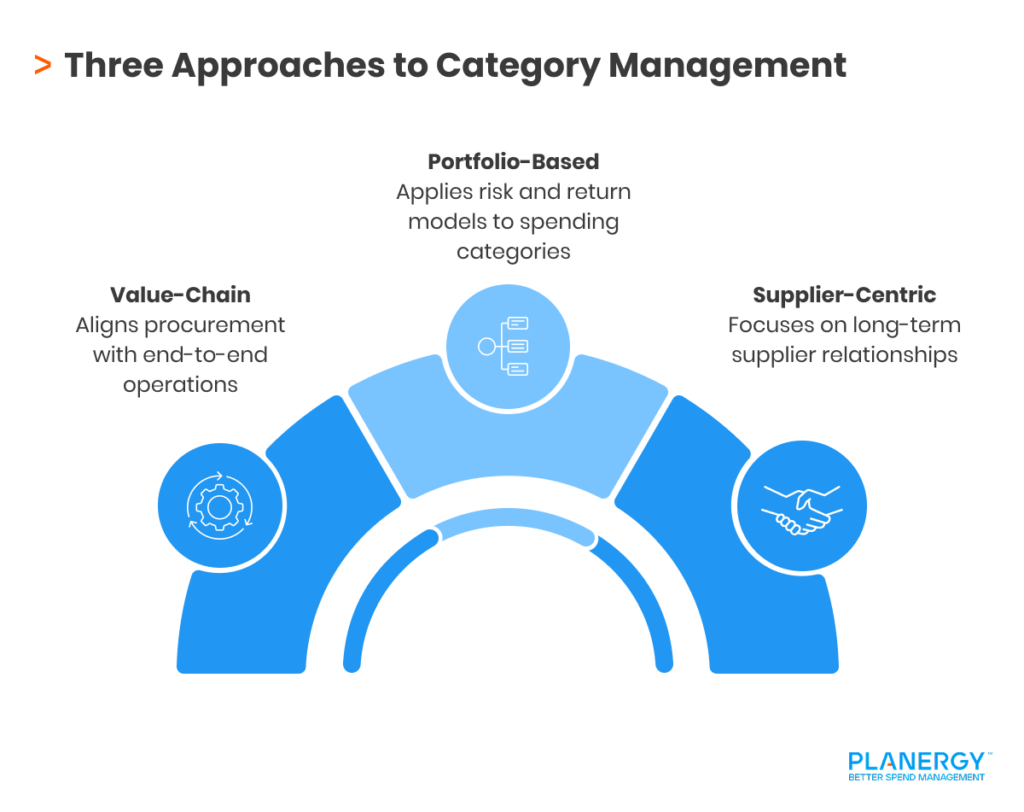
Category management operates across three distinct strategic models, each serving different organizational needs:
Portfolio-Based Category Management This treats purchasing categories as investment portfolios, applying risk-return frameworks to optimize the overall procurement strategy.
This approach excels in complex organizations with diverse spending patterns, enabling strategic resource allocation across categories.
Supplier-Centric Category Management This prioritizes relationship development and collaboration with key suppliers. This model works exceptionally well for categories where innovation, quality, or long-term partnerships drive more value than aggressive price negotiations.
Value-Chain Category Management This integrates category strategies with end-to-end supply chain operations, focusing on total cost of ownership rather than purchase price alone.
This approach proves particularly effective when procurement decisions significantly impact downstream operations or customer experience.
The Four Ps: Building Blocks of Category Excellence
Successful category management rests on four foundational elements that create comprehensive category strategies:
Product This encompasses understanding the specific goods or services within each category, including specifications, quality requirements, and how they support business objectives.
This goes beyond basic commodity knowledge to include emerging alternatives, sustainability considerations, and innovation opportunities.
Price This involves sophisticated total cost analysis, moving beyond unit pricing to consider lifecycle costs, transaction expenses, and value-added services.
Effective category managers develop pricing models that account for volume commitments, payment terms, and risk-sharing mechanisms.
Promotion In category management this refers to internal stakeholder engagement and change management.
This means building buy-in for category strategies, communicating value creation, and managing the adoption of new suppliers or processes across the organization.
Place This addresses the distribution and delivery mechanisms that ensure products or services reach end users efficiently.
This includes logistics optimization, inventory management, and service delivery models that minimize total supply chain costs while maintaining reliability.
Mapping Your Procurement Landscape
Segmenting Spending into Strategic Categories
Effective category management begins with intelligent segmentation of organizational spend. While every business differs, procurement categories typically fall into several universal classifications:
Direct Materials and Components include raw materials, parts, and supplies that become part of finished products. These categories demand close coordination with production planning and quality assurance.
Indirect Goods and Services cover everything that supports operations without becoming part of the product, from MRO supplies to facility management to professional services. These categories often represent fragmented spending with significant consolidation opportunities.
Capital Equipment and Assets involve large, infrequent purchases of machinery, technology, or infrastructure. These decisions require sophisticated lifecycle analysis and cross-functional collaboration.
Marketing and Sales Services encompass agencies, media buying, events, and customer acquisition tools. These categories blend creative considerations with performance metrics.
Technology and Digital Services include software licenses, cloud infrastructure, IT services, and digital tools. This rapidly evolving category requires continuous market monitoring and vendor management.
The key lies not in rigid categorization but in grouping spend in ways that enable specialized strategies and clear ownership.
Executing the Category Management Journey
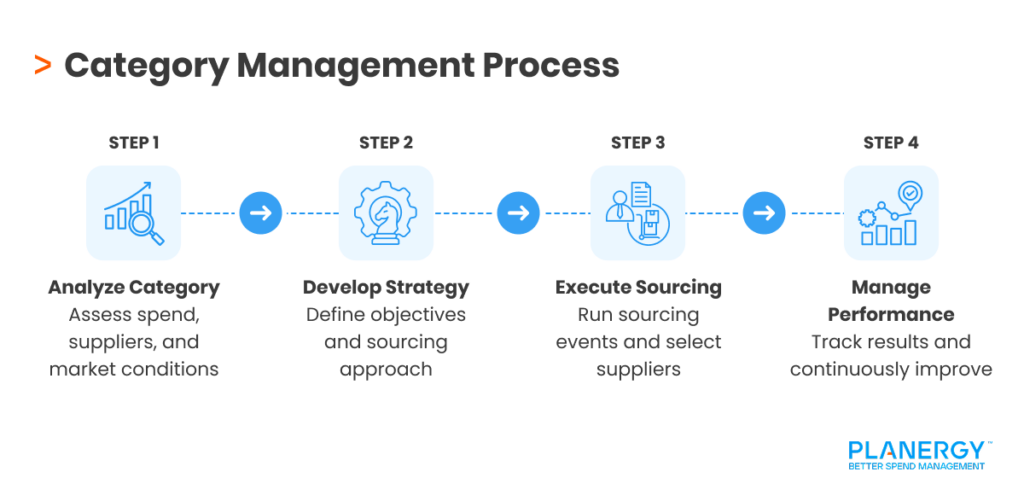
Phase 1: Deep-Dive Category Intelligence
The process begins with a comprehensive category analysis that goes far beyond historical spending reports. This phase involves:
Conducting thorough market research to understand supply dynamics, identifying key suppliers, emerging technologies, and potential disruptions. Analyze demand patterns across your organization to uncover hidden consolidation opportunities and forecast future needs accurately.
Assess your current supplier base critically by evaluating performance, identifying dependencies, and mapping relationship strength. This intelligence gathering reveals leverage points and risk exposures that will shape your strategy.
Perform total cost modeling that captures acquisition costs, ownership expenses, and hidden opportunity costs. This financial analysis provides the baseline against which you’ll measure improvement.
Phase 2: Developing Category-Specific Strategies
Armed with intelligence, craft tailored strategies for each category that align with business priorities:
Define clear objectives that balance cost optimization with quality, innovation, risk management, and sustainability goals. Establish measurable targets that demonstrate procurement’s contribution to business outcomes.
Determine the optimal sourcing approach. Use competitive bidding for commoditized categories, collaborative partnerships for strategic categories, or consortium buying for common indirect goods.
Your strategy should reflect the category’s unique characteristics and organizational priorities.
Design supplier relationship models that match category importance. Strategic categories warrant joint business planning and innovation partnerships, while tactical categories may require efficient transactional relationships.
Phase 3: Strategic Sourcing Implementation
Transform strategy into action through structured sourcing initiatives:
Develop comprehensive RFx documents that clearly communicate requirements while inviting supplier innovation. Include evaluation criteria that reflect total value, not just price.
Conduct rigorous supplier evaluation using cross-functional teams to assess capabilities, cultural fit, and strategic alignment. Site visits, reference checks, and pilot projects reduce selection risk.
Negotiate contracts that allocate risks fairly, include performance incentives, and build in flexibility for changing business needs. Well-structured agreements prevent future disputes and enable productive partnerships.
Phase 4: Continuous Performance Management
Category management succeeds or fails based on ongoing execution, benchmarking, and optimization that drives continuous improvement
Implement comprehensive performance tracking with category-specific KPIs covering cost savings, quality metrics, supplier performance, and compliance rates. Dashboard reporting provides visibility to stakeholders and drives accountability.
Conduct regular business reviews with key suppliers to address issues, explore improvement opportunities, and align on future direction. These forums transform supplier relationships from transactional to collaborative.
Monitor external market conditions continuously, watching for supply disruptions, price volatility, or innovation opportunities. Agile category managers adjust strategies proactively rather than reactively.
Distinguishing Category Management from Strategic Sourcing
While often used interchangeably, category management and strategic sourcing represent different but complementary disciplines.
Strategic sourcing is a tactical process focused on identifying, evaluating, and selecting suppliers for specific purchases. It’s a critical component within the broader category management framework.
Category management encompasses strategic sourcing but extends far beyond it. Where strategic sourcing asks “how do we buy this effectively,” category management asks “how should we approach this entire category strategically over time?”
Category management includes market strategy development, demand management, supplier relationship management, and continuous optimization. Strategic sourcing is one tool among many in this comprehensive approach.
Think of strategic sourcing as an event: a discrete initiative with a defined beginning and end. Category management is an ongoing discipline that continuously evolves strategies based on changing business needs and market conditions.
Transforming Procurement Performance
Driving Efficiency Through Systematic Category Approaches
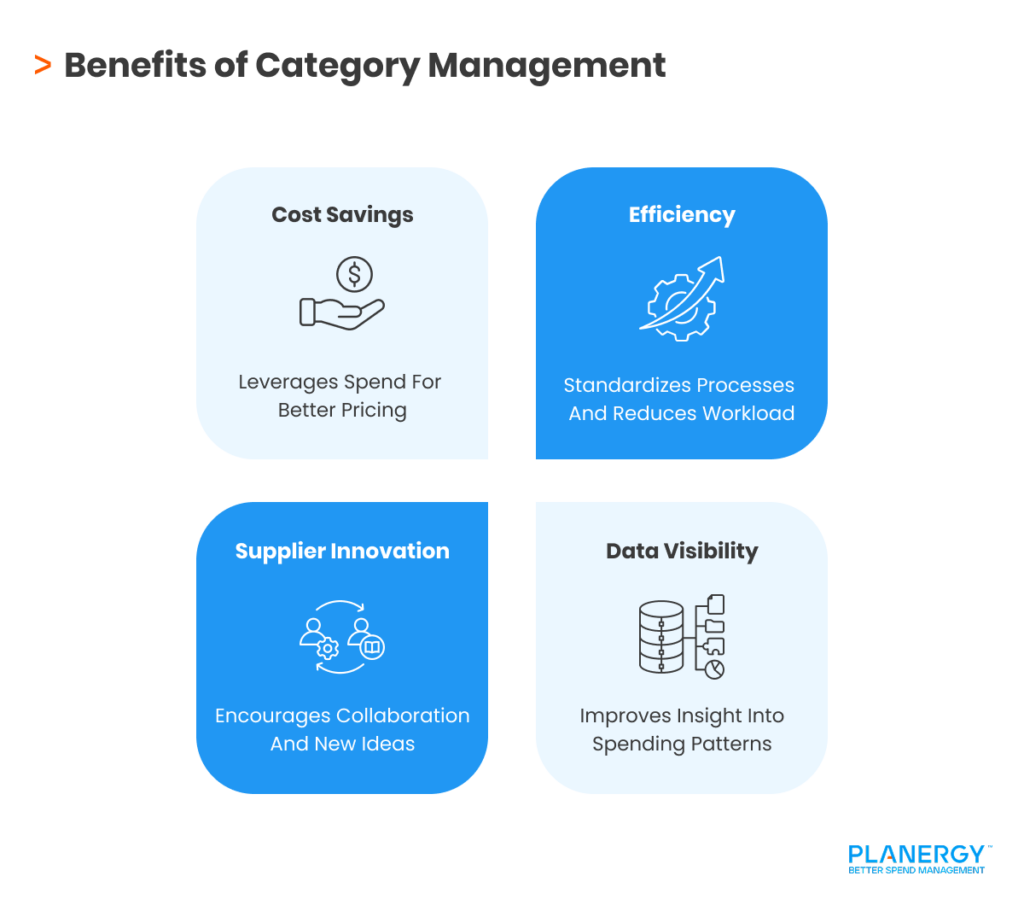
Category management revolutionizes procurement efficiency through several powerful mechanisms:
Consolidation and leverage emerge naturally when organizations understand their total spend within categories. Aggregating purchases previously scattered across departments or regions creates volume leverage that translates into better pricing, improved terms, and stronger supplier relationships.
Process standardization reduces transaction costs and complexity. By establishing category-specific processes, templates, and approval workflows, organizations eliminate redundant work and accelerate procurement cycles.
Specialized expertise develops when procurement professionals focus on specific categories rather than handling all purchases generically. Category managers become market experts who spot opportunities, anticipate risks, and drive innovation that generalist buyers would miss.
Strategic supplier relationships replace arms-length transactions. When procurement engages suppliers as strategic partners rather than interchangeable vendors, both parties invest in process improvements, innovation, and mutual success.
Data-driven decision making becomes possible when spending is organized into coherent categories with consistent metrics. Analytics reveal patterns, opportunities, and performance gaps that remain invisible in fragmented data.
Elevating Retail Performance Through Category Mastery
In retail contexts, category management takes on additional dimensions that directly impact customer experience and financial performance:
Assortment optimization ensures product mix aligns with customer preferences and market trends. Category managers analyze sales data, demographic patterns, and competitive offerings to curate selections that maximize revenue per square foot while minimizing inventory investment.
Pricing and promotion strategies become more sophisticated when managed at the category level. Rather than blanket approaches, category managers develop targeted promotional calendars that reflect seasonal patterns, competitive dynamics, and margin opportunities specific to each category.
Shelf space allocation transforms from intuition-based to analytical when category managers apply planogram software and space-to-sales analysis. This ensures high-performing products receive appropriate prominence while underperformers face strategic decisions.
Supplier collaboration on category growth creates win-win dynamics. Retailers and suppliers jointly invest in category development through enhanced merchandising, consumer education, and innovation that expands the total category rather than just shifting share.
Customer insight integration connects procurement decisions with shopper behavior. Category managers who understand purchase drivers, basket composition, and trip missions make superior decisions about product selection, pricing, and positioning.
Understanding the Supply Chain Foundation
The Critical Role of Supply Chain Management
Supply chain management provides the operational infrastructure upon which effective category management builds.
While category management determines what to buy and from whom, supply chain management ensures those goods or services flow efficiently from source to consumption.
This discipline encompasses demand forecasting, production planning, logistics coordination, inventory optimization, and distribution management.
Strong supply chain management reduces lead times, minimizes working capital tied up in inventory, and ensures product availability when and where needed.
The strategic importance stems from supply chain management’s impact on customer satisfaction, operational efficiency, and financial performance.
Companies with superior supply chains respond faster to market changes, operate with lower costs, and deliver more reliable customer experiences than competitors.
Integration Between Category and Supply Chain Management
The most successful organizations integrate category management and supply chain management into a cohesive strategy.
Category decisions about supplier selection, contract terms, and ordering patterns directly affect supply chain complexity, risk, and cost. Similarly, supply chain capabilities and constraints should inform category strategies.
For example, a category manager evaluating low-cost offshore suppliers must consider the supply chain implications: longer lead times, higher inventory requirements, and increased logistics complexity.
The true cost comparison requires collaboration between category and supply chain professionals to model total delivered cost under realistic operational scenarios.
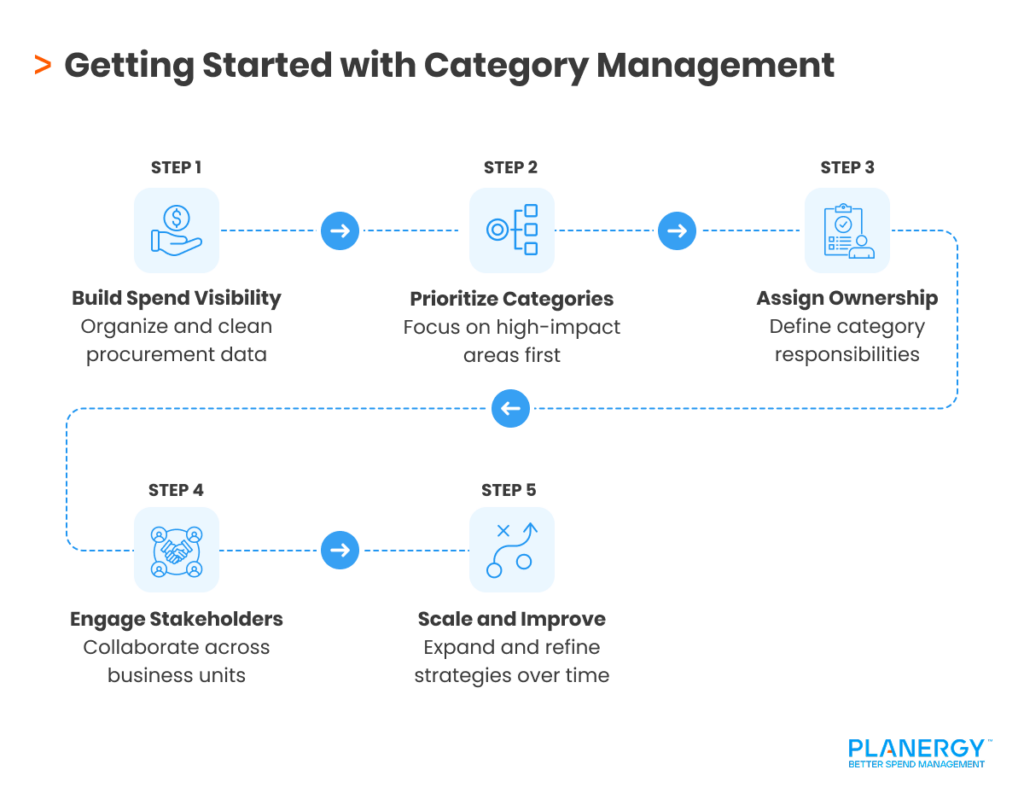
Getting Started with Category Management
Building the Foundation for Success
Organizations embarking on category management should approach implementation systematically rather than attempting wholesale transformation overnight:
Begin With Spend Visibility
Cleanse and categorize procurement data to understand where money flows. Many organizations discover they lack basic visibility into spending patterns. Addressing this gap is prerequisite to strategic category management.
Prioritize High-Impact Categories
Apply Pareto analysis to identify categories representing significant spend, strategic importance, or clear improvement opportunities. Early wins in these areas build momentum and demonstrate value.
Establish Category Ownership
Assign clear accountability for each priority category to individuals or teams with appropriate expertise. Category managers need sufficient authority to develop and implement strategies.
Develop Stakeholder Engagement Models
Category success requires collaboration with internal customers, finance, legal, and other functions. Build processes for gathering requirements, communicating strategies, and managing change.
Invest in Capability Development
Category management requires analytical skills, market knowledge, negotiation expertise, and relationship management capabilities. Assess current capabilities and develop training or recruitment plans to close gaps.
Create Supporting Infrastructure
Implement procurement systems, analytical tools, and performance tracking mechanisms that enable effective category management. Technology doesn’t guarantee success, but lack of basic tools severely limits potential.
Scaling from Pilot to Enterprise Program
After establishing category management in priority areas, successful organizations scale strategically:
Expand category coverage systematically, moving from high-priority categories to broader spend areas. Each category addition should follow proven processes while adapting to category-specific requirements.
Develop communities of practice among category managers to share insights, tools, and best practices. This peer learning accelerates capability development and ensures consistency.
Integrate category management into organizational planning cycles. Category strategies should inform budgeting, inform business unit plans, and connect to corporate objectives.
Measure and communicate value rigorously. Track savings, quality improvements, risk reduction, and innovation contributions to maintain leadership support and stakeholder engagement.
Continuously evolve category strategies as markets change, business needs shift, and capabilities mature. Category management is never “done.” It’s an ongoing discipline that adapts and improves over time.
Organizations that embrace category management transform procurement from a cost center focused on transaction processing into a strategic function that drives competitive advantage.
The journey requires commitment, capability investment, and patience, but the rewards in efficiency, value creation, and strategic alignment make category management an essential discipline for modern enterprises.
What’s your goal today?
1. Use PLANERGY to manage purchasing and accounts payable
We’ve helped save billions of dollars for our clients through better spend management, process automation in purchasing and finance, and reducing financial risks. To discover how we can help grow your business:
Download a free copy of our guide to better manage and make savings on your indirect spend. You’ll also be subscribed to our email newsletter and notified about new articles or if have something interesting to share.
3. Learn best practices for purchasing, finance, and more
Browse hundreds of articles, containing an amazing number of useful tools, techniques, and best practices. Many readers tell us they would have paid consultants for the advice in these articles.
We use cookies to personalise content and ads, to provide social media features and to analyse our traffic. We also share information about your use of our site with our social media, advertising and analytics partners who may combine it with other information that you’ve provided to them or that they’ve collected from your use of their services.
The technical storage or access is strictly necessary for the legitimate purpose of enabling the use of a specific service explicitly requested by the subscriber or user, or for the sole purpose of carrying out the transmission of a communication over an electronic communications network.
Preferences
The technical storage or access is necessary for the legitimate purpose of storing preferences that are not requested by the subscriber or user.
Statistics
The technical storage or access that is used exclusively for statistical purposes.The technical storage or access that is used exclusively for anonymous statistical purposes. Without a subpoena, voluntary compliance on the part of your Internet Service Provider, or additional records from a third party, information stored or retrieved for this purpose alone cannot usually be used to identify you.
Marketing
The technical storage or access is required to create user profiles to send advertising, or to track the user on a website or across several websites for similar marketing purposes.