We saved more than $1 million on our spend in the first year and just recently identified an opportunity to save about $10,000 every month on recurring expenses with PLANERGY.
Today’s guest post is written by Sam King. Sam leads the Xfe team to help schools and academies make the most of their financial systems.
With extensive experience in education finance we are happy to share his insights for the education sector. In this article Sam looks at the challenge of achieving value in education procurement.
KEY TAKEAWAYS
Everyday school purchases, like glue sticks, highlight the ongoing tension between quality in the classroom and limited budgets.
Teachers focus on performance, safety, and reliability, while finance teams focus on cost, scale, and budget control.
The debate extends beyond supplies to software and digital tools, where the cheapest option may not deliver the best long-term value.
Better procurement decisions happen when schools use data, trials, and shared visibility to balance cost, quality, and educational outcomes.
A short while ago, I was demonstrating our system to a school and added a Pritt Stick to an order….little did I know the can of worms I’d just opened!
A tug of war between finance teams in Education and the Educators, a battle of value vs quality (or perceived quality), one side claiming a commodity, the other side claiming a necessity.
This got me thinking….procurement decisions don’t just happen in spreadsheets, they spark debates that go right to the heart of how schools balance quality, value, and student outcomes.
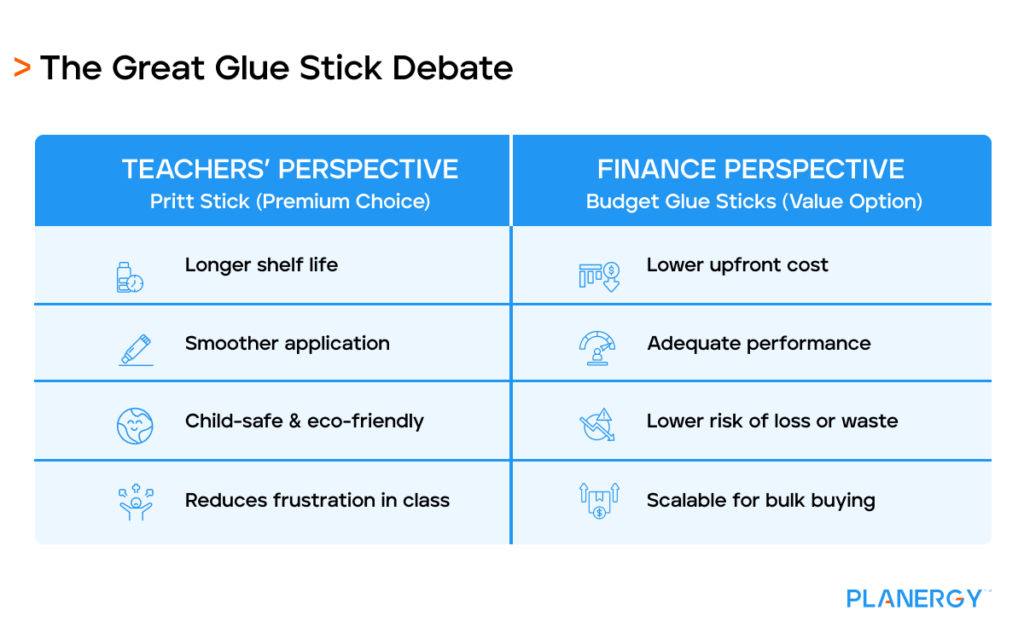
I decided to coin this as ‘THE GREAT GLUE STICK DEBATE’. Should schools spend more on the trusted and much-loved Pritt Stick, or opt for a budget-friendly alternative that still does the job?
It might seem trivial, but this ‘sticky’ little issue (I hope you see what I did there!) reveals a much bigger story about the pressures and priorities that define education spending. Let’s dive in…
Why Do Teachers Love Pritt Sticks?
Educators tend to champion the premium choice. With products like Pritt Stick, they have a good reason for doing so!
Pritt Stick’s reputation isn’t just about brand loyalty; it offers:
Longer shelf life (less wastage from dried-out tubes).
A smoother application (avoiding wrinkled paper and mess).
Safety assurances (solvent-free, child-friendly, compliant with UK/EU standards).
For teachers, these advantages directly impact the classroom experience. They reduce frustration, save time, and keep projects looking presentable.
All these factors matter when the focus should be on learning, not fixing glue-related mishaps.
Why Finance Teams Champion the Budget Option
On the other side of the table, finance leaders and business managers can’t ignore the numbers. Budget glue sticks cost much less and, when schools are buying (or it seems the children are eating them according to the Trust who sparked this debate!) dozens (or hundreds) every year, the savings add up fast.
Other arguments in favour of the cheaper alternatives include:
Lower financial risk if sticks are lost, uncapped, or wasted.
Adequate performance for short-term or disposable projects.
Supermarket own-brands and lesser-known suppliers now delivering improved quality.
For finance teams, the equation is simple: if budget glue sticks work well enough, why spend more? This leads me into looking a little wider at other aspects of school spend – whilst all trivial individually, certainly important as a collective.
Beyond Glue: Paints and Pens
Of course, glue isn’t the only “battleground”. The same “battle” plays out with all sorts of classroom essentials.
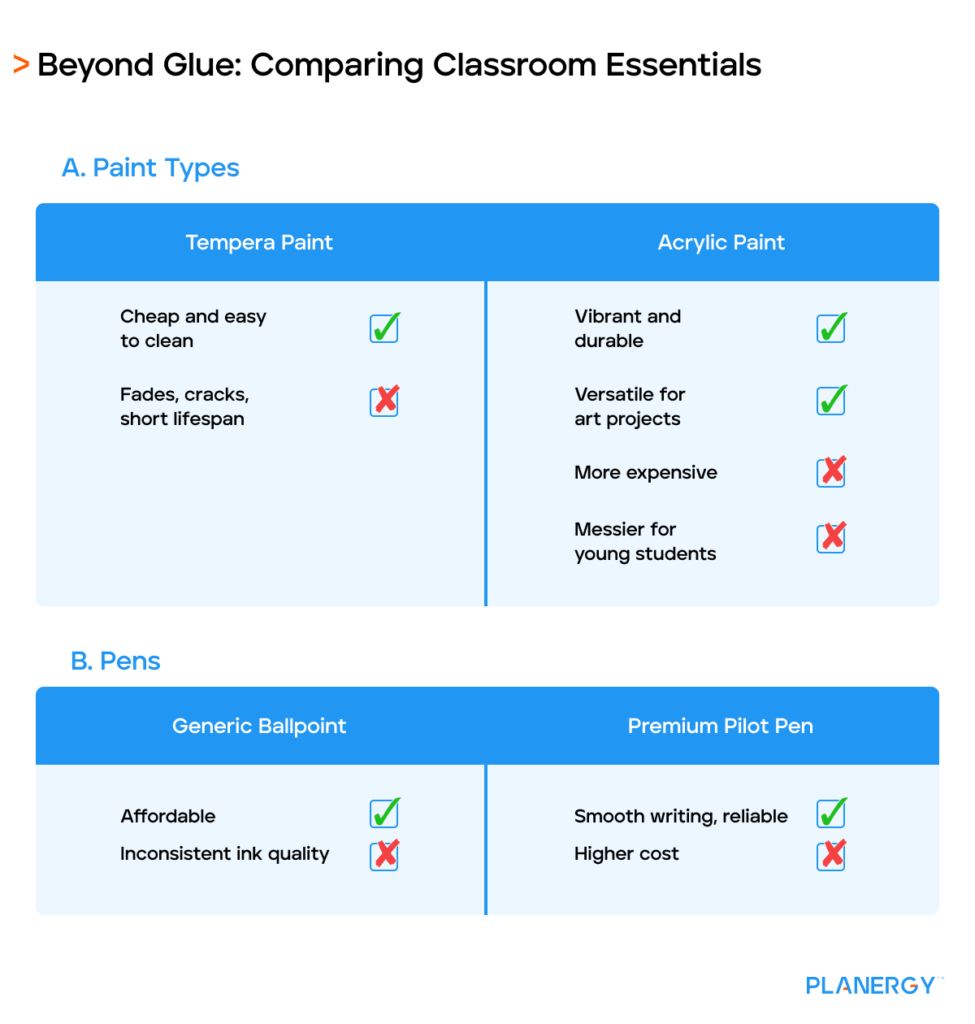
Consider paint and pens, for example. These are two classroom staples that fuel daily frustrations and budget debates.
Teachers will argue for quality: paints with strong pigments that make colour theory come alive or pens that glide smoothly and don’t give up halfway through marking.
These tools aren’t luxuries; they shape how lessons run, how student work looks, and even how quickly feedback gets done.
The business manager looking at the costs, however, may see it differently. Why pay for Premium when bulk budget paint will do the job, it’ll all end up on the paper (or the clothes) either way! Why stock up on Premium pens when Generic ballpoints can be bought by the thousand?
Unfortunately, the question isn’t about buying the best classroom experience. It’s about making already thin budgets stretch that little bit further – and finding the balance.
Different products, same battle, same dilemma, potentially the same friction – educators value reliability and performance, while finance teams prioritises affordability and scale.
The Software Question
Stationery and art supplies are tangible, but the stakes are just as real (and even higher) when it comes to software.
Digital tools and platforms are the backbone of schools, whether it’s the MIS, Finance, Classroom or Administration.
At first glance, a budget-friendly licensing deal or free tool might seem like the obvious choice. But educators and IT leads know that, just like a glue stick, a software’s true value lies beyond the sticker price.
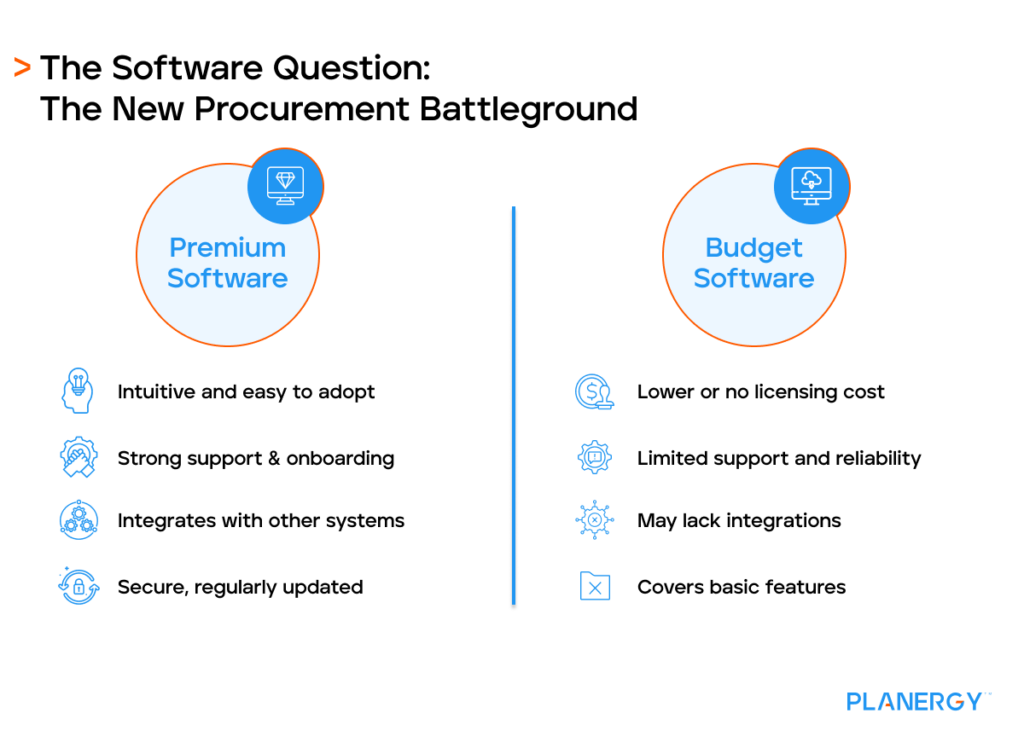
Why Teachers and IT Leaders Push for Premium Solutions
Ease of use and adoption Platforms with intuitive interfaces reduce training time and ensure staff actually use them.
Robust implementation support A knowledgeable vendor team helps tailor rollout, align with curriculum needs, and troubleshoot early issues.
Ongoing customer support Access to responsive experts means problems get solved quickly, avoiding disruptions in teaching and learning.
Integration with existing systems Higher-quality providers ensure compatibility with existing platforms, reducing duplication and manual work.
Long-term stability Premium software is more likely to be updated, secure, and compliant with regulations.
For teachers and administrators, these qualities translate into confidence: they can focus on teaching and operations rather than fighting with technology.
Why Finance Teams Push for Lower-Cost Options
Finance leaders see software budgets consuming a growing share of school spend. They may question whether all the premium features are really necessary when a cheaper, or free, option can cover the essentials.
Arguments often include:
Subscription Creep Dozens of licenses across departments add up quickly.
Underused Features Schools may pay for functionality that goes largely untouched.
Viable Alternatives Lower-cost platforms or open-source tools may deliver sufficient performance for many tasks.
The Trade-Off in Action
Just like glue sticks, paint, and pens, the tension lies in defining value. A free platform might work “well enough” — until it lacks reporting features, breaks during term time, or leaves teachers unsupported.
Meanwhile, a higher-cost platform with a responsive helpdesk and strong implementation team may pay for itself in time saved, avoided disruptions, and better educational outcomes.
Ultimately, schools must weigh not only the product but the ecosystem around it. Vendor expertise, support, and long-term reliability are all part of the true value equation.
Funding Pressures in Context
This tension is sharpened by the funding realities schools face in both the UK and the US.
United Kingdom
A Department of Education report on academy schools in England found that, in 2022-23, over 70% of total spending goes to staff costs, meaning little is left to be allocated for supplies and services.
The Institute for Fiscal Studies (IFS) predicts that growth in per-pupil funding in England in 2025–26 (2.8% in cash terms) won’t be enough to cover the expected increase in school costs (3.6%).
Federal funding covers only about 8% of K–12 costs, with states and districts left to cover the rest.
Many teachers bridge the gap personally: one study found that U.S. public school teachers spent an average of $429 of their own money annually on classroom supplies without reimbursement.
The result? Budgets for the little things like glue, paint, and pens are always under pressure. What feels like a minor purchase decision can scale into a multi-thousand-pound or dollar question across a Trust or district.
The Core Tension: Value vs. Perceived Value
At its heart, the “battle” isn’t about glue sticks, paint, or pens. It’s about the definition of value.
Educators often define value as the product that works best for learning, teaching, and outcomes – even if it costs more. They rarely see the impact on the budget or see the wider picture, as they’re focused on educating.
Finance often define value as the product that delivers acceptable quality at the lowest price, ensuring budgets go further, and trying to balance an already tight position.
Both perspectives are valid. Schools simply cannot afford to ignore budgets, but they also cannot afford to undermine the learning environment by going for the cheapest option as a default. So, how do we move forward?
Finding the Middle Ground
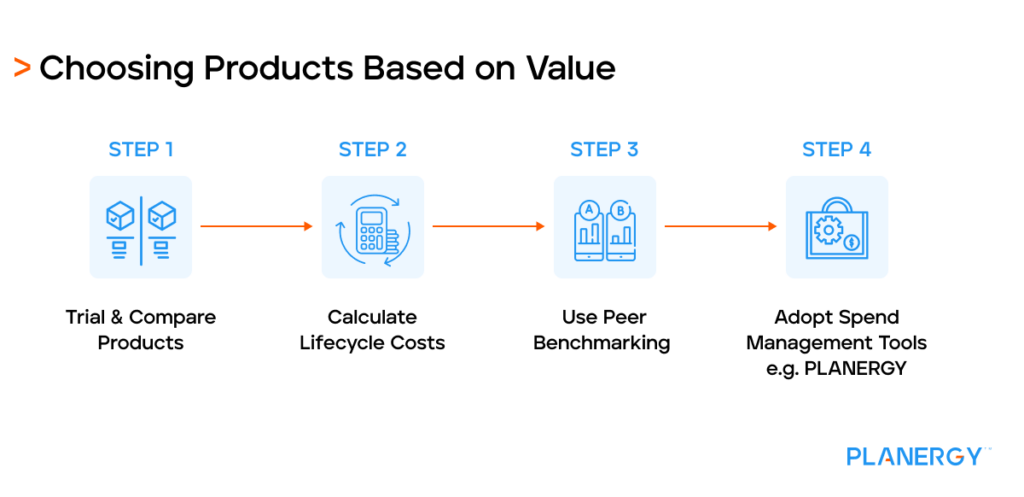
The answer lies in compromise. This is best achieved with a system that make the trade-offs visible, and easy to digest for all. Using a procurement system in this scenario would work well. For example:
Conducting parallel product trials so both teachers and finance staff can see real-world performance.
Factoring in lifecycle costs (e.g., if cheaper glue dries out twice as fast, is it really cheaper?).
Using peer recommendations to benchmark performance – what does ‘good’ look like for other schools? (something many schools already do through professional forums and networks).
When conversations move away from raw emotion and onto evidence and shared goals, the purchasing decisions become a less divisive, and a lot more strategic, and a pattern is set for future purchasing decisions.
Conclusion: It’s More Than Just Glue!
The Great Glue Stick Debate may seem like a light-hearted metaphor, but it gets to the heart of education procurement. From glue, paint, and pens all the way to software, procurement represents a balancing act between cost and quality, finance and teaching.
The challenge for schools is not to pick a side, but to create processes where both perspectives shape the outcome. Because when a good procurement process starts to stick, everyone gets a little more value.
1. Use Planergy to manage purchasing and accounts payable
We’ve helped save billions of dollars for our clients through better spend management, process automation in purchasing and finance, and reducing financial risks. To discover how we can help grow your business:
2. Download our guide “Preparing Your AP Department For The Future”
Download a free copy of our guide to future proofing your accounts payable department. You’ll also be subscribed to our email newsletter and notified about new articles or if have something interesting to share.
3. Learn best practices for purchasing, finance, and more
Browse hundreds of articles, containing an amazing number of useful tools, techniques, and best practices. Many readers tell us they would have paid consultants for the advice in these articles.
We use cookies to personalise content and ads, to provide social media features and to analyse our traffic. We also share information about your use of our site with our social media, advertising and analytics partners who may combine it with other information that you’ve provided to them or that they’ve collected from your use of their services.
The technical storage or access is strictly necessary for the legitimate purpose of enabling the use of a specific service explicitly requested by the subscriber or user, or for the sole purpose of carrying out the transmission of a communication over an electronic communications network.
Preferences
The technical storage or access is necessary for the legitimate purpose of storing preferences that are not requested by the subscriber or user.
Statistics
The technical storage or access that is used exclusively for statistical purposes.The technical storage or access that is used exclusively for anonymous statistical purposes. Without a subpoena, voluntary compliance on the part of your Internet Service Provider, or additional records from a third party, information stored or retrieved for this purpose alone cannot usually be used to identify you.
Marketing
The technical storage or access is required to create user profiles to send advertising, or to track the user on a website or across several websites for similar marketing purposes.