We saved more than $1 million on our spend in the first year and just recently identified an opportunity to save about $10,000 every month on recurring expenses with PLANERGY.
Tax compliance challenges stem from complex, constantly changing regulations, making automation and centralized data critical for maintaining accuracy and compliance.
Implementing a single source of truth or tax data hub improves visibility, reduces errors, and makes reporting easier.
Automating tax processes increases efficiency, ensures up-to-date calculations for tax, and supports scale as you grow.
Proactively managing tax compliance helps reduce risk, avoid penalties, and save money.
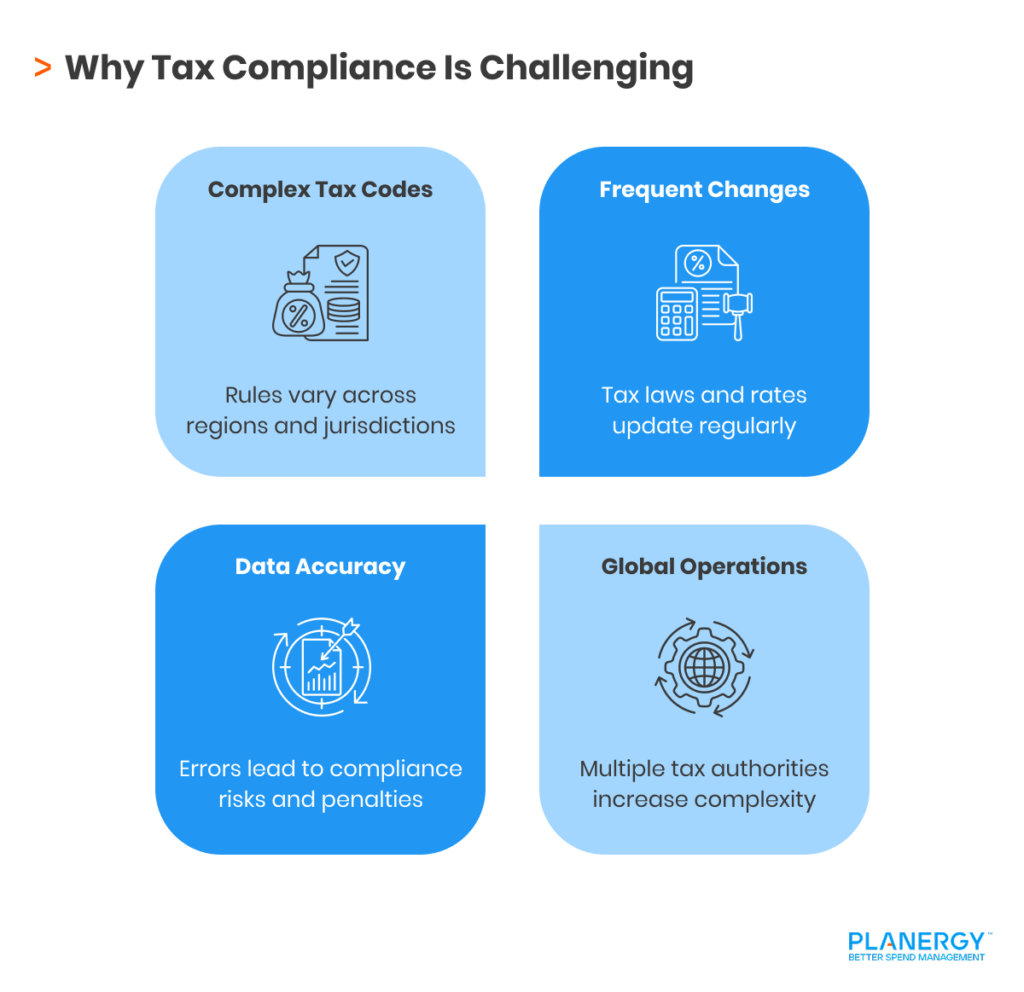
Tax compliance presents numerous challenges for small and large businesses alike.
While the challenges can stem from a lack of knowledge about tax codes in general, it remains difficult to keep up with frequent tax code changes while keeping business tax collection accurate.
Making Tax Management Everybody’s Business
While the proposition may seem daunting to those outside the finance department, tax management begins the moment an order is placed with a vendor or supplier or received from a customer.
Processing tax information properly from the start reduces the likelihood of erroneous calculations, under-or over-payments, and other non-compliance issues in real time.
Integrating Tax Data from a Single Source of Truth
A single source of truth, or SSOT, is a repository where all organizational data, such as customer information, taxpayer data, product and services details, and financial information, is stored.
Using a SSOT to manage company data maintains consistency while eliminating data silos.
A SSOT that specializes in tax policy is called a tax data hub. Managing taxes using a tax data hub keeps all tax-related data in a centralized location that can be accessed when needed. Using a tax data hub offers several advantages.
Streamlines Tax Preparation
Being able to manage multiple tax regulations in one central location eliminates the need to import data from multiple systems, saving time.
Eliminates Manual Processes
Managing tax data in one location reduces the amount of manual data entry necessary, reducing errors and increasing filing accuracy.
Centralized Storage of All Related Data
Storing all related data in a single location eliminates the need to store information in silos, reduces data entry, and makes it easy to access data when necessary.
Simplified Reporting and Compliance
Instead of producing reports from multiple sources, using a tax data hub allows you to produce accurate, consistent reports from a single, centralized location.
Improved Data Visibility
Tired of accessing multiple applications to get the data you need? By using a tax data hub, you can access all of your tax-related information in one single location.
Provides a Clear Audit Trail
No one enjoys being audited, but when your business is, having a clear audit trail is essential.
Having all tax-related data stored and managed in a single location provides easy access to all the necessary documentation you need to support your tax position during an audit.
Cost and Time-Effectiveness
Rather than using multiple applications with limited accuracy, using a single application to manage your tax data can save you both time and money.
Automating Manual Tax Processes to Increase Efficiency and Accuracy
If you’re only selling a few items a month, tax management can be straightforward.
However, for companies that sell hundreds or thousands of products monthly and/or sell globally, managing multiple tax authorities and tracking thousands of tax rules manually, or keeping up with numerous tax law changes, is impossible.
Automating the tax administration process streamlines tasks traditionally processed manually, collects relevant customer and tax-related data, performs complex tax calculations, and automates and pays tax due.
1. Increased Accuracy and Efficiency
For growing companies, tax management can quickly escalate to an untenable level. Automating the process increases data accuracy and tax calculations while eliminating the risks commonly associated with manual data entry.
Automating tax processes also eliminates costly tax-filing errors, ensuring that filings and remittances are accurate.
2. Improved Compliance
Tax laws and rates are always in flux, sometimes changing multiple times a year. Automating tax processing eliminates the need to constantly check for updates, ensuring that sales tax, use tax, and VAT calculations always reflect the most up-to-date rates.
3. Scalability
Even if you’re a start-up processing a minimal number of tax transactions each month, it can be beneficial to automate the tax management process, making it easy to scale up to adjust to any future growth.
4. Reduced Costs
Automating the entire tax process helps eliminate manual processes such as data entry while also reducing associated labor costs. Having a centralized system also eliminates the need to pay for additional tax-related applications.
Combating the VAT Dilemma
According to a briefing from the European Parliamentary Research Service, value-added tax (VAT) fraud is causing government revenue losses worth billions, due to criminals exploiting weaknesses in the VAT system.
VAT compliance remains a complicated process, with regulations often confusing and complex.
These are a few of the areas where businesses can struggle when processing VAT taxes.
Understanding VAT regulations and registration thresholds VAT regulations are complicated and vary from region to region, but it’s the business’s responsibility to understand and abide by the varying requirements.
Calculating VAT tax accurately Goods and services carry a different VAT rate than alcohol and tobacco, and should be processed accordingly.
Filing and payment deadlines Each VAT jurisdiction has its own set of deadlines that sellers must be aware of.
Invoice requirements VAT has very specific requirements for what should be on an invoice, including VAT I.D. numbers and the current VAT rate for the jurisdiction.
Processing international transactions properly For global sellers, you’ll need to be able to properly manage digital sales for customers residing in a country where VAT tax is required.
VAT compliance for e-commerce transactions Any business selling globally will need to register and remit VAT taxes in the buyer’s country.
Proper documentation and record keeping Having the proper documentation is essential, with companies required to keep a record of all invoices, regardless of whether it’s a purchase or a sale. In addition, import and export documentation must also be kept.
Access to VAT updates VAT rates and regulations change constantly. Any business responsible for filing and paying VAT taxes must have access to regular updates.
Investing in software that can automate VAT calculations and reporting can increase efficiency while eliminating costly filing errors.
Tax Management and Operational Obstacles
Along with processing standard taxable transactions, several other operational obstacles may directly impact on your business and your taxes.
Misaligned SLAs (Service Level Agreements)
A misaligned service level agreement or SLA can indirectly impact taxes in numerous ways.
For example, financial penalties or fines and service credits can impact taxes, since any recovery may be viewed as taxable, while excessive expenses related to an SLA breach may temporarily reduce taxable income.
Another issue that may crop up would be penalty payments that are spread across multiple tax periods, which may cause a temporary mismatch between reported taxes and totals reflected in financial statements.
The “That’s Out-of-Scope” Trap
When you’re managing taxes manually, you may not be aware of the out-of-scope activities that can directly affect your tax calculations. Out-of-scope transactions are financial transactions that are not taxable.
Examples of out-of-scope transactions include:
Gifts and inheritances are usually not subject to taxes as they are not considered income.
Loans are not usually considered taxable income since the borrower is required to pay the funds back
Insurance payouts are also not considered income and are generally not taxable
Bartering is generally not taxable, as the purpose of bartering is exchanging items of similar value, though there may be some exceptions.
Liability Issues: How Business Structure Impacts Taxes
Tax liability issues vary depending on where a business operates. In the U.S., for example, the legal structure of your business plays a large role in tax liability.
For instance, if you’re a sole proprietor, business income will be considered personal income and taxed accordingly, with the business owner also responsible for self-employment taxes.
For partnerships and limited liability companies (LLCs), all income and losses are passed through to the partners, who report them on their personal income tax returns. However, LLCs can also elect to be taxed as an S corporation or a C corporation.
S Corporations can elect to be taxed as a C Corporation or as a pass-through entity, which passes both profit and loss totals through to shareholders’ federal tax returns.
C Corporations are considered a separate legal entity and are subject to double taxation, with corporate tax paid on profits, with individual shareholders paying taxes on dividends as well.
For businesses located in the European Union, the biggest challenge is the varying tax requirements for each EU member state, with EU countries using both direct taxes and indirect taxes like VAT.
Because of these varying tax systems, reporting requirements, and other regulations, managing taxes presents a challenge for businesses.
Audit Responses and Controversy
Regardless of whether a tax audit notice is from the IRS or an international tax agency, a prompt response is essential. Ignoring the notice will only exacerbate the issue and rarely benefit the business.
Instead, take the time to address the issues mentioned in the audit notice to see if they can be addressed in-house or if a CPA or other tax professional should be involved.
Making Tax Management Less Taxing with Automation
An automated tax management application won’t eliminate the possibility of an audit, but using one can go a long way towards ensuring that the information filed and the amount paid are accurate.
Regardless of whether you’re selling locally or globally, having a modern tax management application can streamline the tax process from initial tax assessment to filing and paying taxes on time.
While local sellers may be able to get by with manual tax management for local taxes, national or global sellers will appreciate the benefits of having the proper tax management program in place for handling cross-border taxes.
Automated tax systems can collect necessary documentation during transactions, apply complex and location-specific tax laws accurately, and significantly reduce the risk of calculation errors that can lead to incorrect filings or payments.
They also help identify inconsistencies early, improving compliance with constantly changing regulations and ensuring returns are submitted on time.
With global sales now routine for even small businesses, automating your tax management system is the best solution for tracking, assessing, collecting, and remitting taxes.
What’s your goal today?
1. Use PLANERGY to manage purchasing and accounts payable
We’ve helped save billions of dollars for our clients through better spend management, process automation in purchasing and finance, and reducing financial risks. To discover how we can help grow your business:
2. Download our guide “Preparing Your AP Department For The Future”
Download a free copy of our guide to future proofing your accounts payable department. You’ll also be subscribed to our email newsletter and notified about new articles or if have something interesting to share.
3. Learn best practices for purchasing, finance, and more
Browse hundreds of articles, containing an amazing number of useful tools, techniques, and best practices. Many readers tell us they would have paid consultants for the advice in these articles.
We use cookies to personalise content and ads, to provide social media features and to analyse our traffic. We also share information about your use of our site with our social media, advertising and analytics partners who may combine it with other information that you’ve provided to them or that they’ve collected from your use of their services.
The technical storage or access is strictly necessary for the legitimate purpose of enabling the use of a specific service explicitly requested by the subscriber or user, or for the sole purpose of carrying out the transmission of a communication over an electronic communications network.
Preferences
The technical storage or access is necessary for the legitimate purpose of storing preferences that are not requested by the subscriber or user.
Statistics
The technical storage or access that is used exclusively for statistical purposes.The technical storage or access that is used exclusively for anonymous statistical purposes. Without a subpoena, voluntary compliance on the part of your Internet Service Provider, or additional records from a third party, information stored or retrieved for this purpose alone cannot usually be used to identify you.
Marketing
The technical storage or access is required to create user profiles to send advertising, or to track the user on a website or across several websites for similar marketing purposes.