We saved more than $1 million on our spend in the first year and just recently identified an opportunity to save about $10,000 every month on recurring expenses with PLANERGY.
Payment practices reporting requires large companies to disclose how quickly they pay suppliers and how their payment processes work.
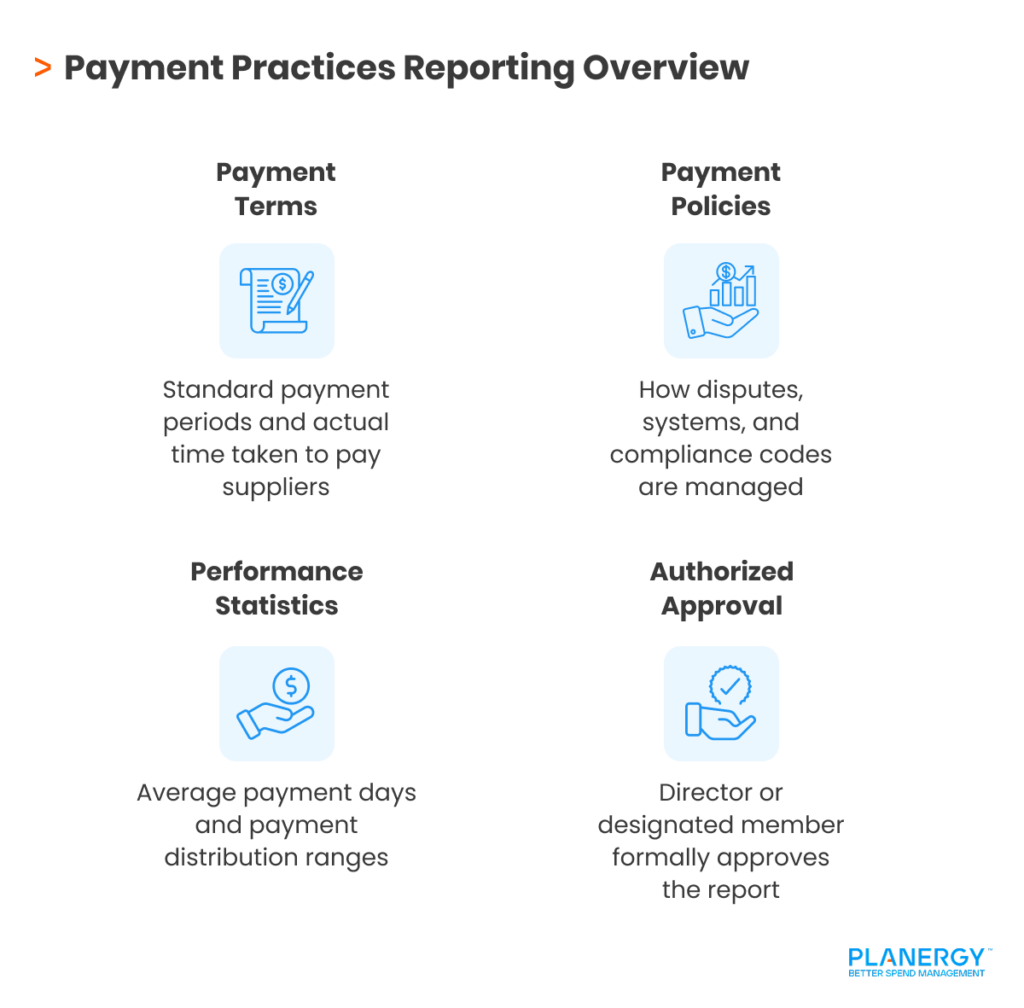
Reports typically include payment terms, payment policies, performance statistics, and approval by a responsible company officer.
Countries like the U.K., Australia, and Sweden mandate regular reporting to increase transparency and reduce late payments to suppliers.
Automated accounting and procure-to-pay systems help companies track payment data, meet reporting requirements, and improve payment cycle times.
Payment practices reporting is required in several countries globally, providing transparency on payment terms and invoice processing time for public sector businesses and large businesses.
We’ll explain what payment practices reporting is, who is required to submit a report, and how often reporting must be completed.
What is Payment Practices Reporting?
Payment practices reporting requires large companies and Limited Liability Partnerships (LLPs) to report on payment practices, policies, and performances regularly.
What Information is Required in a Payment Practices Report?
Check with local authorities for the specific requirements for your area, such as the reporting period, financial year.
Be sure to also confirm whether detailed information, such as qualifying contracts, standard payment terms, or agreed terms need to be included in the report.
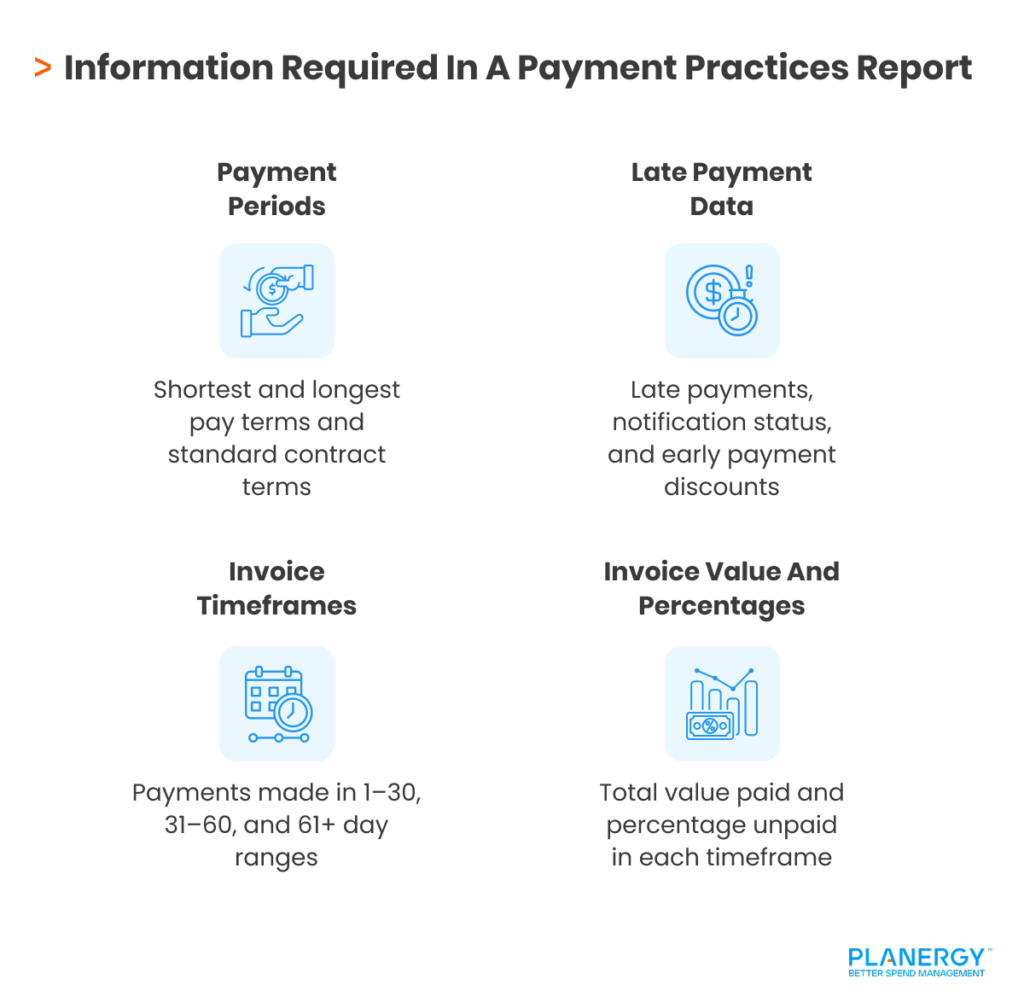
Payment practices reporting generally requires the following information:
Payment Terms
Companies and LLPs required to submit reports should include a description of their payment terms, including the standard pay period and the number of days it takes to pay suppliers.
Reporting should also include any payment variations that occurred during the reporting period, such as late payments, and whether notification was provided to suppliers.
For instance, if different contract types have different payment terms, this information should be provided in detail, including the shortest and longest pay periods.
Companies should also include any early payment discounts taken, and if a specific supplier or contractor is paid unusually early or late.
Payment Policies
All reporting companies are required to explain their current payment policies and practices, including how supplier disputes are handled, including:
Whether they are currently using a relevant Code of Conduct, and if so, which one
Whether they currently utilize an electronic system for tracking invoice submissions and payments, or e-invoicing is used
If there were payment issues during the period reporting, and how those issues were handled
Performance Tracking
Companies and LLPs must provide detailed payment performance statistics that show the average number of days that payment is made. Companies must also include the total number of payments made in the following number of days:
1-30 days
31-60 days
61 + days
The report should also include the total value of the invoices paid in each of the date ranges, along with the percentage of payments due within that time frame that have not been made.
Signature of Authorized Party
Any company or LLP that submits a report must name the director or designated member who is required to approve the report.
Companies and LLPs should be aware that there are consequences to not reporting payment practices in a timely manner, including criminal charges that can be prosecuted for up to three years after the report was due.
What Countries Have Payment Practice Requirements?
The U.K, Australia, and Sweden top the list of countries that have very specific payment practices reporting requirements, while other countries have voluntary measures in place to help address the late payment issue.
U.K.
The U.K. currently has strict requirements for payment practices reporting, requiring large companies to submit payment practices reporting twice a year. All reports are submitted at www.gov.uk through the portal.
Australia
Australia requires large businesses and certain government entities to report payment terms and practices twice a year regarding small business suppliers. All reports should be submitted through the Payment Times Reporting Portal.
Sweden
Large companies in Sweden are required to follow new regulations introduced in 2025 to report on payment statistics at regular intervals, depending on the information required.
For instance, card-based payments, ATM cash withdrawals, and ATM cash deposits must be reported weekly, while direct debits, money remittances, payment initiation services, and over-the-counter cash deposits or withdrawals must be reported monthly.
European Union
While the European Union does not have a reporting requirement, they have instituted a variety of payment directives that must be followed to help curb late payments to smaller businesses. These include:
Goods and services received must be paid for within 30 days (or 60 days under exceptional circumstances.
All enterprises must pay invoices within 60 days.
Companies that do not receive timely payment are entitled to interest for late payment and compensation for recovery costs.
Companies are also entitled to interest at least 8% above the European Central Bank’s reference rate.
Countries Without Reporting Requirements
Not all countries impose payment practices reporting requirements.
United States
According to an Atradius survey, overdue invoices current impact 43% of credit sales in the U.S., with 45% of survey respondents saying that liquidity issues are the driving force behind late payments, but there are currently no reporting requirements in place.
New Zealand
Before 2024, New Zealand had payment practices reporting requirements in place, but the act has since been repealed, with the government focusing on creating a voluntary approach to improving payment times.
Eastern Europe
According to a survey from Atradius, in countries such as Bulgaria, the Czech Republic, Poland, and Turkiye, overdue invoices remain a pressing concern, with 53% of all invoices issued on credit typically overdue
Despite putting small businesses in jeopardy, there are no reporting requirements to date.
When and How Should I Do Payment Practices Reporting?
When and how you report depends on the jurisdiction you are in. For instance, Sweden has monthly reporting requirements, while the U.K. and Australia have implemented bi-annual reporting requirements.
What Can Your Company Do to Avoid Late Payments?
Vendors and Suppliers
While payment practices reporting is designed to eliminate late payments to smaller vendors and suppliers, there are some things your small business can do to reduce late payments.
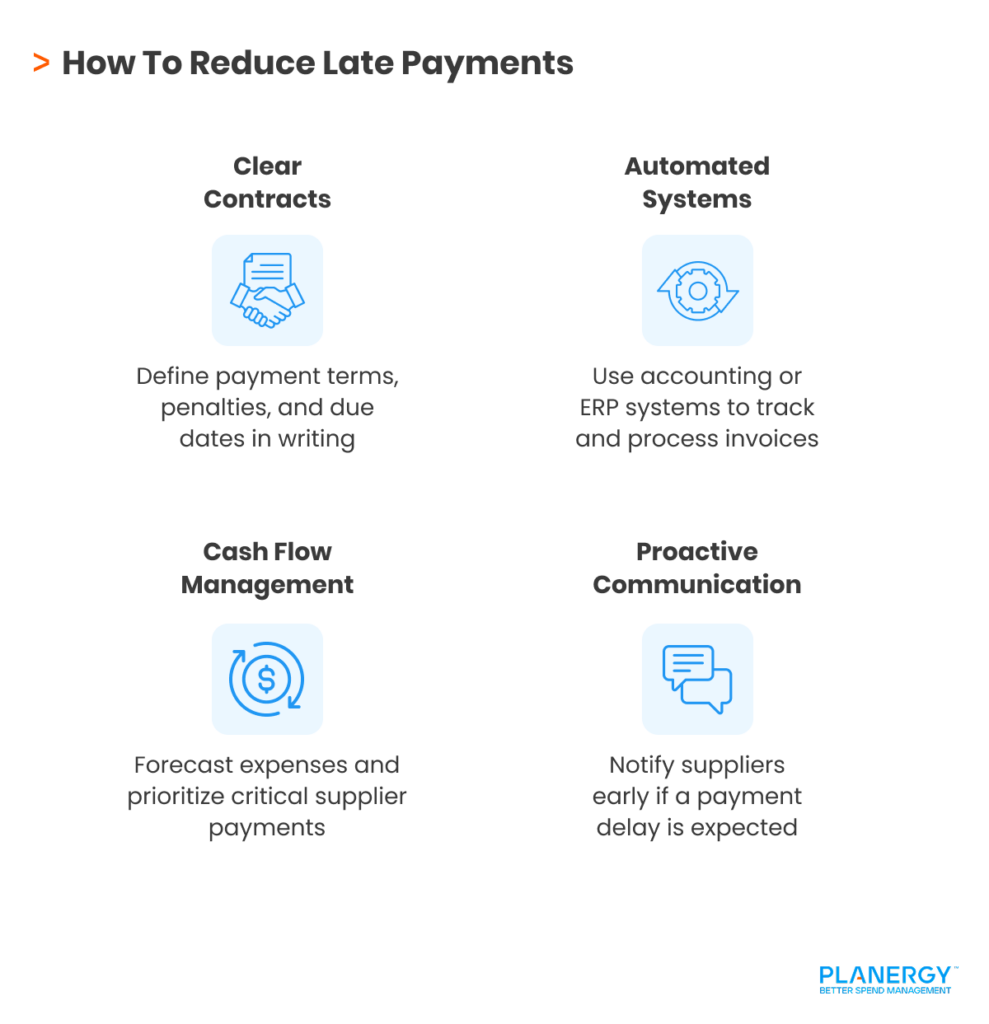
Have a signed contract in place that clearly outlines payment terms as well as late fees and other penalties.
Regularly send payment reminders to your customers, and include a link to online payment options.
Offer a variety of ways to make a payment.
Check the potential client’s credit. A credit history is important for setting terms and conditions. Be sure to review the credit of any company you’re thinking of offering credit terms to.
Consider offering early payment incentives that may motivate a business to pay your invoice sooner rather than later.
Consider asking new clients for an upfront deposit, particularly for larger, more expensive projects.
Large Companies
Large companies should consider implementing practices designed to reduce or eliminate late payments to vendors and suppliers.
Utilize an automated accounting/ERP system that streamlines the entire invoice process from invoice receipt through payment.
Properly manage cash flow, forecasting upcoming expenses against available cash.
If cash flow is going to be low, prioritize payments accordingly.
Track your expenses accordingly and reduce purchases when cash flow is limited.
Reduce expenses in other areas, such as finding office/warehouse space at a reduced cost or eliminating unnecessary overhead expenses.
Communicate proactively with vendors and suppliers. If you know a payment is going to be late, contact the vendor or supplier and make payment arrangements accordingly.
What are the Size Criteria for Large Companies/LLPs?
Size criteria for payment practices reporting vary from country to country, with some based on revenue and others based on the number of employees.
U.K.
U.K. company size criteria for businesses that need to submit payment practices reports are:
£54 million annual turnover
£27 million balance sheet total
250 employees
Australia
Australian companies with more than $100 million in annual turnover must report on their small business payment times and practices.
Sweden
In 2025, new legislation was created that requires large companies with more than 250 employees to report detailed, frequent payment statistics to monitor market stability.
Other countries, such as France and Germany, have set payment terms but do not currently require payment practices reporting.
Meanwhile, trends in Eastern European countries, such as Bulgaria, the Czech Republic, Poland, and Turkey have been actively tracked by the Atradius Payment Practices Survey.
How Can a Small Business Access and Use Data?
Most government agencies that require payment reporting provide ways for small businesses to access this data. This helps businesses evaluate potential sellers and understand payment behavior.
The data shows how quickly or slowly companies pay suppliers. This helps small businesses manage risk and reduce late payments.
Accessing this information offers several benefits for business decisions. Before agreeing to terms, you can review average payment times and late invoice percentages.
The data can also help when negotiating improved payment terms with existing clients. You may also avoid companies that frequently pay suppliers late.
KPIs to Track Payments
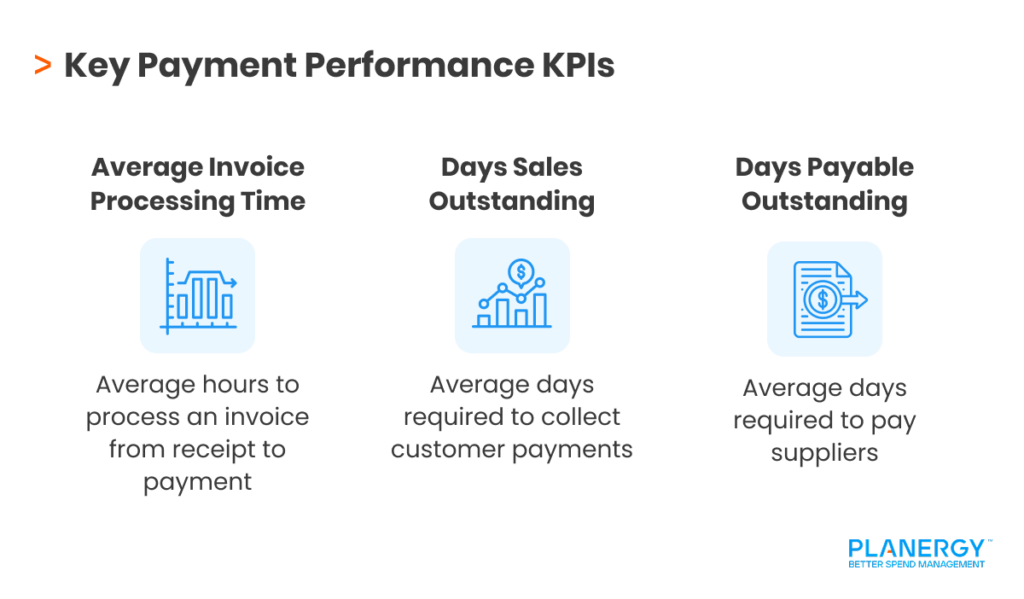
Ratios and KPIs can help your business better manage the accounts payable process, including:
Average Invoice Processing Time
The Average Invoice Processing Time lets you calculate the average time it takes to process an invoice from receipt to payment.
The formula for obtaining the average invoice processing time is the number of hours spent processing the invoice divided by the number of invoices processed.
If your AP department spent 120 hours per month processing a total of 85, the calculation would be:
120 / 85 = 1.4 hours. This means average invoice processing time is 1.4 hours.
For reference, a fully automated AP system can reduce these processing times significantly. This means faster, more accurate, and on-time payments.
Days Sales Outstanding
Days Sales Outstanding calculates the number of days it takes for your business to receive payment on an invoice.
To calculate this number, divide your average accounts receivable balance by your total credit sales and then multiply that total by the number of days in the period.
Let’s say your average accounts receivable balance for the last quarter of 2025 (which has 92 days) was $95,000, and your total credit sales were $310,000. The calculation would be:
$95,000 / $310,000 = 0.31 x 92 = 28.52, which means that the average number of days your invoices are outstanding is 29 days, with 30 days considered good.
Days Payable Outstanding
Days Payable Outstanding measures the number of hours it takes companies to pay suppliers.
To calculate this number, divide your average accounts payable number by your cost of goods sold, and then multiply it by the number of days in the period you’re calculating.
For instance, if your average accounts payable is $150,000 and your cost of goods sold is $700,000, and you’re calculating for the last quarter of 2025, your calculation would be:
$150,000 / $700,000 = 0.21 x 19.32, which means that it’s taking you 19 days to pay your suppliers.
How Can You Record the Relevant Data for Reporting Automatically?
Because of the details required for payment practices reporting, it’s impossible to create an accurate report using manual systems. Data required for reporting includes:
Average payment time.
Percentage of late payments.
Payment timeframes (e.g., 1-30 days or 31-60 days).
Detailed information on payment terms and maximum contracted payment period.
Information on all dispute resolutions.
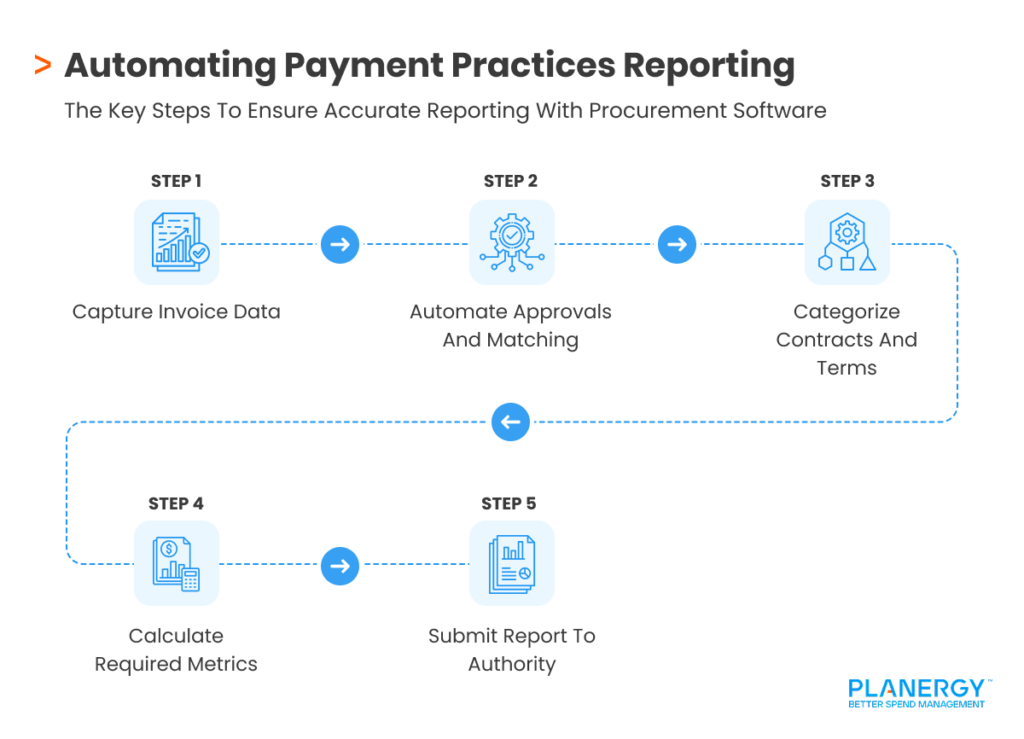
To have this data handy, you’ll want to do the following:
Use an automated accounting software application or ERP that tracks the above information.
Automate workflows that streamline both the approvals process and three-way matching.
Categorize contracts and suppliers while differentiating terms between the groups.
Calculate required percentages by number of invoices, not invoice totals.
Submit the required reporting to the correct agency.
How to Improve Your Invoice Payment Cycle Time Using Procure-to-Pay Software
If you’re required to provide payment practices reporting, using an automated procure-to-pay system like PLANERGY is paramount for prompt payment processing and easy reporting capability.
An automated procure-to-pay process provides the following benefits:
Eliminates Manual Data Entry
Eliminating manual data entry of purchase orders and invoices improves data accuracy by reducing the possibility of errors.
Automates Three-way Matching
An automated procure-to-pay solution automatically matches an invoice with a purchase order and delivery receipt, reducing exceptions and increasing processing time.
Helps Enforce Spending Controls
By mandating the use of purchase orders for all purchases, companies can better control spending while streamlining the invoice approval process.
Creates Automated Workflows
No longer will you have to worry about invoices getting lost between approvers, or never making it to the approver’s desk at all. Using automated workflows, you can ensure that the invoice is routed to all approvers promptly.
Helps Companies Abide by Payment Terms
For businesses that are required to submit payment practices reporting, being able to easily abide by vendor and supplier payment terms helps your business remain compliant with rules and regulations.
Increases Transparency
Using a procure-to-pay application provides easy transparency into the entire payment processing lifecycle.
Whether you’re in a country like the U.K., where payment practices reporting is required, or in the U.S., where payment processing times are closely monitored, having an automated procure-to-pay application in place is highly recommended.
Why It Matters
Payment practices reporting plays a vital role in promoting transparency, accountability, and fair treatment of suppliers across global markets.
By requiring companies to disclose payment terms, policies, and performance, these regulations help reduce late payments and support healthier cash flow for smaller businesses.
Leveraging automated accounting and procure-to-pay systems enables organizations to meet compliance requirements more efficiently while improving internal processes.
Ultimately, adopting strong payment practices benefits both businesses and their supply chains, fostering trust and long-term sustainability.
What’s your goal today?
1. Use PLANERGY to manage purchasing and accounts payable
We’ve helped save billions of dollars for our clients through better spend management, process automation in purchasing and finance, and reducing financial risks. To discover how we can help grow your business:
2. Download our guide “Preparing Your AP Department For The Future”
Download a free copy of our guide to future proofing your accounts payable department. You’ll also be subscribed to our email newsletter and notified about new articles or if have something interesting to share.
3. Learn best practices for purchasing, finance, and more
Browse hundreds of articles, containing an amazing number of useful tools, techniques, and best practices. Many readers tell us they would have paid consultants for the advice in these articles.
What’s your goal today?
1. Use PLANERGY to manage purchasing and accounts payable
We’ve helped save billions of dollars for our clients through better spend management, process automation in purchasing and finance, and reducing financial risks. To discover how we can help grow your business:
2. Download our guide “Preparing Your AP Department For The Future”
Download a free copy of our guide to future proofing your accounts payable department. You’ll also be subscribed to our email newsletter and notified about new articles or if have something interesting to share.
3. Learn best practices for purchasing, finance, and more
Browse hundreds of articles, containing an amazing number of useful tools, techniques, and best practices. Many readers tell us they would have paid consultants for the advice in these articles.
We use cookies to personalise content and ads, to provide social media features and to analyse our traffic. We also share information about your use of our site with our social media, advertising and analytics partners who may combine it with other information that you’ve provided to them or that they’ve collected from your use of their services.
The technical storage or access is strictly necessary for the legitimate purpose of enabling the use of a specific service explicitly requested by the subscriber or user, or for the sole purpose of carrying out the transmission of a communication over an electronic communications network.
Preferences
The technical storage or access is necessary for the legitimate purpose of storing preferences that are not requested by the subscriber or user.
Statistics
The technical storage or access that is used exclusively for statistical purposes.The technical storage or access that is used exclusively for anonymous statistical purposes. Without a subpoena, voluntary compliance on the part of your Internet Service Provider, or additional records from a third party, information stored or retrieved for this purpose alone cannot usually be used to identify you.
Marketing
The technical storage or access is required to create user profiles to send advertising, or to track the user on a website or across several websites for similar marketing purposes.