What's PLANERGY?

Modern Spend Management and Accounts Payable software.

Helping organizations spend smarter and more efficiently by automating purchasing and invoice processing.

We saved more than $1 million on our spend in the first year and just recently identified an opportunity to save about $10,000 every month on recurring expenses with PLANERGY.

King Ocean Logo

Cristian Maradiaga

King Ocean

Download a free copy of "Preparing Your AP Department For The Future", to learn:

  • How to transition from paper and excel to eInvoicing.
  • How AP can improve relationships with your key suppliers.
  • How to capture early payment discounts and avoid late payment penalties.
  • How better management in AP can give you better flexibility for cash flow management.

Meeting EU E-Invoicing Regulation Compliance in 2026: A Guide for Procurement & AP Teams

KEY TAKEAWAYS

  • E-invoicing regulations differ across EU countries, requiring businesses to adapt to local mandates.
  • Tools like PLANERGY streamline workflows, ensure real-time reporting, and maintain audit trails for seamless compliance.
  • Conduct internal audits, onboard vendors, plan integrations, and train teams to ensure a smooth transition to e-invoicing compliance.

Across the European Union (EU), many countries have established regulations for digital invoicing. Some regulations are voluntary, while others are mandatory.

These regulations for issuing electronic invoices provide transparency to reduce tax fraud and address issues with collecting VAT and GST.

Under these mandates, e-invoices must be compliant with regulatory standards and may also apply to cross-border transactions. They apply to business-to-business (B2B) and government transactions.

It requires businesses to use e-invoicing systems that offer document storage and government access to maintain visibility and tax compliance.

What is E-Invoicing?

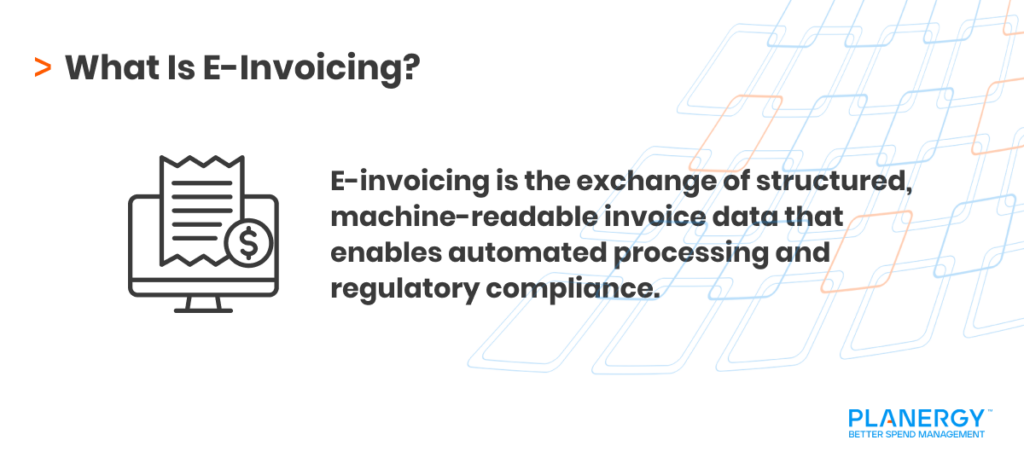
Electronic invoicing, also known as e-invoicing, refers to buyers and sellers exchanging structured invoice data in an electronic format, using the electronic data interchange (EDI).

Unlike traditional invoices or PDFs, e-invoicing uses machine-readable formats (e.g., XML, UBL), enabling seamless digital processing.

What Is E-Invoicing?

Benefits of E-Invoicing:

  • Cost Savings: Reduced printing, mailing, and administrative overhead due to automated business transactions.
  • Improved Compliance: Automated audit trails and structured data formats minimize errors.
  • Efficiency Gains: Faster invoice processing and approvals streamline cash flow.
  • Stronger Vendor Relationships: Transparent invoicing builds trust with suppliers.

E-Invoicing vs. E-Billing

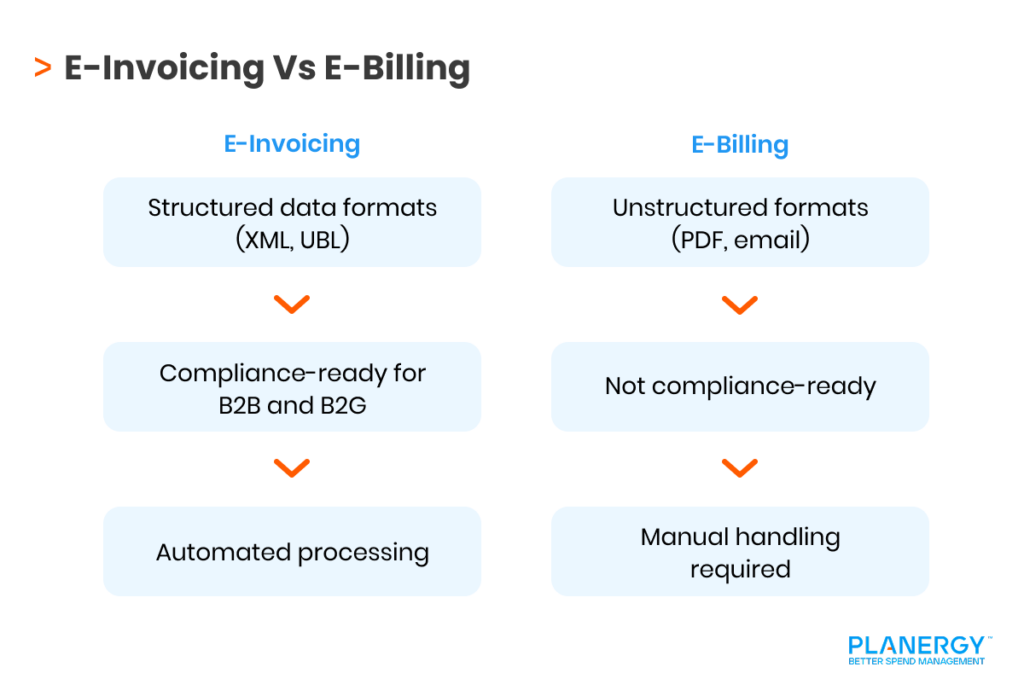
Though the terms are used interchangeably, there are key differences. E-invoices are structured and generally apply to government and B2B transactions for compliance with regulatory standards.

E-billing is less structured, often using static formats (emailed PDFs, for instance), that lack compliance-ready data structures.

E-Invoicing Vs E-Billing

Major E-Invoicing Schemes

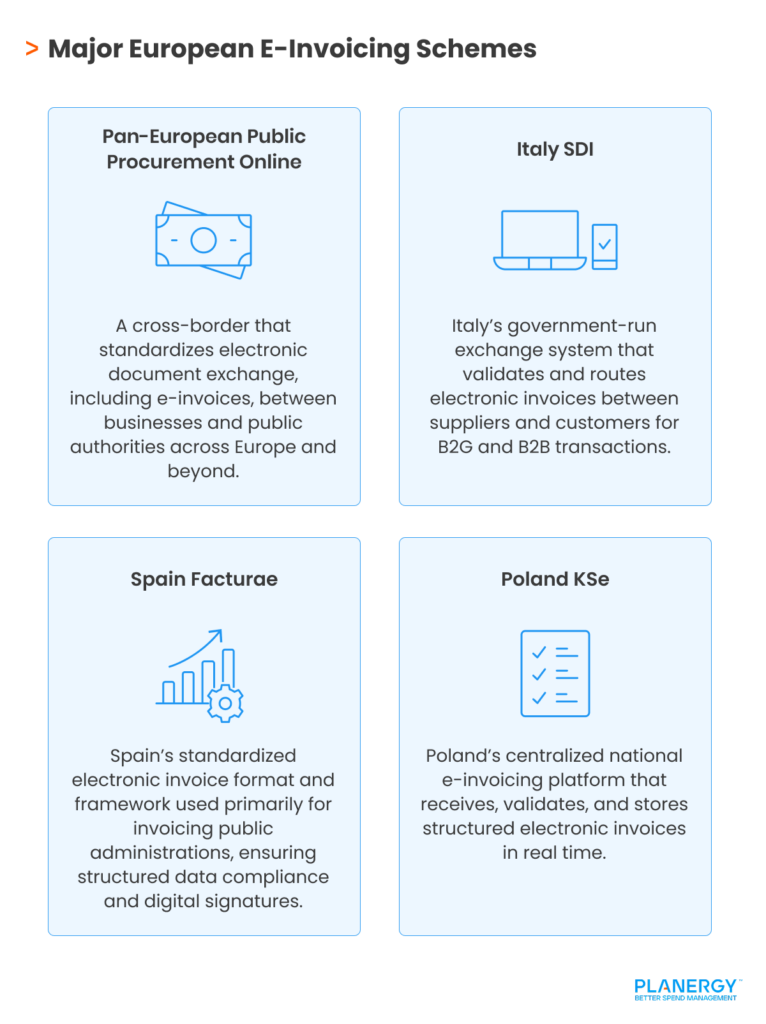
  • PEPPOL (Pan-European Public Procurement Online) offers a framework for standardized e-invoice exchange across borders while adhering to EU rules.
  • Italy’s Sistema di Interscambio (SDI) leads in real-time reporting.
  • Spain’s Facturae and Poland’s KSeF mandate localized e-invoicing adoption to ensure regional compliance.

Major EU E-Invoicing Schemes

Why EU E-Invoicing is Now Mandated

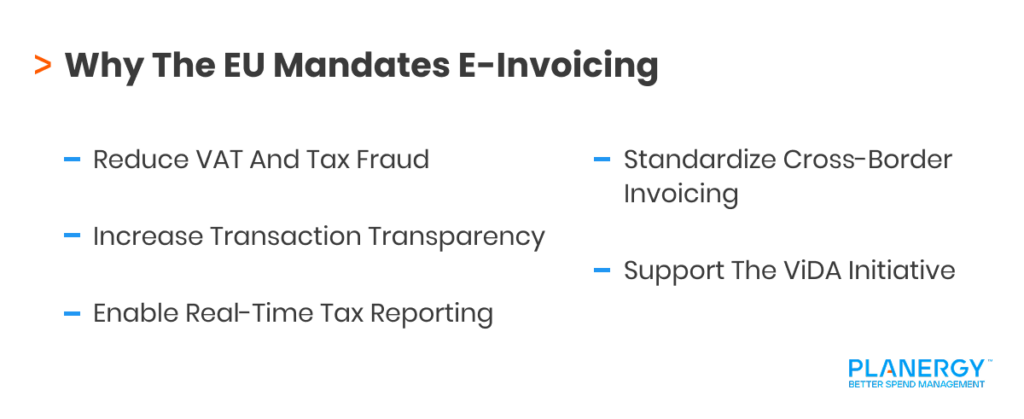
The EU’s new e-invoicing mandate is part of its VAT in the Digital Age (ViDA) initiative. It aims to combat tax evasion, enhance transparency, and create a unified invoicing approach.

Why The EU Mandates E-Invoicing

The legislation outlines specific system requirements and format standards to keep things as uniform and transparent as possible. Eliminating paper invoices and issuing everything in standardized formats with e-reporting makes it easy to manage

Countries with E-invoicing Mandates

Jurisdictions that have implemented e-invoicing include:

  • European Union (EU) for its member states
    • Austria
    • Belgium
    • Bulgaria
    • Croatia
    • Cypress
    • Czech Republic
    • Denmark
    • Estonia
    • Finland
    • France – mandate delayed from July 1, 2024, to September 1, 2026
    • Germany – mandatory for all businesses to receive invoices electronically since January 1, 2025, part of a phased rollout through 2028
    • Greece
    • Hungary
    • Ireland
    • Italy
    • Latvia
    • Lithuania
    • Luxembourg
    • Malta
    • Netherlands
    • Poland
    • Portugal
    • Romania
    • Slovakia
    • Slovenia
    • Spain
    • Sweden
  • Turkey
  • United States: California only for state contractors. The US encourages e-invoicing, but without VAT or GST taxes and so many states and local jurisdictions managing tax and varying regulations, no nationwide mandate is in place.
  • Latin American countries (listed below)
  • Australia
  • New Zealand
  • Some Asian countries
  • Some Middle Eastern countries
  • Some African countries

There are many private companies in the US using voluntary frameworks to facilitate their invoicing. US businesses operating in the EU must comply with local mandates, but stateside adoption is in its early stages.

E-Invoicing Requirements

The rules vary based on country and region, so it’s important to know the specifics where you do business and where your suppliers operate. But the rules generally include:

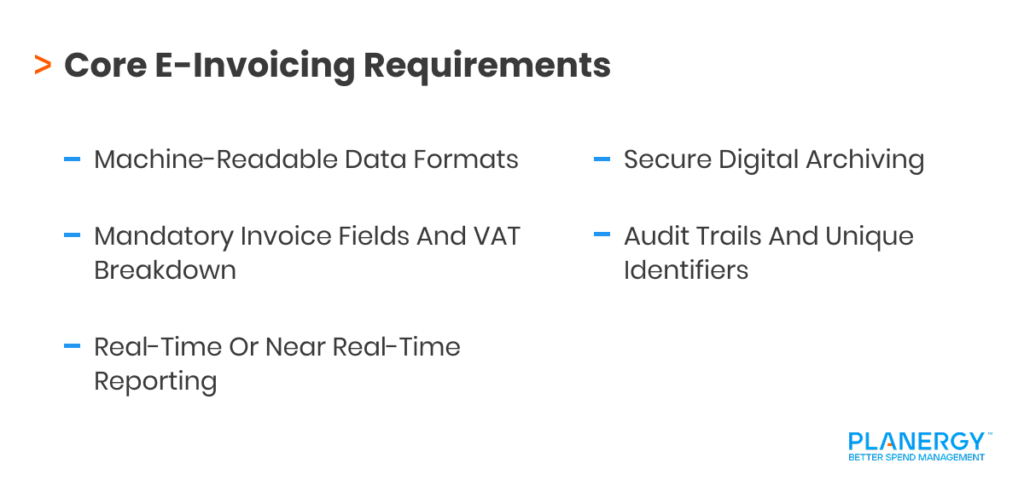
Core E-Invoicing Requirements

  • The use of standard data formats, like XML-based formats, for machine readability
  • Standards like PEPPOL BIS Billing for cross-border transactions.
  • Secure archival (length depends on local laws)
  • Real-time reporting for tax authorities
  • Mandatory buyer and supplier details, invoice number, VAT breakdown, and a unique identifier.
  • Digital signatures or other verification methods to ensure authenticity.

The EU VAT Directive mandates that invoices for taxable supplies must be issued within 15 days of the taxable event.

However, some member states apply stricter timelines. Some countries require nearly instant submission to centralized platforms when invoices are issued, but in some countries, you may have a seven-day time limit for invoice issuance.

Certain transactions, such as business-to-government (B2G) in some countries, have mandatory e-invoicing already in effect. The mandatory timeline varies from country to country.

Procurement & AP Impacts

E-invoice impacts more than the compliance department. It influences the entire procurement and accounts payable workflow.

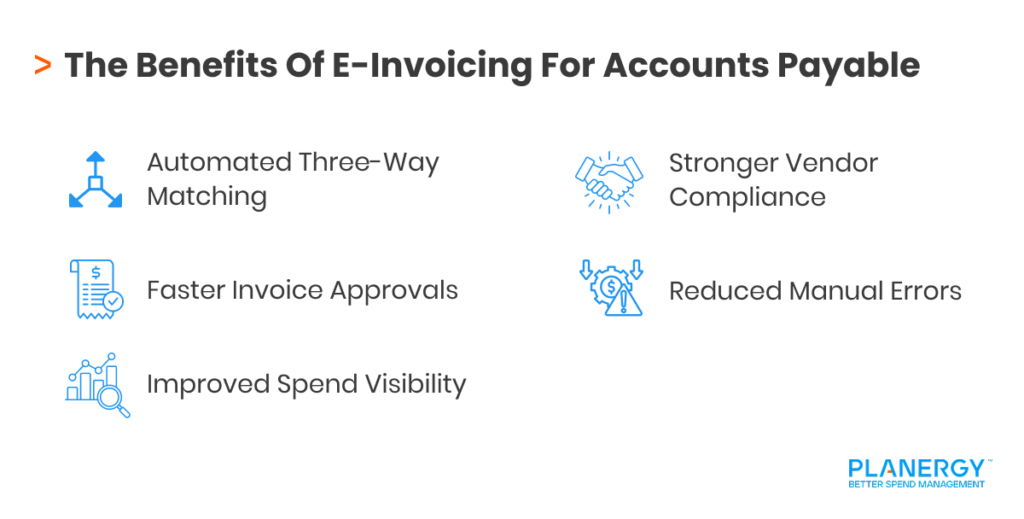
Impact On Procurement And Accounts Payable

For procurement teams, e-invoicing seamlessly aligns with purchase-to-pay (P2P) processes. Procurement relies on accurate purchase orders and delivery receipts, both of which are mirrored in the structured invoice data for maximum accountability.

It also increases efficiency with:

  • Three-Way Matching
    Automated matching between purchase orders, invoices, and goods receipt data minimizes discrepancies and streamlines approvals.
  • Approvals
    With structured formats, AP teams can use software to accelerate invoice review and processing times.

When it comes to vendor relationships, ensuring everyone you work with meets e-invoicing requirements is crucial.

You must educate vendors about the process during onboarding to ensure they are familiar. Failure to do so could cause disruptions and penalties for non-compliance.

Key Compliance Steps

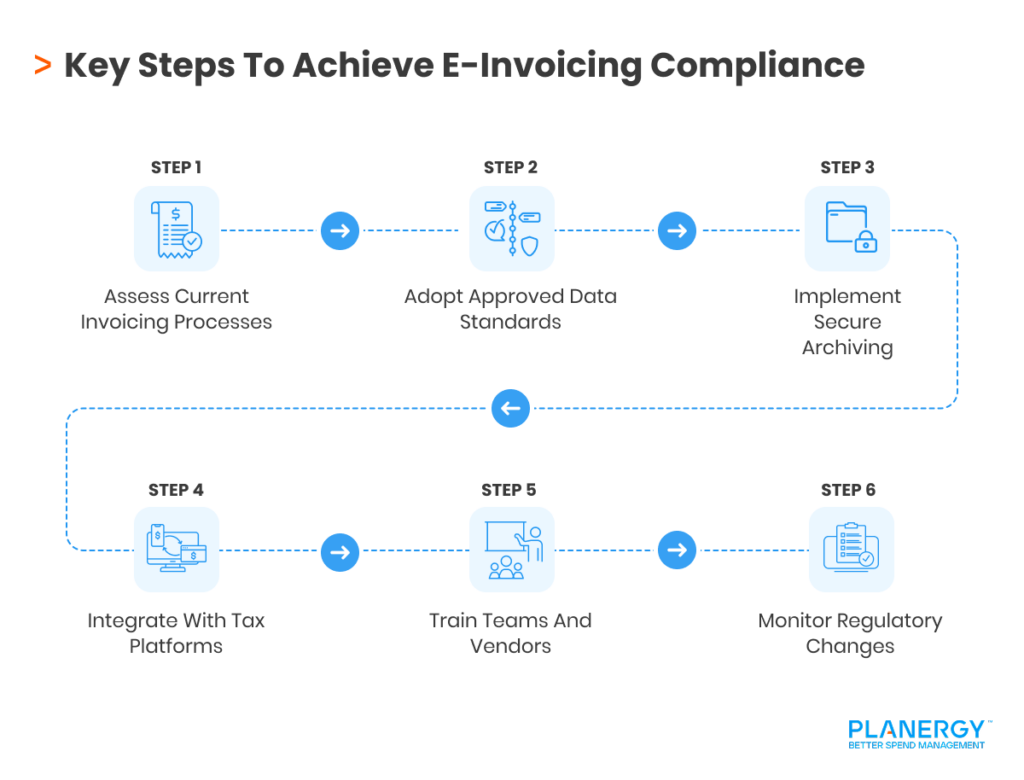
Key Steps To Achieve E-Invoicing Compliance

Understand Data Standards

You must ensure all invoices are generated in machine-readable formats, like XML, UBL, or other country-specific standards.

If you’re handling cross-border transactions, adopt PEPPOL BIS Billing 3.0 to maintain compatibility and compliance.

Familiarize yourself with local data requirements, such as Facturae in Spain or SDI in Italy, to avoid errors and rejections.

Implement Secure Archiving

You’re required to store invoices for a certain length of time. Each country has specific period requirements, ranging from five to 10 years.

Archived invoices must be easily accessible for any audit or tax authority requests.

Use secure, tamper-proof (unalterable) digital storage solutions to maintain invoice data integrity.

Maintain Comprehensive Audit Trails

Every step of the invoicing process, from creation to payment, needs to be recorded so there is a clear audit trail.

Audit trails are subject to regulatory compliance, so make sure they have things like timestamps and unique identifiers. You should be able to see who took what action and when at any point, so that if something is off, you can trace the issue.

Automation software can help with this, since it can automatically log and organize audit data to reduce manual efforts and errors.

Adapt to Real-Time Reporting

Understand the real-time reporting requirements for each country where you operate. For instance, Italy’s SDI requires invoices to be submitted and approved before they’re considered valid. Poland’s KSeF mandates centralized tax reporting for all invoices.

Use software that integrates with these platforms to automate submissions and maintain compliance. Implement validation checks to make sure invoices meet standards before submission.

Invest in Vendor and Stakeholder Alignment

When you onboard your suppliers, educate them about e-invoicing requirements and make sure they are equipped to comply.

Work closely with your vendors to standardize your invoicing practices to avoid disruptions. Train your procurement and AP teams on new workflows, tools, and compliance requirements.

Leverage Technology

Invest in e-invoicing software like PLANERGY to automate workflows, ensure compliance, and reduce manual errors.

Make sure your solution seamlessly integrates with your existing ERP and procurement systems. Invest in solutions that are scalable, so they can adapt as your needs evolve.

How PLANERGY Supports EU E-Invoicing Compliance


AP automation addresses many challenges posed by e-invoicing regulations:

  • Error Reduction: Automated workflows minimize manual data entry errors.
  • Compliance Management: Pre-built frameworks in tools ensure adherence to regional mandates.
  • Efficiency Boost: Invoice matching, approval workflows, and integration with ERP systems save time and resources.

Monitor Regulatory Requirement Changes

Regulations are constantly changing, so you need to be aware of things as they happen. Assign a team or individual to keep an eye on changes in e-invoicing mandates across the EU.

Proactively adjust your processes and accounting systems so you can remain aligned with new requirements.

How PLANERGY Can Help

Automation

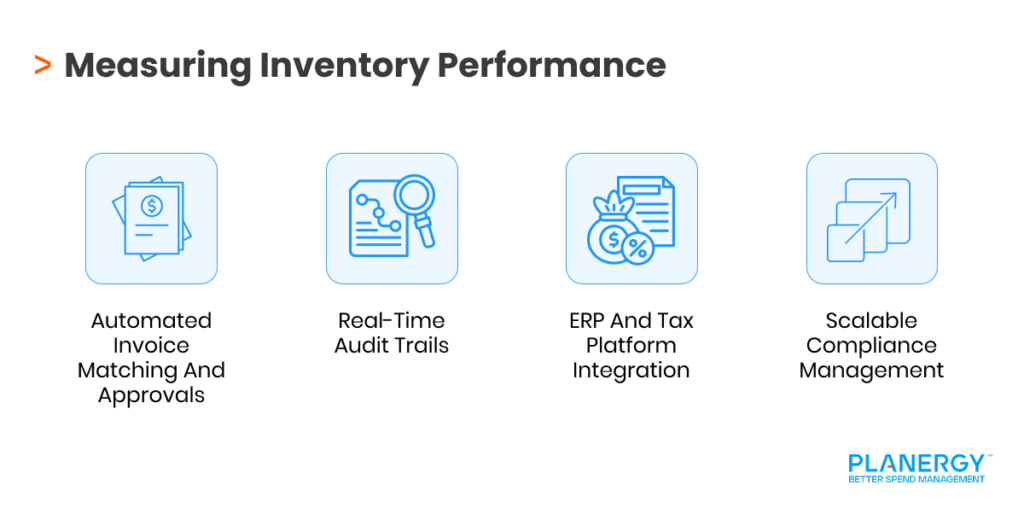
PLANERGY automates critical workflows, from invoice matching to approvals, eliminating manual errors and expediting processes.

Transparent Audit Trails

Every invoice processed in PLANERGY is automatically logged, ensuring a compliant data trail available for audits.

ERP Integration

PLANERGY seamlessly integrates with leading ERP systems to centralize all invoicing and procurement activities for greater visibility and control.

Scalability and Adaptation

As regulations evolve, tools like PLANERGY adapt quickly to new compliance requirements, making it easy for you to scale as needed.

Implementation Roadmap for Compliance

To make sure you’re compliant with regulations as they go into effect, follow this plan:

Internal Audit

Start with a thorough evaluation of your current processes. Look at your existing invoicing workflows to spot gaps in compliance with EU mandates.

Make sure your invoice data is structured, accurate, and compatible with the required formats. Make sure your suppliers are set up to issue complaint e-invoices and identify any suppliers who may require additional support.

Vendor Selection

Evaluate e-invoicing platforms. Look for software tailored to European Commission regulations, supporting compliance with country-specific mandates in the areas where you conduct business. Prioritize platforms that integrate with PEPPOL standards for your cross-border invoice exchanges.

Make sure the platform offers advanced features like automated workflows, real-time reporting capabilities, and secure, compliant archiving.

Evaluate scalability to ensure it meets your current needs but will also work well in the future as operational demands and regulations evolve.

Segment the trading partners in your supply chain to distinguish between technologically advanced vendors and those that need support. Provide the affected suppliers with clear instructions, templates, and timelines to adjust their processes.

Offer regular communication and resources to encourage vendor buy-in and prevent non-compliance disruption.

Integration Planning

Once you’ve found the e-invoicing solution you’ll use, you must embed it into your existing systems to keep operations running consistently and smoothly.

Collaborate with Procurement, Accounts Payable, and IT teams to map workflow integration, so you know how the issued invoices will flow through your systems from submission to final approval.

Define all the touchpoints with your current ERP, financial systems, and procurement tools.

Work with your service provider to tailor features like invoice templates, data validation rules, and reporting settings to your regional and industry-specific needs. Implement automation for repetitive tasks like invoice matching and approval workflows.

Ensure that the integration can handle high volumes of transactions and accommodate additional functionalities, such as multi-country compliance.

Create comprehensive documentation outlining the new process to serve as a reference for your teams moving forward.

Testing and Validation

Start by running a small-scale pilot program with select vendors or internal departments. This allows you to identify and address potential issues before full implementation.

Cross-check the data formats, field completeness, and real-time reporting features against the specific regulations of all relevant countries.

Simulate compliance audits to test the system’s ability to provide required documentation. Address errors such as inaccurate formatting, delayed processing, or data mismatches.

Test high-transaction scenarios to ensure the platform performs efficiently under full operational pressure. Collaborate with your solution vendor to troubleshoot and refine the system.

Training and Change Management

Transitioning to e-invoicing affects not only processes but also the people who execute them. Providing adequate training and managing change ensures successful adoption.

Develop training programs for your Procurement and AP teams to familiarize them with the new system. Focus on critical topics like new workflows, compliance requirements, and troubleshooting basic issues.

Share training resources, such as guides or webinars, with your vendors to support alignment with your e-invoicing expectations.

Keep organizational leaders informed and engaged, demonstrating how the transition aligns with company objectives to drive support across departments.

Utilize a phased approach to implementation, reducing resistance by introducing change incrementally. Provide ongoing technical support and forums for employee feedback to ensure continuous improvement and adoption.

Take Action for E‑Invoicing Compliance Today

As mandatory e-invoicing increases across the EU, it’s not just an opportunity to achieve compliance but also to streamline operations, reduce errors, and build stronger supplier relationships.

Following the advice here makes it easier to transition your team confidently and efficiently and prepares you for the day we reach global e-invoicing.

Don’t wait until deadlines loom. Start preparing today and learn more about how PLANERGY can help you achieve compliance.

What’s your goal today?

1. Use PLANERGY to manage purchasing and accounts payable

We’ve helped save billions of dollars for our clients through better spend management, process automation in purchasing and finance, and reducing financial risks. To discover how we can help grow your business:

2. Download our guide “Preparing Your AP Department For The Future”

Download a free copy of our guide to future proofing your accounts payable department. You’ll also be subscribed to our email newsletter and notified about new articles or if have something interesting to share.

3. Learn best practices for purchasing, finance, and more

Browse hundreds of articles, containing an amazing number of useful tools, techniques, and best practices. Many readers tell us they would have paid consultants for the advice in these articles.

Related Posts

Business is Our Business

Stay up-to-date with news sent straight to your inbox

PLANERGY LOGO

Sign up with your email to receive updates from our blog