We saved more than $1 million on our spend in the first year and just recently identified an opportunity to save about $10,000 every month on recurring expenses with PLANERGY.
Prepare early by negotiating cost transparency upfront so you’re better positioned to challenge future price increases.
When prices rise, decide whether to absorb costs, adjust pricing, or pass increases to customers based on impact.
Use data, contracts, and cost breakdowns to keep negotiations fact-based and reach a fair outcome.
Maintain strong supplier relationships by communicating openly, sharing pressures, and treating pricing as a partnership.
Knowing how to respond to supplier price increase requests is critical for protecting profitability while maintaining strong vendor relationships. Rising supplier costs can quickly impact your margins, customer pricing, and long-term procurement strategy if they are not handled carefully.
Getting work done means juggling tons of things at once. It also means relying on many things we don’t control. Did you know, for example, that the average small business uses around 22 apps to get things done?
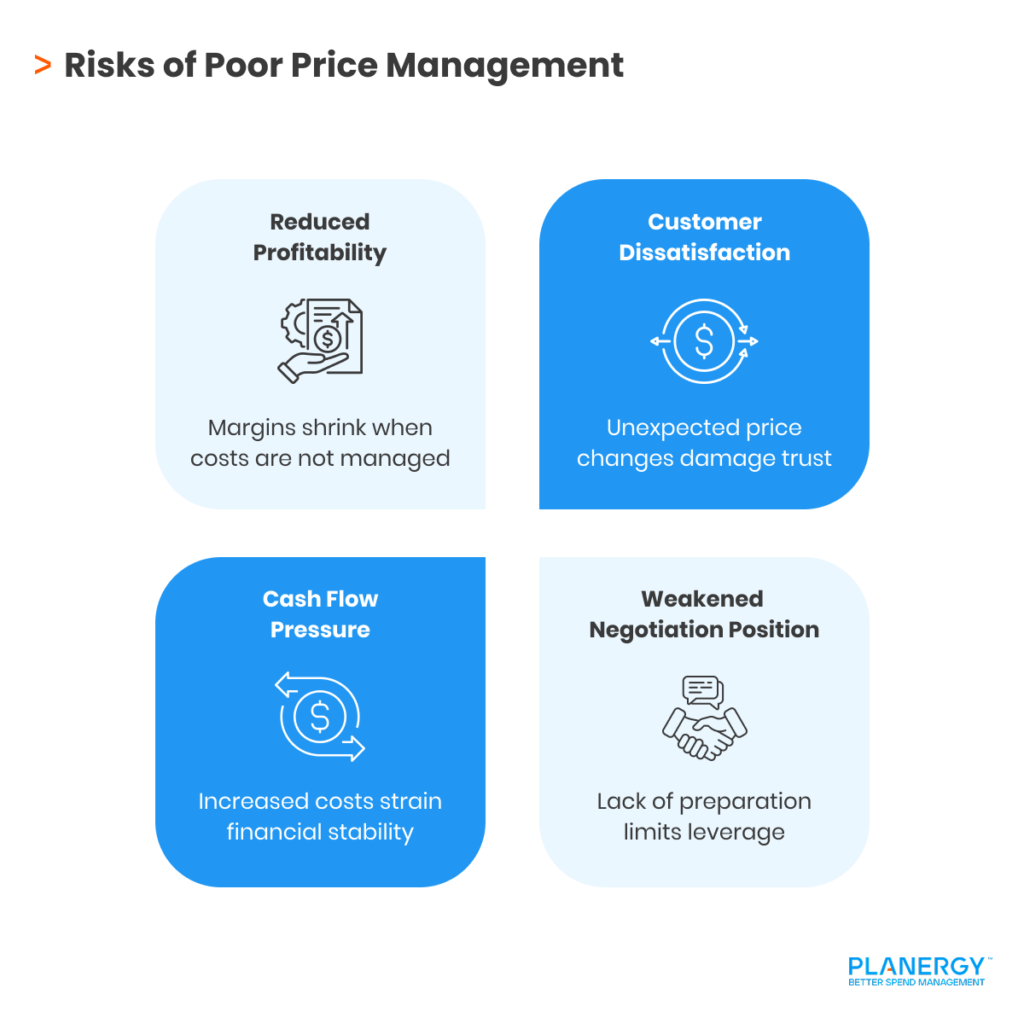
That means if we’re not paying attention to these fixed costs, alongside the pricing we offer to clients, we could seriously be putting a dent in our profitability, while also leaving money on the table.
That aside, it’s important to think about what happens to your business when one of your mission-critical vendors decides to increase prices on the products or services you’re using?
How can you manage this with your customers so that you’re not eating most of the cost increase? When should you start price negotiations to negate the increases or at least reduce their impact on your business?
The answer may surprise some of you: you should have started negotiating when you originally obtained your current pricing.
Always include this statement with your request for proposal (RFP): “Please include cost breakdowns for this product/service in your response to our RFP.”
When you include this statement, make sure you also let your supplier know that by asking for this costing information, you’re not aiming to take a bite out of their profit.
Instead, you should emphasize that you’re looking for ways to help them maintain the same, or even better profit levels, while also exploring ways to reduce costs in the supply network.
Understanding how to respond to supplier price increase requests starts with evaluating how the change affects your customers, margins, and supplier relationships.
Why Is This Pricing Information So Helpful?
Take, for example, a supplier who says they’re going to raise your cost by 23% due to a 23% increase in the cost of aluminum last year.
You’ll be in a much tougher position to argue against the increase if you don’t have the supplier’s costing information.
Communicating this upfront can help keep the relationship on solid ground in the future as you adjust to new pricing and payment terms.
When choosing vendors, consider not only the current price and the exchange rate, but also the potential for total cost increases in the future.
How to Respond to Supplier Price Increase Requests
There are a couple of things to consider whenever a vendor proposes a price increase. Mainly, you need to think about who or what is affected by the change. Then, you need to think about the steps your company will take in response to said increase.
Who or What is Affected?
If you have all your clients on a formal contract that details their service package that includes all vendor costs, you’ll have a much easier time identifying the clients that are affected by a vendor price increase.
If, for instance, all your clients are affected by the price increase, that’s a much bigger deal than if just one or two are.
What Steps Could We Take?
You have two options when a vendor increases their costs:
Absorb the difference.
Pass the costs on.
If the price increase is small and you can spread it across multiple clients, you may be able to absorb the price increase, so that your customers don’t feel it at all.
If you have been able to increase profitability elsewhere in your business, it also makes it easier to absorb smaller costs like this.
Another option is to price in an increase your services. You can accomplish this by retaining some of the discount your vendor gives you if there’s a vendor volume-based discount.
You can also package your vendor costs into your service package with a margin. Pricing in changes makes your pricing more robust to change and gives you a bit of a profit margin if vendors’ costs remain the same.
Your final option is to pass the difference in price onto the customer. This is usually the best option when the change is significant – too much for you to absorb.
Sometimes the charge by the vendor means your clients must accept a change to your terms and conditions. You’ll pass the difference on to your clients with a contract scope change.
Negotiating Supplier Price Increase Requests
In procurement, it’s no secret how important negotiation skills are throughout the supply chain. Whether you’re negotiating with a supplier for the first time or trying to achieve a win-win solution after a price increase, there’s a certain checklist you should follow.
Listen to What the Supplier Has to Say
It’s quite possible that negotiations will be tense in the beginning. If this is the case, let the supplier vent. You win some bonus points with your show of empathy. This helps the supplier come around to rational business discussions.
One of the best ways to learn how to respond to supplier price increase discussions is by relying on data instead of emotion.
With the emotions out of the way, both parties listen better, which makes it easier to shift the conversation from feelings to facts.
Be transparent so that the supplier knows you’re not trying to take advantage of them. The supplier needs to see you as reasonable.
Look Closely at the Bill of Materials
Spend some time reviewing commodity price trends. Separate each bill of materials (BOM) into material times. Many commodity prices are at all-time highs, especially metal and plastic.
The increase should not be more than the historical movement for the specific metals in specific categories. The increase should not apply to portions of the assembly where prices have remained constant for months. Use the facts in your negotiations.
Separate All Your SKUs
Sort your product line into baskets. Segregate the increase to lower-volume parts where you likely have more margin to work with. Do your best to protect your high-volume parts where there is less of a margin to work with.
Lock in your prices with a written contract, for as long as you possibly can. You want to avoid having to go back to the drawing board every time there’s a price hike.
Adjust for a Temporary Increase
Similar to a gas surcharge in the transportation industry, carve out the price change as a separate line item. Keep your historical contracted pricing the same.
Make sure the supplier knows you’ll debate the topic from time to time to make sure everyone understands why the higher price needs to be kept a little longer or removed.
Keep the discussion data-driven, and before each meeting ends, set the next review date.
Use Historical Data
On occasion, suppliers will have issues that cause them to fail to meet obligations. Use the contract data to your advantage. If the conversation ever gets emotional, go back to the facts presented in the contract. Keep things fair, but fact-driven.
If it applies, remind suppliers of times when you took an increase and didn’t ask them to share the burden with you. You may have absorbed a tariff on a specific product a few months ago.
Use that to your advantage to get them to help you absorb plastic material cost increases. Remember, you’re in a partnership, and everyone should share the burden.
Consider the Timing
Make sure you know when the pricing changes will go into effect. Sometimes, suppliers may argue that price changes go into effect retroactively, applying them to purchase orders (POs) that were shipped weeks ago.
The increase should only apply to orders placed after a certain date, to give you ample time to adjust things and re-quote customers.
Businesses that understand how to respond to supplier price increase notices early are often in a stronger negotiating position.
Explain Your Costs
Vendors will often overlook things like warehousing, marking, sales, order fulfillment, labor costs, and several other costs associated with bringing products to market.
Transportation times and costs are higher than ever, and most deals are quotes in the port closest to the supplier.
The brand owner has to take on all transportation costs and working capital during the transit time. Lead times are longer than ever before, so that means you’re dealing with more of these costs than your existing supplier may realize.
Make sure your suppliers know you’re absorbing these higher costs, and you want a partner who will share the burden. Make them understand costs they don’t see.
Share the News
If this is a major increase that has the potential to upset your customers, then let them know about the pressure you’re dealing with. A single voice may not do much to keep prices where you need them to be.
But, when you have an entire group of people talking with your supplier about the issue, there is a different impact. That puts more pressure on the supplier to do what they can to keep the pricing where you need it to be.
Prepare for several rounds of negotiations before you can reach the final mutually beneficial agreement. Remember, sometimes decisions aren’t final so you must get the agreement in writing with clear instructions.
Make sure the Accounts Payable team is up to date with the changes when the next set of invoices arrives. This way, they can confirm that everything that was agreed upon in negotiations is reflected in the invoice.
Suppliers may try to get away with keeping things as they were, hoping that you didn’t let AP know. (Not all of them will, but there are some out there who might.)
Though you may be tempted to tell your supplier you’ll just take your business elsewhere, making switches like this are often unrealistic. Suppliers know this.
That’s why you must think about what each supplier means to your business, revenue, and bottom line as you approach every negotiation and price conversation.
Ultimately, knowing how to respond to supplier price increase situations can help your business protect margins, maintain supplier partnerships, and avoid unnecessary financial strain.
What’s your goal today?
1. Use PLANERGY to manage purchasing and accounts payable
We’ve helped save billions of dollars for our clients through better spend management, process automation in purchasing and finance, and reducing financial risks. To discover how we can help grow your business:
2. Download our guide “Preparing Your AP Department For The Future”
Download a free copy of our guide to future proofing your accounts payable department. You’ll also be subscribed to our email newsletter and notified about new articles or if have something interesting to share.
3. Learn best practices for purchasing, finance, and more
Browse hundreds of articles, containing an amazing number of useful tools, techniques, and best practices. Many readers tell us they would have paid consultants for the advice in these articles.
We use cookies to personalise content and ads, to provide social media features and to analyse our traffic. We also share information about your use of our site with our social media, advertising and analytics partners who may combine it with other information that you’ve provided to them or that they’ve collected from your use of their services.
The technical storage or access is strictly necessary for the legitimate purpose of enabling the use of a specific service explicitly requested by the subscriber or user, or for the sole purpose of carrying out the transmission of a communication over an electronic communications network.
Preferences
The technical storage or access is necessary for the legitimate purpose of storing preferences that are not requested by the subscriber or user.
Statistics
The technical storage or access that is used exclusively for statistical purposes.The technical storage or access that is used exclusively for anonymous statistical purposes. Without a subpoena, voluntary compliance on the part of your Internet Service Provider, or additional records from a third party, information stored or retrieved for this purpose alone cannot usually be used to identify you.
Marketing
The technical storage or access is required to create user profiles to send advertising, or to track the user on a website or across several websites for similar marketing purposes.