We saved more than $1 million on our spend in the first year and just recently identified an opportunity to save about $10,000 every month on recurring expenses with PLANERGY.
A “No PO, No Pay” policy ensures invoices are only paid when linked to an approved purchase order, improving control and accountability.
It strengthens budget control, reduces fraud risk, and gives finance teams clear visibility into committed spend.
Success depends on clear rules, defined exceptions, and strong stakeholder communication to drive adoption.
Pairing the policy with automation and e-procurement systems makes processes faster, more accurate, and scalable.
Understanding the No PO, No Pay Framework
Accounts Payable teams face constant pressure from inefficiency, disputes, and maverick spending that undermines procurement strategies.
The solution? A “No PO No Pay” policy, a financial control measure that mandates suppliers cannot receive payment unless they provide a valid purchase order number with their invoice.
While straightforward in concept, implementing this policy requires careful planning, stakeholder buy-in, and the right e-procurement technology to make it work seamlessly.
What Is a No PO No Pay Policy?
A No PO No Pay policy establishes purchase orders as the foundation for all supplier payments. Accounts Payable will only process invoices that reference an approved purchase order created before goods or services were delivered.
Why No PO No Pay?
Without a valid PO number, organizations lose the ability to track commitments accurately. A valid PO number serves as a unique identifier that connects the original approval, the goods receipt, and the final invoice.
When businesses operate with no purchase order system, they experience payment delays due to disputes over pricing and quantities, strained vendor relationships, and difficulty enforcing payment terms.
The chaos of retroactive approvals and scrambling to verify what was actually agreed upon creates friction throughout the procure-to-pay cycle.
This creates a clear workflow: departments submit purchase requisitions, obtain approvals, and generate purchase orders before engaging providers. When the invoice arrives, AP matches it against the existing PO to verify pricing, quantities, and terms.
Without that official PO number, the invoice enters an exception queue or gets rejected entirely.
What No PO No Pay Achieves
The policy transforms purchase orders from optional documentation into essential business instruments. Every PO becomes a binding commitment reviewed according to your organization’s authorization matrix.
Finance knows what’s been committed, procurement maintains visibility into spending patterns, and suppliers understand exactly what documentation they need for timely payment.
Advantages of Enforcing Purchase Order Discipline
Financial Control and Budget Adherence
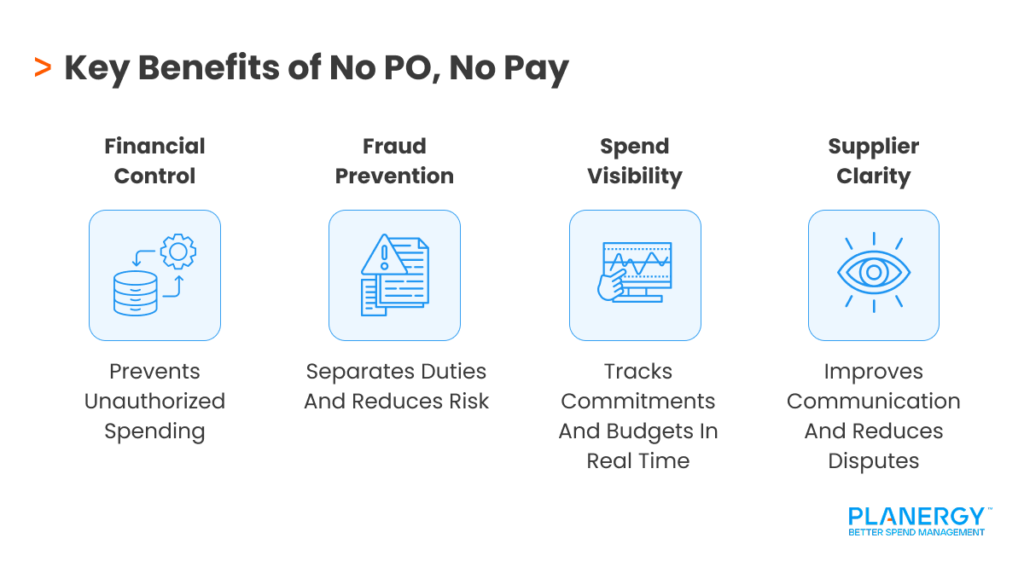
The policy creates a hard stop against unauthorized spending. When every purchase requires an approved PO, budget holders must explicitly commit funds before transactions occur. This stops invoices arriving for purchases no one authorized.
Purchase orders enable real-time visibility into commitments. Your ERP system’s accounting becomes accurate because every PO represents a claim against the budget.
Finance teams see exactly how much budget has been committed versus spent, preventing month-end surprises from unapproved invoices.
Enhanced Fraud Prevention and Compliance
Requiring purchase orders creates natural segregation of duties. The requester, the approver, and the team processing payment are all different people working with different documents. This makes it much harder for fraudulent invoices to slip through.
The policy generates a comprehensive audit trail. Every transaction has documentation showing who requested it, who approved it, what was ordered, and what terms were agreed upon. This information becomes critical for auditors and compliance officers.
Procurement Leverage and Supplier Management
When all purchases flow through formal procurement processes, your team gains visibility into the organization’s full spending profile.
This consolidated view enables strategic sourcing decisions, volume discounts, and ensures providers meet quality and compliance standards.
The policy also improves supplier relationships. Vendors receive clear documentation of what you’ve ordered, expected pricing, and delivery terms. This reduces disputes and streamlines invoice-to-payment processes.
Process Efficiency Through Automation
Modern AP automation platforms like PLANERGY automatically match invoice line items to purchase orders, verifying that quantities, prices, and terms align with what was approved.
Purchase order automation enables the system to route invoices for streamlined approval or even auto-approve payment.
When invoices match POs within acceptable tolerances, the system routes them for streamlined approval or even auto-approves payment. This eliminates manual matching work.
This automation removes the majority of manual processing for standard invoices. Your team only handles exceptions where discrepancies exist. The PO enables touchless invoice processing, turning a financial control measure into an efficiency driver.
Navigating the Challenges and Limitations
Initial Implementation Resistance
Change management is the first hurdle. Employees accustomed to informal purchasing will resist additional steps required for requisitions and approvals.
Supplier pushback is also predictable. Providers used to receiving prompt payment without formal POs may view the requirement as an unnecessary complication.
Legitimate Exceptions Requiring Flexible Handling
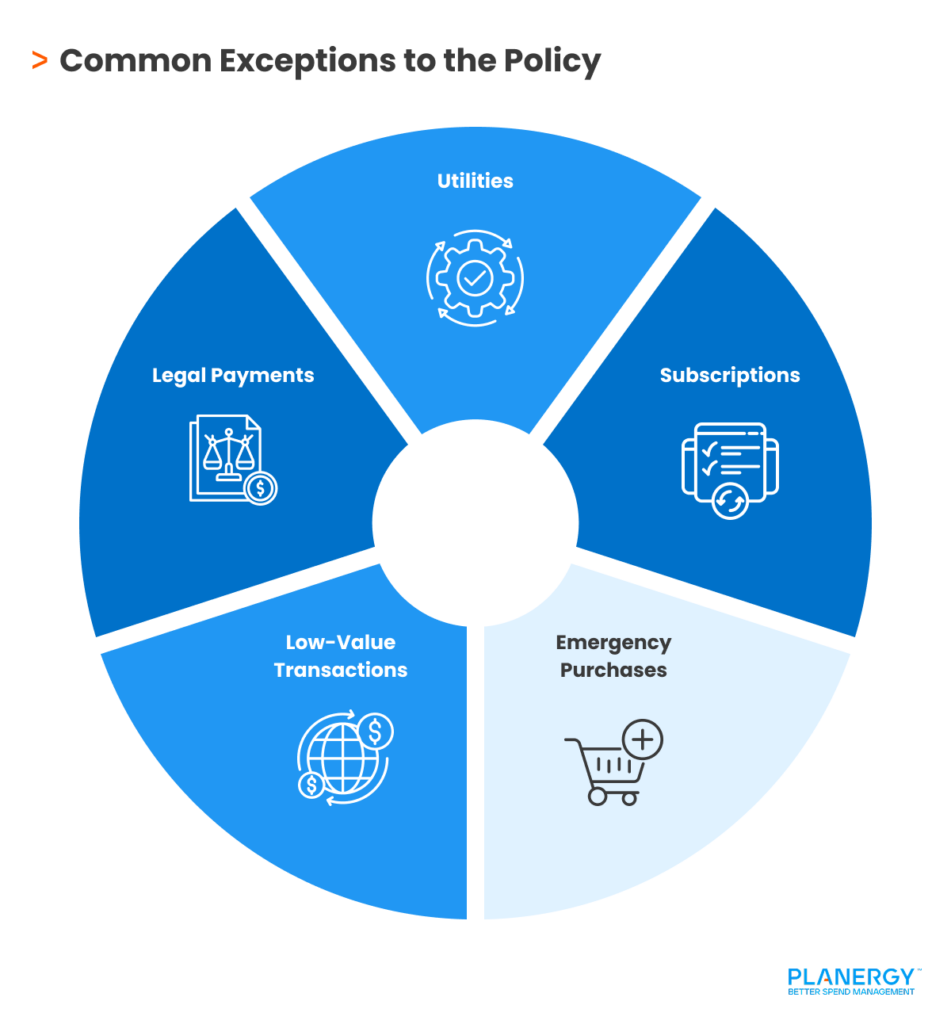
Certain categories don’t fit the PO model. Utility bills, subscription services, and legal settlements typically can’t be ‘PO’d’ in advance.
Emergency purchases sometimes require goods before a formal PO can be generated. Low-value, high-frequency transactions may not justify individual POs. Organizations need clearly defined exception processes for handling non-PO invoices.
This might include blanket POs for recurring services with pre-negotiated payment terms, expedited emergency procedures, or purchasing card programs for small-dollar transactions.
P-cards (procurement cards or purchasing cards) provide an effective alternative for low-value purchases that don’t justify the overhead of generating a purchase order.
With P-cards, employees can make small purchases within pre-set limits while maintaining spending visibility and control.
The key is making exceptions documented and controlled, rather than creating loopholes that allow unlimited spending with no purchase order required.
Administrative Burden Without Proper Systems
Without the right tech, a No PO, No Pay policy creates significant overhead. Manual PO creation is time-consuming. Paper-based approval routing slows emergency purchases. Hand-matching invoices to POs consumes AP resources without adding value.
This is why modern organizations pair No PO, No Pay policies with e-procurement solutions and AP automation integrated with their ERP systems. The policy provides structure, and the technology provides efficiency.
Building a Successful Implementation Roadmap
Establish Clear Policy Parameters and Exceptions
Document exactly what the policy covers and what exceptions exist. Define purchase categories requiring POs, establish dollar thresholds, and create explicit procedures for handling non-PO invoices. State clearly what happens to non-compliant invoices and how suppliers should format invoices for smooth processing.
Create your exception framework upfront. Identify recurring services, utilities, and other categories that don’t fit the PO model. Establish blanket PO procedures, corporate card programs, or alternative approval mechanisms for these scenarios.
Invest in Enabling Technology Infrastructure
Modern AP automation platforms fundamentally change the efficiency equation. Solutions like PLANERGY automate the three-way match process, comparing invoice data against purchase orders and receiving documents.
The system flags discrepancies for human review while auto-processing compliant invoices.
The procurement side requires equal attention. Implement purchase order software that integrates with your ERP system and makes the process simple for end users. Mobile-friendly interfaces, catalog-based ordering, and automated approval routing reduce friction and encourage compliance.
Execute Phased Rollout with Strategic Sequencing
Implement in stages rather than organization-wide overnight. Begin with a pilot group, perhaps a single department or spend category, to validate your processes and technology before broader rollout.
Consider sequencing by spend category or supplier criticality. Start with high-volume, repetitive purchases where benefits are most obvious, and procurement processes are most standardized.
Initially, track PO compliance rates without strictly rejecting non-compliant invoices. Once compliance rates reach acceptable levels, begin enforcing the “no pay” consequence.
Communicate Relentlessly with All Stakeholders
Internal users need to understand the strategic rationale. Explain how PO discipline prevents fraud, improves budget control, and reduces invoice disputes. Provide training on new systems and make support readily available.
Give providers advance notice before enforcement begins. Provide clear guidance on how to include PO numbers on invoices and what happens if they don’t comply. Consider supplier onboarding sessions to walk key vendors through the new process.
Monitor, Measure, and Continuously Improve
Establish metrics to track policy effectiveness. Monitor PO compliance rates, invoice processing cycle times, exception volumes, and payment accuracy. Create feedback loops with users and suppliers to identify friction points.
Use data analytics and effective purchase order control strategies to identify patterns. If certain departments consistently struggle with compliance, they may need additional training or simplified procurement processes.
If specific providers routinely submit invoices without POs, targeted outreach can address the issue.
The Automation Imperative: Technology as Policy Enabler
Modern AP automation transforms the PO from a control document into an efficiency enabler. When invoices arrive, whether by email, EDI, or supplier portal, automation platforms extract relevant data and immediately match it against existing purchase orders.
The system compares invoice line items to PO line items, checking quantities, unit prices, and totals. When everything matches within configured tolerances, the invoice flows automatically toward payment with minimal human intervention.
Without that PO foundation, AP staff must manually research every invoice. This is exactly the inefficiency the policy aims to eliminate.
PLANERGY manages the entire procure-to-pay workflow. Users create requisitions and POs through intuitive interfaces. Approval routing happens automatically based on your authorization matrix.
When invoices arrive, the system handles matching and exception routing. Your AP team focuses on genuine discrepancies rather than routine data comparison.
The automation provides real-time visibility into the procure-to-pay cycle. You can see which POs have outstanding invoices, track invoice approval status, and identify bottlenecks slowing payment.
This transparency helps optimize cash flow management and strengthens supplier relationships.
Making the Commitment to Procurement Excellence
A No PO, No Pay policy represents more than an accounts payable procedure. It’s a strategic commitment to financial discipline, fraud prevention, and process excellence.
Organizations that successfully implement this approach gain tighter budget control, reduced fraud risk, improved procurement visibility, and significantly more efficient invoice processing.
Success lies in pairing the policy with appropriate e-procurement technology integrated with your ERP system.
Modern AP automation platforms transform the PO from an administrative burden into an efficiency driver, enabling touchless processing for compliant invoices while maintaining robust controls.
Implementation requires careful planning, phased rollout, and persistent communication. But organizations that make this commitment will see benefits that far outweigh the implementation challenges.
In an era where every efficiency gain matters and financial controls face increasing scrutiny, the No PO, No Pay policy has evolved from best practice to business imperative.
What’s your goal today?
1. Use PLANERGY to manage purchasing and accounts payable
We’ve helped save billions of dollars for our clients through better spend management, process automation in purchasing and finance, and reducing financial risks. To discover how we can help grow your business:
Download a free copy of our guide to better manage and make savings on your indirect spend. You’ll also be subscribed to our email newsletter and notified about new articles or if have something interesting to share.
3. Learn best practices for purchasing, finance, and more
Browse hundreds of articles, containing an amazing number of useful tools, techniques, and best practices. Many readers tell us they would have paid consultants for the advice in these articles.
We use cookies to personalise content and ads, to provide social media features and to analyse our traffic. We also share information about your use of our site with our social media, advertising and analytics partners who may combine it with other information that you’ve provided to them or that they’ve collected from your use of their services.
The technical storage or access is strictly necessary for the legitimate purpose of enabling the use of a specific service explicitly requested by the subscriber or user, or for the sole purpose of carrying out the transmission of a communication over an electronic communications network.
Preferences
The technical storage or access is necessary for the legitimate purpose of storing preferences that are not requested by the subscriber or user.
Statistics
The technical storage or access that is used exclusively for statistical purposes.The technical storage or access that is used exclusively for anonymous statistical purposes. Without a subpoena, voluntary compliance on the part of your Internet Service Provider, or additional records from a third party, information stored or retrieved for this purpose alone cannot usually be used to identify you.
Marketing
The technical storage or access is required to create user profiles to send advertising, or to track the user on a website or across several websites for similar marketing purposes.