
What's PLANERGY?

Modern Spend Management and Accounts Payable software.

Helping organizations spend smarter and more efficiently by automating purchasing and invoice processing.

We saved more than $1 million on our spend in the first year and just recently identified an opportunity to save about $10,000 every month on recurring expenses with PLANERGY.

King Ocean Logo

Cristian Maradiaga

King Ocean

Download a free copy of "Preparing Your AP Department For The Future", to learn:

  • How to transition from paper and excel to eInvoicing.
  • How AP can improve relationships with your key suppliers.
  • How to capture early payment discounts and avoid late payment penalties.
  • How better management in AP can give you better flexibility for cash flow management.

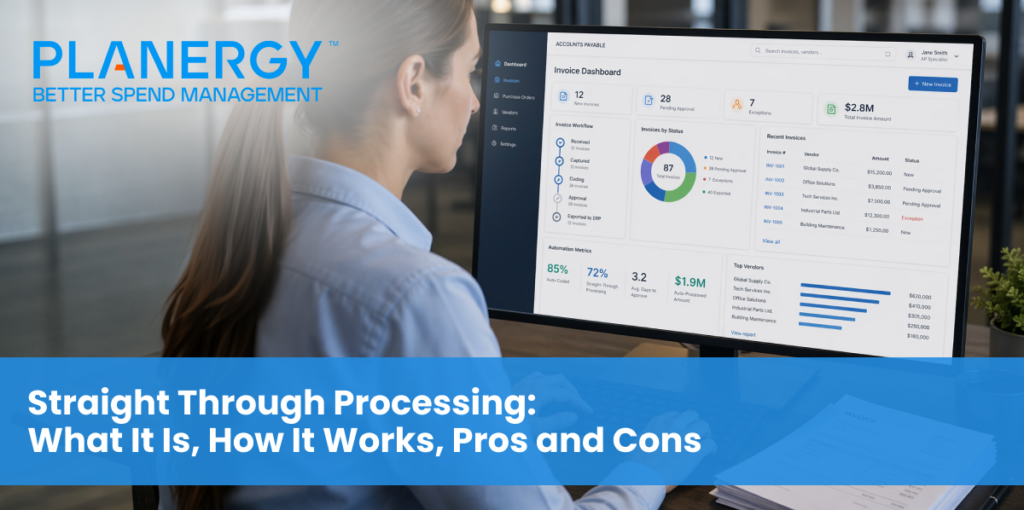
Straight Through Processing: What Is It, How It Works, Pros and Cons

KEY TAKEAWAYS

  • Straight-through processing (STP) automates transactions end-to-end with no human intervention, improving speed and efficiency.

  • Data accuracy is critical, because poor input quality leads to fast, large-scale errors instead of efficiency gains.

  • E-invoicing helps ensure accuracy by sending structured data directly, eliminating manual entry and OCR issues.

  • When implemented well, STP reduces costs, speeds up payments, and allows finance teams to focus on higher-value work.


Automation promises faster, cheaper invoice processing. But here’s the catch: if your data isn’t accurate, you’re just automating mistakes at high speed.

Straight-through processing (STP) can transform how you handle financial transactions in Accounts Payable (AP) operations—but only if you get the accuracy piece right first.

What Is Straight-Through Processing?

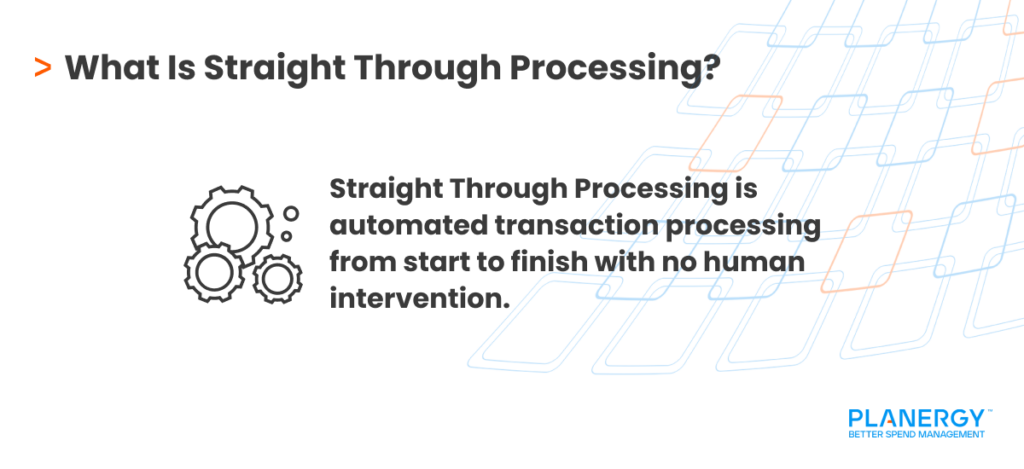
Straight-through processing is automated transaction processing from start to finish with no human intervention. Think of it as a digital assembly line: data enters at one end and exits as a completed transaction on the other—no human touchpoints needed.
What Is Straight Through Processing?

Traditional workflows require people to manually review, enter, validate, and approve each transaction. Manual data entry at each handoff creates delays, errors, and costs. Paper-based processes are especially prone to these inefficiencies.

STP eliminates these bottlenecks by letting systems talk directly to each other, validate data automatically, and execute transactions based on predefined business rules—streamlining the entire process.

STP started in financial services where investment firms needed to process thousands of securities transactions daily. Today, it’s expanded across industries, with Accounts Payable automation being one of its most powerful applications.
How Straight-Through Processing Works

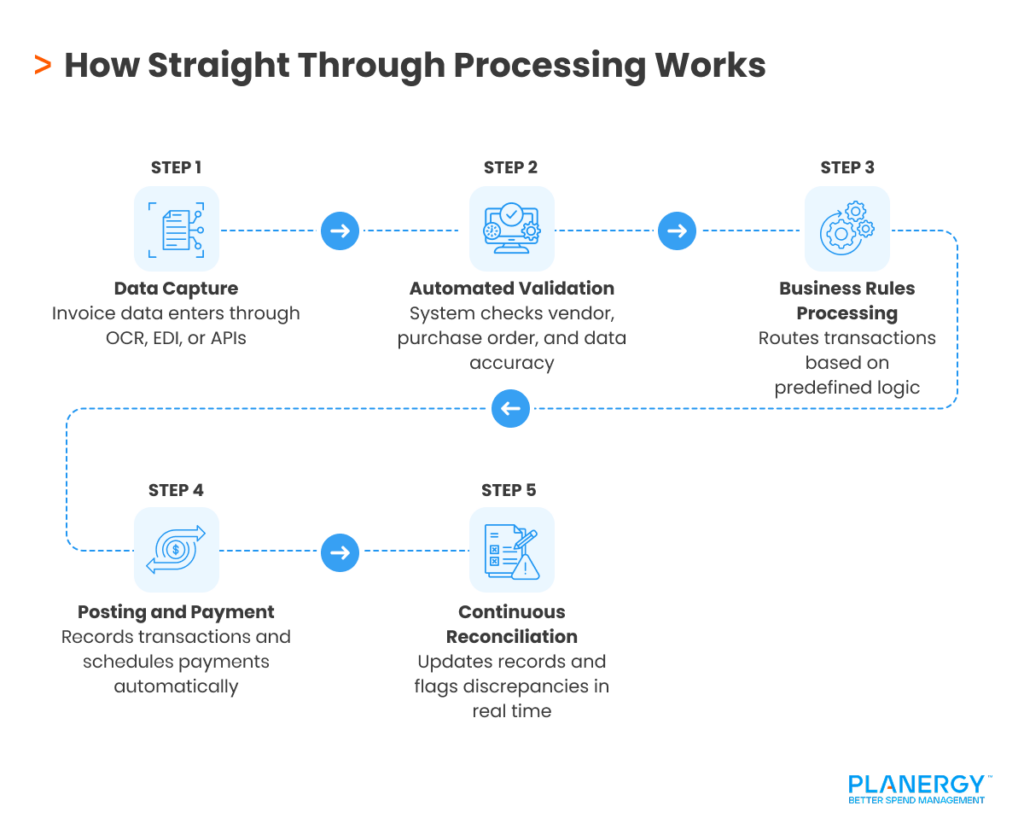
STP operates through five integrated stages that cover the complete transaction lifecycle:

How Straight Through Processing Works

Data Capture
Invoice data enters your system in numerous ways. Modern systems use Optical Character Recognition (OCR), Electronic Data Interchange (EDI), and Application Programming Interfaces (APIs) connections to capture information.

Automated Validation
The system validates data against multiple sources. Does this vendor exist? Does the purchase order match? Are line items within tolerance?

Your Enterprise Resource Planning (ERP) software, procurement platforms, and contract databases verify each data point to dramatically reducing processing time.

Business Rules Processing
Predefined logic routes transactions automatically. Three-way matching confirms invoice quantities align with purchase orders and receiving reports.

Approval hierarchies trigger based on amount thresholds. Exception handling flags anomalies for manual review.

Automated Posting and Payment
Validated transactions flow into your financial systems, get coded to general ledger accounts, scheduled for payment, and recorded in audit trails automatically.

Continuous Reconciliation
The system maintains real-time reconciliation, updates dashboards, flags discrepancies, and generates compliance documentation.

The Accuracy Problem: Why 99% Isn’t Good Enough

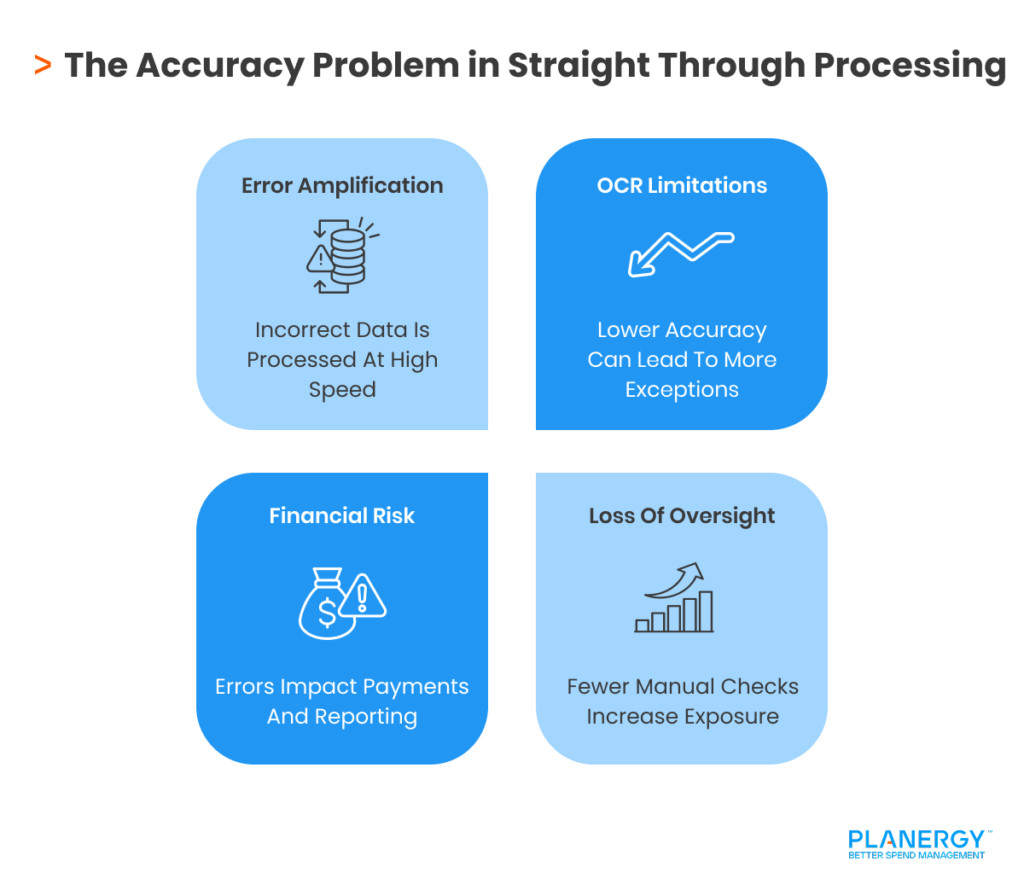
Here’s what most organizations miss: Straight-through processing automates whatever you feed it. That means that if your data capture accuracy is 95%, your STP system will process 5% of transactions incorrectly.

Manual processing is slow, but humans can catch errors before they spread through your financial systems. STP removes that safety net. Without near-perfect accuracy, you’re automating errors, not efficiency.

The math is harsh. Process 10,000 invoices monthly with 90% OCR accuracy? You’re systematically processing 1,000 incorrect transactions every month. Each error needs manual investigation, correction, and supplier outreach

Obviously, this will kill any efficiency gains promised by straight-through processing.

The Accuracy Problem in Straight Through Processing

Common problems with inaccurate data:

  • Incorrect vendor payments damage supplier relationships.
  • Misclassified expenses corrupt financial reporting.
  • Duplicate invoices slip through, causing double payments.
  • Tax compliance failures from bad data.
  • Impossible working capital optimization with unreliable payment data.

This is why OCR accuracy matters so much in AP automation. Your STP system is only as good as the data entering it. Rush to automate without establishing data accuracy first, and you’ll manage more exceptions than your old manual process ever created.

E-Invoicing: The Accuracy Solution

Rather than abandoning automation, the fix is ensuring data quality at the source. Electronic invoicing delivers the accuracy levels STP demands.

Unlike paper invoices or PDFs requiring OCR interpretation and manual data entry, e-invoices send structured data directly from supplier systems to your AP platform.

No scanning, no character recognition, no ambiguity. Invoice data arrives in standardized formats (XML, EDI, JSON) with field-level precision.

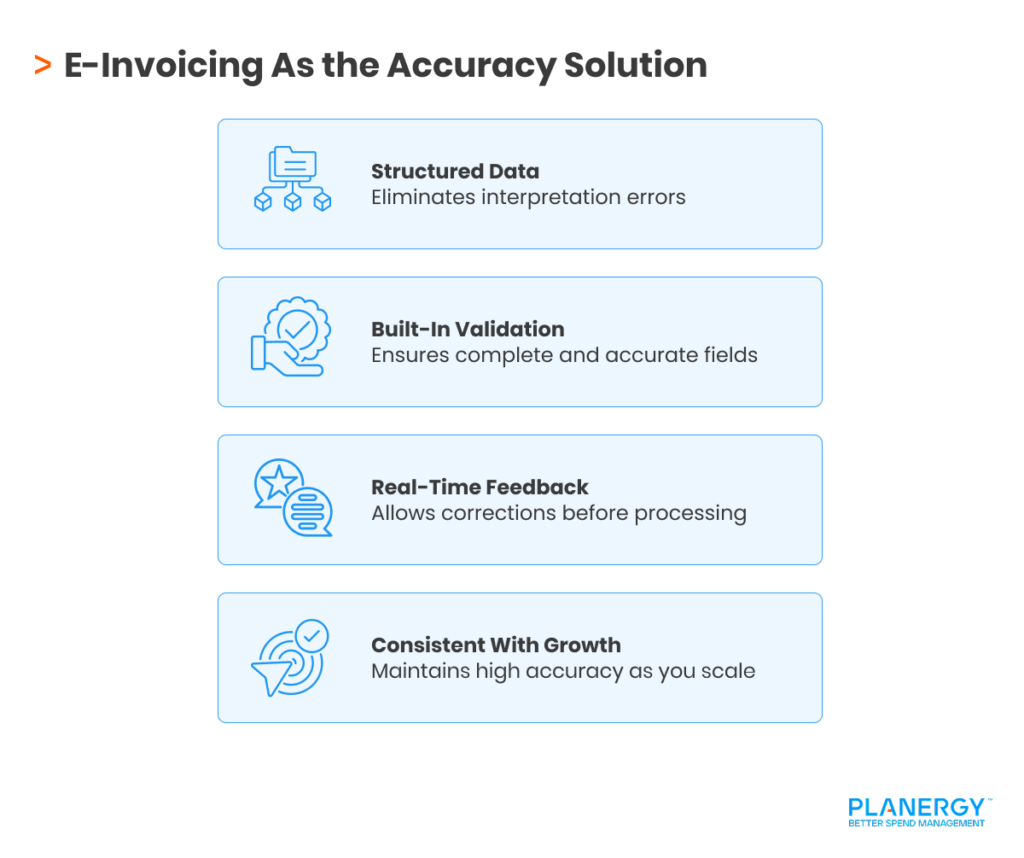
E-Invoicing as the Accuracy Solution

Below are some key e-invoicing advantages:

Eliminates Interpretation Errors

Structured data means no confusion about whether a “1” is an “l” or a smudged number is a “5” or “8.”

Built-In Validation

Required fields are complete and formats are correct before transmission. Your AP system receives invoices that have already passed quality checks.

Real-Time Feedback

Suppliers can correct problems before invoices enter your workflow, continuously improving data quality.

Consistent Accuracy at Scale

OCR accuracy drops as invoice complexity and volume increase. E-invoicing maintains accuracy regardless of scale or invoice characteristics.

For organizations serious about STP in Accounts Payable, adopt e-invoicing before—or alongside—automation initiatives. It transforms STP from risky to reliable.

Benefits of Straight-Through Processing

With proper accuracy safeguards, STP delivers significant advantages:

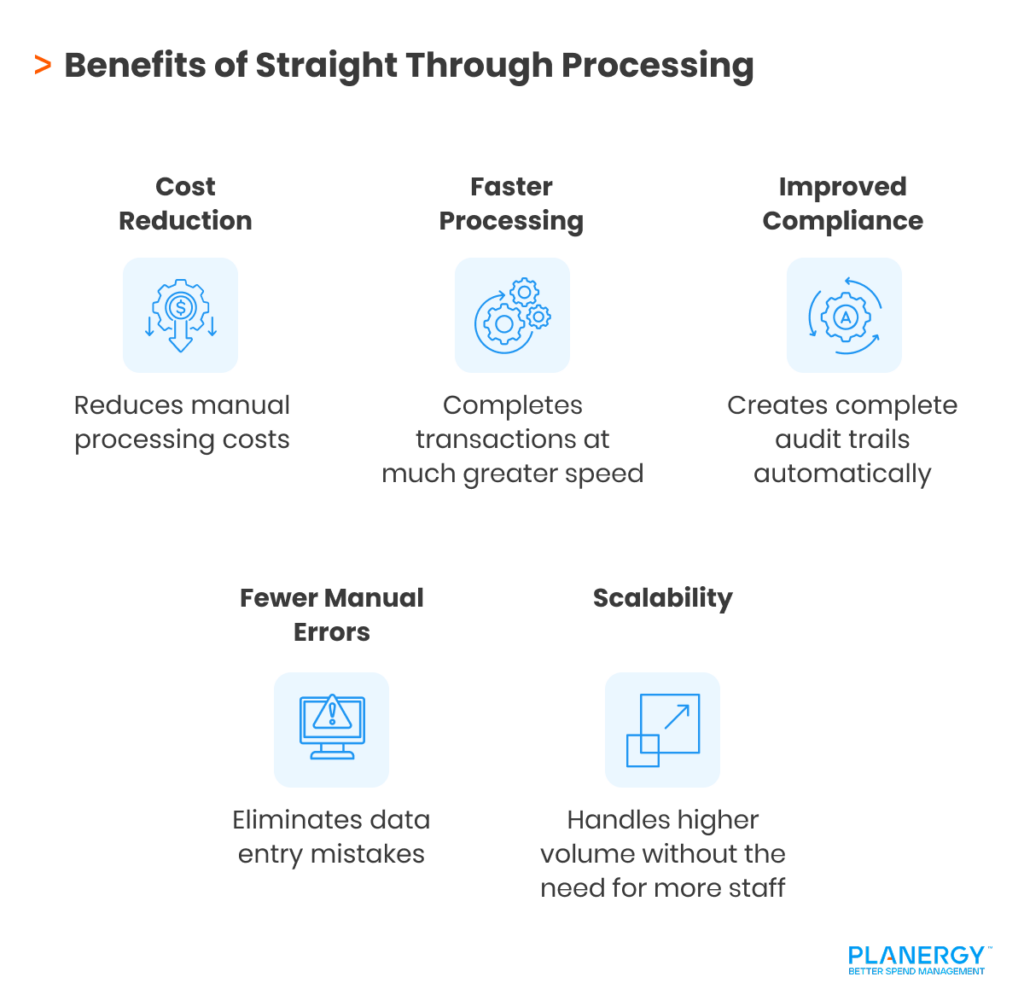
Benefits of Straight Through Processing

Cost Reduction

Manual invoice processing can cost $12-$30 per transaction. STP reduces this to $2-$5 by eliminating repetitive tasks. For high-volume processors, these savings compound quickly.

Speed and Working Capital Optimization

STP compresses processing time from days to hours. This enables early payment discounts, improves cash flow forecasting, and lets treasury teams optimize working capital instead of managing payment bottlenecks.

Better Compliance

Automated workflows create comprehensive audit trails documenting every transaction, approval, and validation. This simplifies regulatory compliance and reduces audit prep time.

Fewer Processing Errors

While STP amplifies data capture errors, it eliminates manual processing mistakes—transposition errors, duplicate entries, incorrect coding, and calculation mistakes.

Strategic Resource Allocation

Automation frees your finance team for strategic work: supplier relationships, contract negotiations, spend analysis, and process improvement. AP transforms from transactional to strategic.

Scalability

Effective STP lets you handle significant volume increases without proportional headcount growth.

Risks of Straight-Through Processing

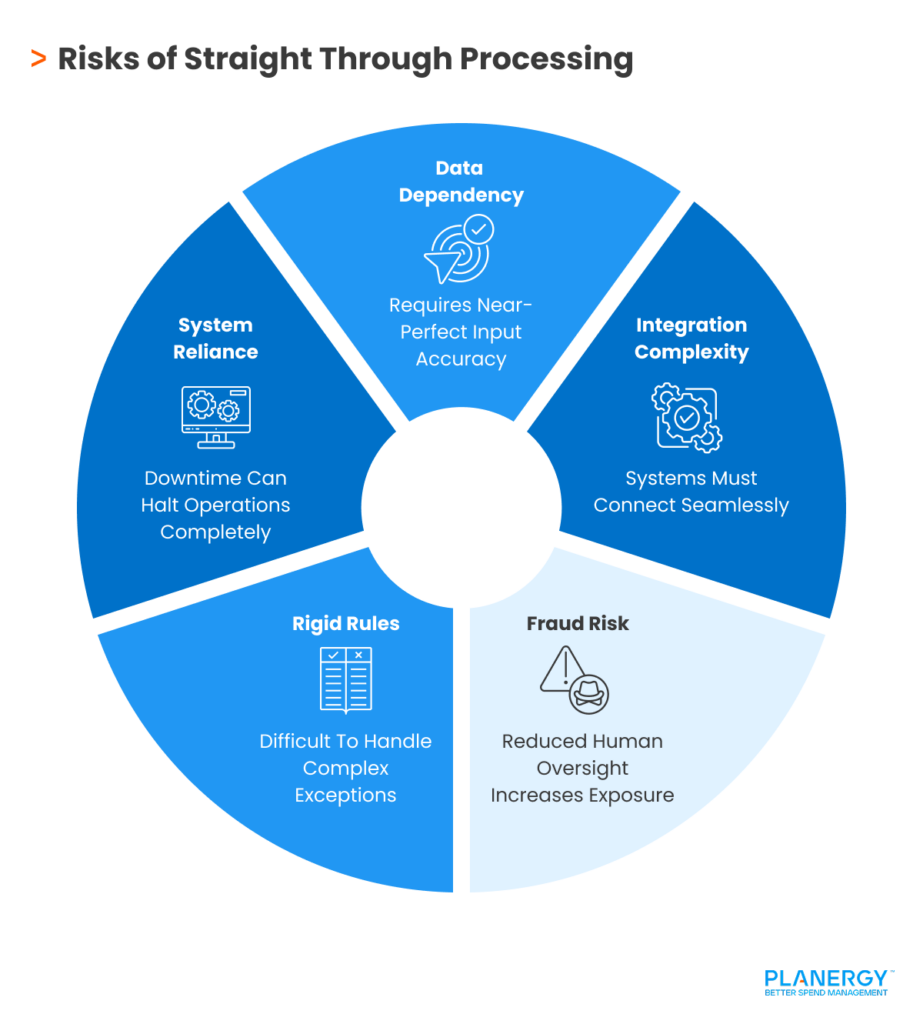
Automated Error Multiplication

Insufficient data accuracy turns STP into an error factory. Establish minimum 98%+ accuracy thresholds before enabling STP.

Integration Complexity

STP requires seamless communication between procurement platforms, ERP systems, vendor databases, and payment systems. Integration failures create bottlenecks and require expensive IT fixes.

Reduced Fraud Detection

Automation reduces human oversight that catches fraud. Implement compensating controls—anomaly detection, regular sampling, and segregated system access.

Risks of Straight Through Processing

Inflexible Business Rules

Predefined logic struggles with exceptions. Unusual transactions or complex vendor arrangements can overwhelm exception queues.

System Dependency

You become critically dependent on system availability. Technical failures can halt entire operations, unlike manual workflows with fallback options.

Who Uses Straight-Through Processing?

Financial Services

Banks process millions of daily transactions, including securities settlements, foreign exchange, payment processing. STP reduces settlement risk and operational costs in high-volume environments. Investment firms use it to meet T+2 settlement requirements.

Healthcare

Providers managing complex billing with insurers, government payers, and patients use STP for claims processing, payment posting, and denial management. This improves cash flow and reduces administrative costs.

Manufacturing and Distribution

Manufacturers processing high invoice volumes use STP to accelerate procure-to-pay cycles and strengthen supplier relationships.

Retail and E-Commerce

Retailers managing vast supplier networks leverage STP to maintain efficiency during peak periods without temporary staff.

Professional Services

Consulting, legal, and accounting firms use STP for expense reimbursement and client billing to accelerate revenue recognition and reduce disputes.

Shared Services Centers

Centralized AP operations use STP to manage volume efficiently while maintaining service levels across business units.

Why Financial Services Pioneered STP

Regulatory Compliance

Banking regulations require extensive transaction documentation and real-time reporting. STP creates comprehensive documentation while reducing compliance costs.

Settlement Risk Management

In securities processing, delays create counterparty risk. STP minimizes timelines, reducing default probability.

Operational Cost Control

Razor-thin margins mean banks can’t afford manual processing costs. STP enables profitable service on high-volume, low-margin financial transactions.

Competitive Edge

Faster processing and transparent tracking attract sophisticated clients demanding operational excellence. Fintech companies and traditional financial institutions alike can use STP to differentiate their services.

Broader Financial Applications

While Accounts Payable automation represents one major STP application, financial institutions also leverage it for Accounts Receivable, enabling faster payments, invoice generation, and streamlined reconciliation across financial operations.

Implementation Strategy

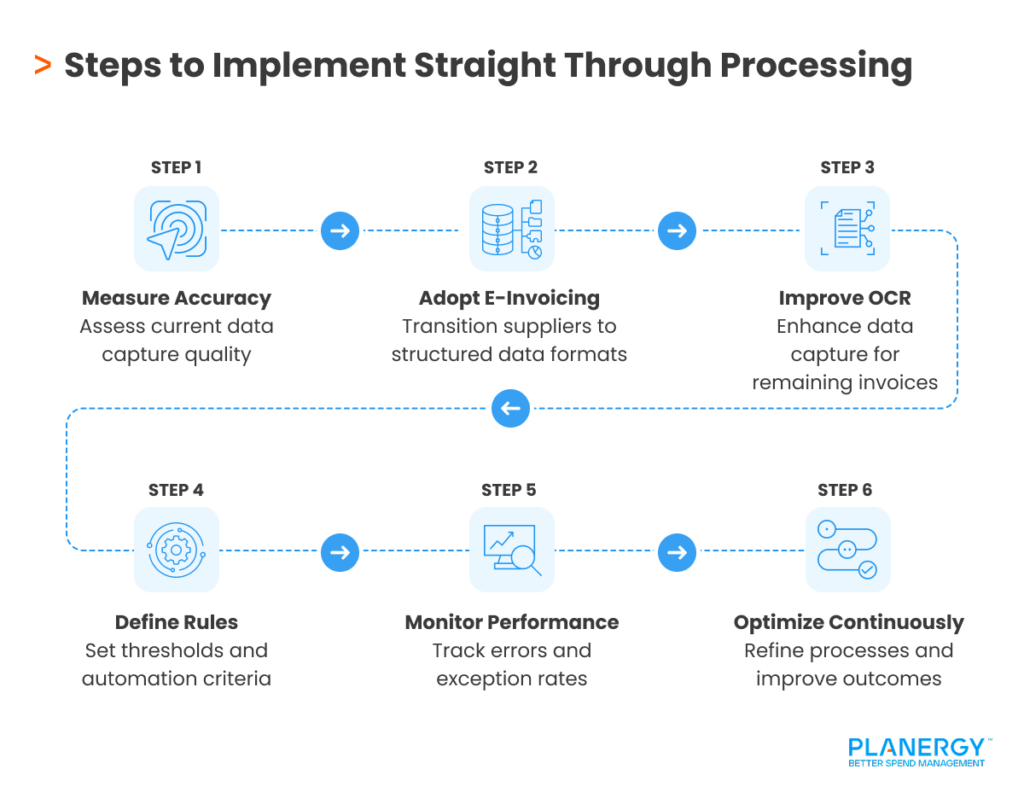
Steps to Implement Straight Through Processing

Step 1: Measure Current Accuracy

Audit your data capture accuracy across all invoice sources for 30 days. Establish a 98% minimum threshold for STP eligibility.

Step 2: Adopt E-Invoicing

Migrate high-volume suppliers to e-invoicing first. Focus on suppliers representing 80% of volume, which are typically your most sophisticated partners.

Step 3: Improve OCR

For remaining suppliers, invest in advanced OCR with machine learning and template optimization. Monitor accuracy continuously.

Step 4: Design Smart Business Rules

Balance efficiency with control. Set dollar thresholds, matching tolerances, and vendor risk ratings to determine which transactions qualify for full automation.

Step 5: Monitor Continuously

Maintain sampling protocols that regularly audit STP-processed transactions. Use anomaly detection to flag unusual patterns early.

Step 6: Optimize

Track processing costs, cycle times, error rates, and exception volumes. Refine rules and demonstrate ROI.

Building Your STP Foundation

Straight-through processing can deliver Accounts Payable efficiency, but only on a foundation of exceptional data accuracy. Organizations that recognize STP’s potential while respecting its limitations gain sustainable competitive advantage.

The path forward for streamlining financial operations:

  • Prioritize e-invoicing adoption
  • Invest in high-accuracy data capture
  • Implement intelligent business rules
  • Maintain vigilant quality monitoring

Build your accuracy foundation first. Enable suppliers to provide structured data. Implement STP strategically, not universally.

Straight-through processing can transform Accounts Payable into a strategic function, driving working capital optimization, stronger supplier relationships, and financial intelligence that powers business growth.

Just remember, in straight-through processing, accuracy isn’t optional. It’s the foundation everything else is built on.

What’s your goal today?

1. Use PLANERGY to manage purchasing and accounts payable

We’ve helped save billions of dollars for our clients through better spend management, process automation in purchasing and finance, and reducing financial risks. To discover how we can help grow your business:

2. Download our guide “Preparing Your AP Department For The Future”

Download a free copy of our guide to future proofing your accounts payable department. You’ll also be subscribed to our email newsletter and notified about new articles or if have something interesting to share.

3. Learn best practices for purchasing, finance, and more

Browse hundreds of articles, containing an amazing number of useful tools, techniques, and best practices. Many readers tell us they would have paid consultants for the advice in these articles.

Business is Our Business

Stay up-to-date with news sent straight to your inbox

PLANERGY LOGO

Sign up with your email to receive updates from our blog