What's PLANERGY?

Modern Spend Management and Accounts Payable software.

Helping organizations spend smarter and more efficiently by automating purchasing and invoice processing.

We saved more than $1 million on our spend in the first year and just recently identified an opportunity to save about $10,000 every month on recurring expenses with PLANERGY.

King Ocean Logo

Cristian Maradiaga

King Ocean

Download a free copy of "Indirect Spend Guide", to learn:

  • Where the best opportunities for savings are in indirect spend.
  • How to gain visibility and control of your indirect spend.
  • How to report and analyze indirect spend to identify savings opportunities.
  • How strategic sourcing, cost management, and cost avoidance strategies can be applied to indirect spend.

Download a free copy of "Indirect Spend Guide", to learn:

  • Where the best opportunities for savings are in indirect spend.
  • How to gain visibility and control of your indirect spend.
  • How to report and analyze indirect spend to identify savings opportunities.
  • How strategic sourcing, cost management, and cost avoidance strategies can be applied to indirect spend.

Blanket PO Vs Standard PO: Advantages and Disadvantages

KEY TAKEAWAYS

  • Standard purchase orders are best for one-time or unpredictable purchases, offering clear tracking, flexibility, and straightforward financial management.

  • Blanket purchase orders streamline recurring purchases by reducing administrative workload, improving pricing through volume commitments, and strengthening supplier relationships.

  • While blanket POs increase efficiency, they require accurate forecasting, strong tracking systems, and clear controls to avoid budget overruns and complexity.

  • The most effective procurement strategy uses a mix of both PO types, aligning each to purchase frequency, value, and business needs for optimal efficiency and control.


Every procurement decision comes down to finding the right tool for the job.

When your company needs office supplies for a one-time event, a standard purchase order gets the job done efficiently.

But when you’re ordering the same materials month after month from the same supplier, repeating that purchase order process becomes a drain on resources.

This is where blanket purchase orders come into play. Understanding the key differences between these purchase order types, and when to use each, can save your organization thousands of dollars while reducing administrative burden.

Let’s break down the differences, advantages, and strategic applications of both standard and blanket orders.

Understanding the Purchase Order Landscape

Before diving into the comparison, it’s worth noting that purchase orders come in several varieties, each designed for specific procurement scenarios.

Beyond standard and blanket POs, organizations also use planned purchase orders and contract purchase orders. Each serves a distinct purpose in modern procurement operations.

The four main types of purchase orders give procurement teams the flexibility to match their purchasing approach to their business needs. Choosing the right type isn’t just about following protocol—it’s about maximizing value and efficiency.
What Standard Purchase Orders Bring to the Table

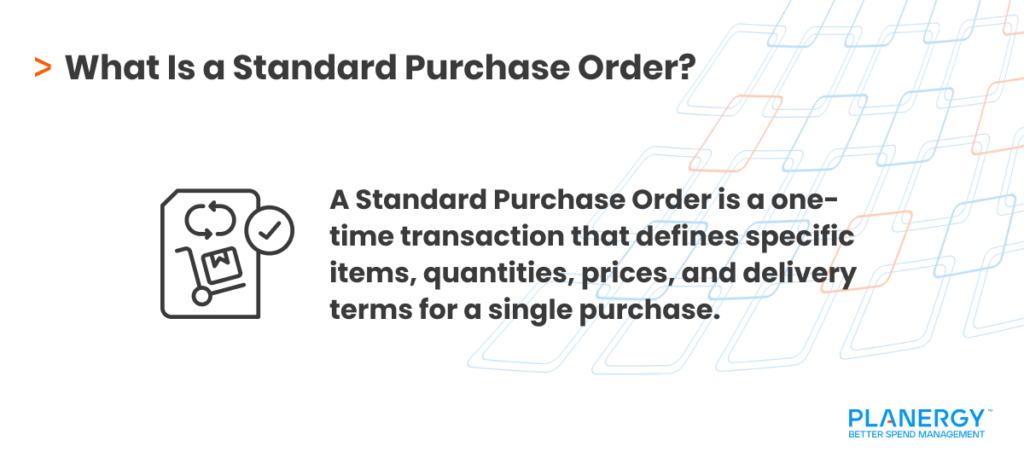
A standard purchase order represents the most straightforward procurement transaction. When you need specific goods or services delivered on a particular date at an agreed-upon price, a standard PO documents that agreement between buyer and seller.

What Is a Standard Purchase Order

Think of standard POs as the workhorse of procurement. They include all the essential details: unit prices, delivery dates, shipping information, and payment terms. Once approved, they become legally binding documents that protect both parties.

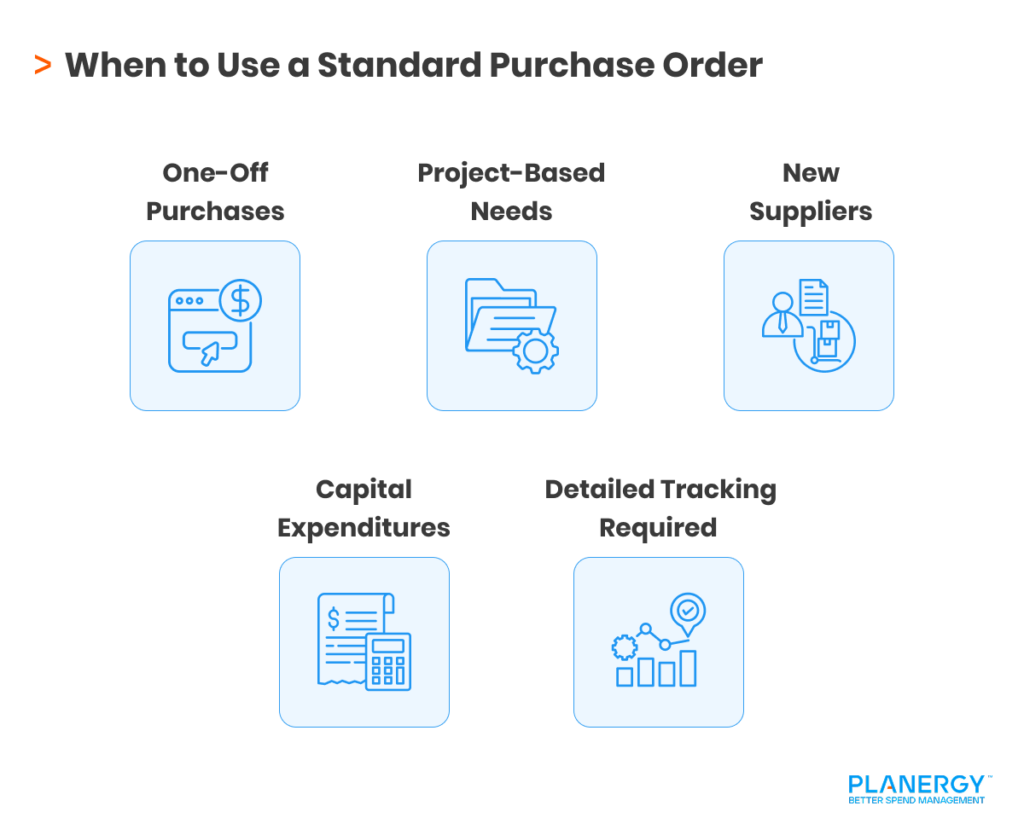
When Standard POs Make the Most Sense

Standard purchase orders work best for:

  • One-off purchases where you don’t anticipate repeat orders.
  • Project-specific needs with clear specifications and deadlines.
  • New vendor relationships where you’re testing quality and reliability.
  • Capital expenditures like equipment or furniture with fixed specifications.
  • Situations requiring detailed line-item tracking for audit or compliance purposes.

For example, if your marketing department needs 500 branded tote bags for an upcoming trade show, a standard PO captures all the specific details—dimensions, colors, logo placement, delivery date—in one clean document.

When to Use a Standard Purchase Order

How Blanket Purchase Orders Change the Game

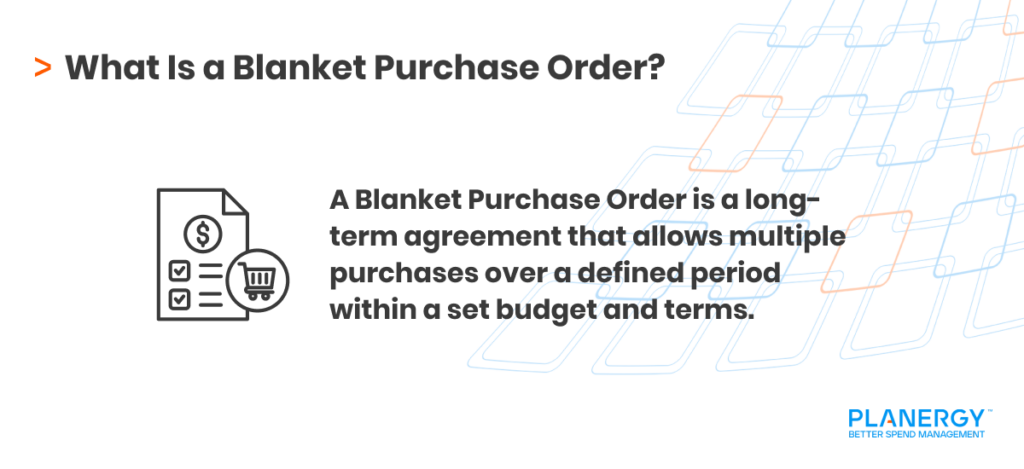
A blanket purchase order takes a different approach. Instead of authorizing a single transaction, it establishes an ongoing purchasing relationship for a specified period.

You’re essentially pre-approving multiple purchases within defined parameters—total budget, timeframe, pricing, and terms.

Blanket POs, sometimes called standing purchase orders, create a purchasing framework rather than a single transaction. They’re ideal for recurring needs where the total quantity isn’t known upfront, but the need for regular purchases is certain.

What Is a Blanket Purchase Order

Creating a Blanket Purchase Order

Setting up a blanket PO involves several key steps:

  1. Identify recurring purchase patterns in your procurement data.
  2. Negotiate favorable terms with your supplier, including volume discounts and fixed price agreements.
  3. Establish the time period (typically 3-12 months).
  4. Set a total budget cap for all purchases under the agreement.
  5. Define quality specifications and delivery expectations.
  6. Document payment terms and pricing structures.
  7. Include contingency clauses for early termination if needed.

Once established, team members can make releases against the blanket PO without going through full approval process workflows for each individual purchase. The supplier invoices against the same PO number throughout the agreement period.

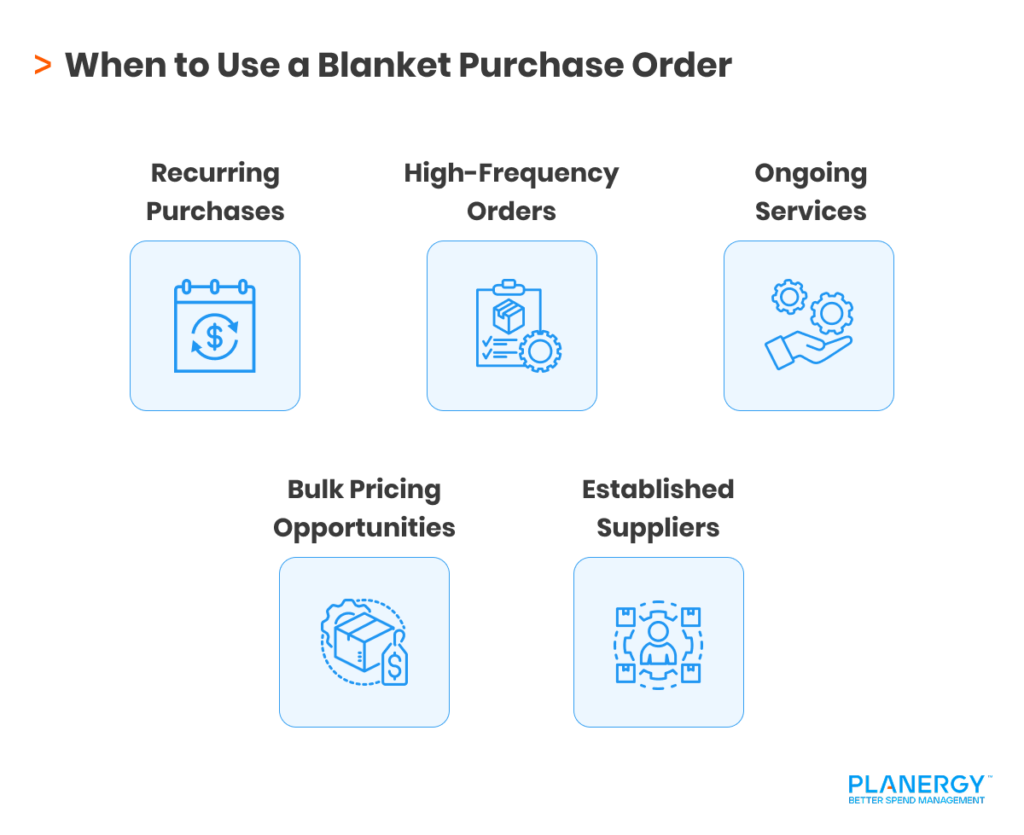
When Blanket POs Deliver Maximum Value

Blanket purchase orders excel in these scenarios:

  • Regularly consumed supplies like office materials, cleaning supplies, or break room items.
  • Production materials ordered on a recurring schedule to support supply chain continuity.
  • Ongoing services such as maintenance contracts or consulting agreements.
  • High-frequency, low-value purchases that would otherwise bog down your approval process.
  • Situations where bulk pricing delivers significant savings.
  • Vendor relationships you want to strengthen through consistent business.

Consider a manufacturing facility that uses specific raw materials daily. Rather than issuing a new PO every time inventory runs low, a blanket PO with a six-month term and a $100,000 budget gives the production team flexibility to order what they need, when they need it, while locking in favorable pricing.

When to Use a Blanket Purchase Order

Framework vs. Blanket: Understanding the Distinction

While the terms sometimes get used interchangeably, framework purchase orders and blanket POs have subtle but important differences.

A framework PO (also called a contract PO) establishes a long-term agreement with no specific expiration date. It sets the foundation for future transactions, but doesn’t commit to specific quantities or delivery schedules.  

This means each purchase still requires a separate release or call-off order.

A blanket PO, by contrast, has a defined timeframe and budget. It’s more prescriptive and time-bound, making it better suited for predictable, recurring needs within a specific period.

Think of framework POs as evergreen agreements that establish “if you buy, here are the terms,” while blanket POs say “we’re committing to buy approximately this much over this period.” For a deeper exploration of how purchase orders differ from contracts, see our guide on purchase orders vs. contracts.

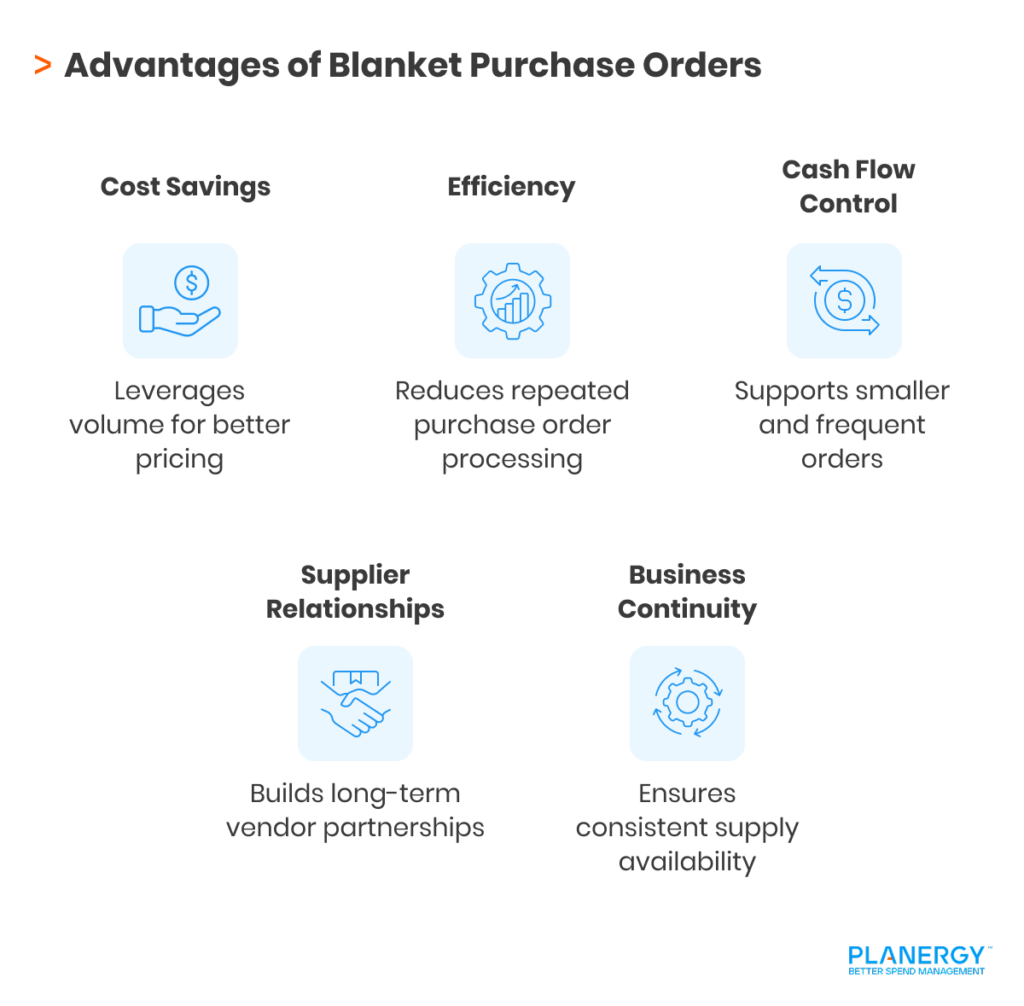
The Advantages That Make Blanket POs Attractive

Blanket purchase orders offer compelling benefits that can transform procurement efficiency:

Advantages of Blanket Purchase Orders

Financial Leverage and Predictability

By committing to a larger purchase volume over time, you gain negotiating power. Suppliers offer better unit pricing, volume discounts, or preferential terms because they’re guaranteed consistent business.

This locks in rates for the agreement period, protecting your budget from market fluctuations and price volatility. You thereby address a critical element of risk management in procurement.

Administrative Efficiency

Instead of processing dozens or hundreds of individual POs, your procurement team handles one blanket PO setup. Requisitioners make releases against it without full approval process cycles. Your Accounts Payable team processes invoices against the same PO number, streamlining reconciliation.

This time savings is substantial. If it takes 30 minutes to process a standard PO from requisition through approval, and you’re making 50 related purchases per year, that’s 25 hours saved with a single blanket PO.

Inventory and Cash Flow Management

Blanket POs let you order smaller quantities more frequently, reducing the need for large storage facilities and minimizing carrying costs. This just-in-time approach also improves cash flow since you’re not tying up capital in excess inventory that sits on shelves, depreciating.

Stronger Vendor Relationships

Suppliers appreciate the revenue predictability that blanket POs provide. This creates goodwill that often translates into better service, prioritized orders during shortages, and more collaborative problem-solving when issues arise.

Business Continuity

For critical supplies and services, blanket POs ensure uninterrupted access. There’s no risk of operations halting because someone forgot to submit a purchase requisition or because approvals are delayed.

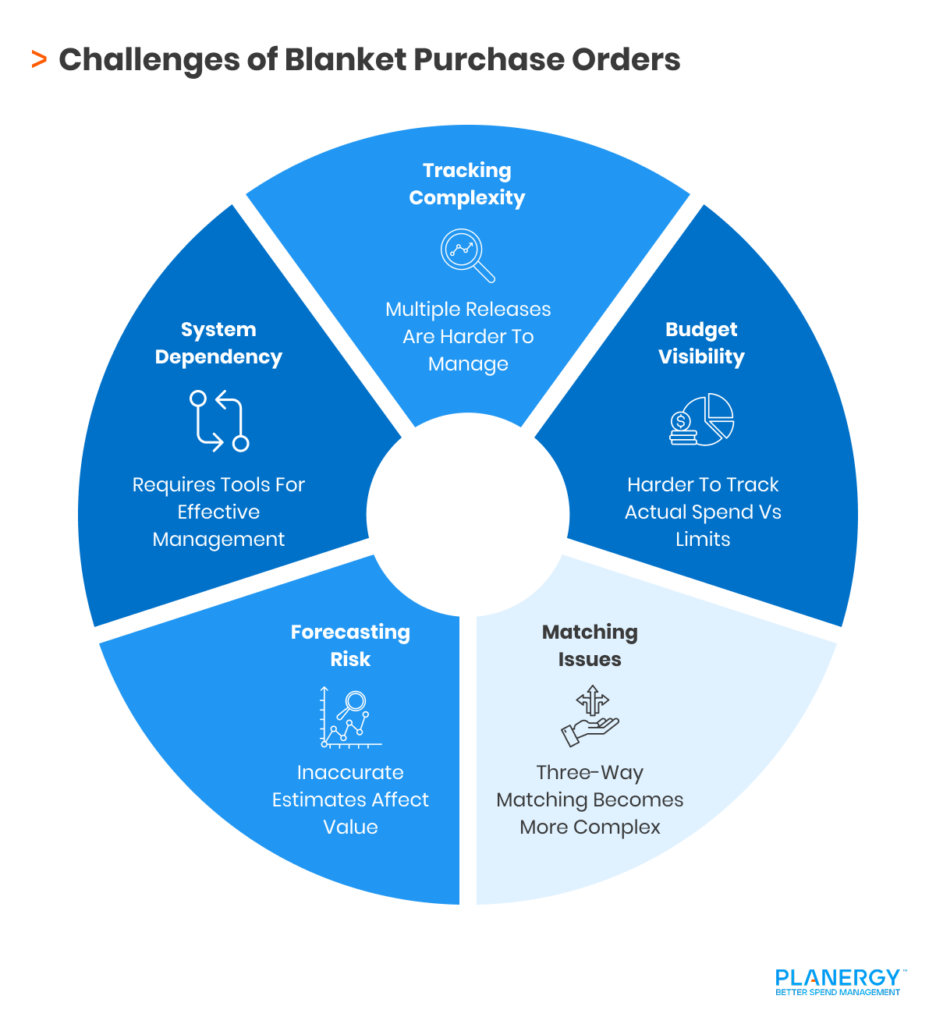
The Challenges You Need to Navigate

Despite these advantages, blanket POs introduce complexities that require careful management:

Challenges of Blanket Purchase Orders

Visibility and Tracking Complexity

With multiple releases against a single PO number, tracking exactly what’s been ordered, received, and invoiced becomes more challenging.

Finance teams may struggle to reconcile actual spend against budgets when transactions are consolidated under one umbrella.

This can lead to “budget bloat” where departments pad their blanket PO requests to avoid running short, resulting in allocated but unused funds that could be deployed elsewhere.

Matching and Audit Trails

Three-way matching—comparing purchase orders, receiving documents, and invoices—gets trickier with blanket POs.

Vendors might continue using an expired PO number, creating exceptions that require manual intervention. Each release needs proper documentation, and without automated systems, this administrative burden can negate the efficiency gains.

Forecasting Accuracy Requirements

Blanket POs demand accurate demand forecasting. Overestimate your needs, and you’ve committed to spend you might not use. Underestimate, and you’ll need to process additional POs or negotiate amendments mid-term, undermining the efficiency benefits.

Technological Dependencies

To realize the full value of blanket POs, you need procurement software that provides:

  • Real-time visibility into remaining budget balances
  • Automated tracking of releases and invoices
  • Integration between purchasing, receiving, and accounting systems
  • Analytical tools for evaluating BPO performance

Without these capabilities, managing blanket POs manually becomes unwieldy and error-prone.

Standard POs: Straightforward but Essential

While blanket POs get attention for their efficiency benefits, standard purchase orders remain indispensable. Their advantages include:

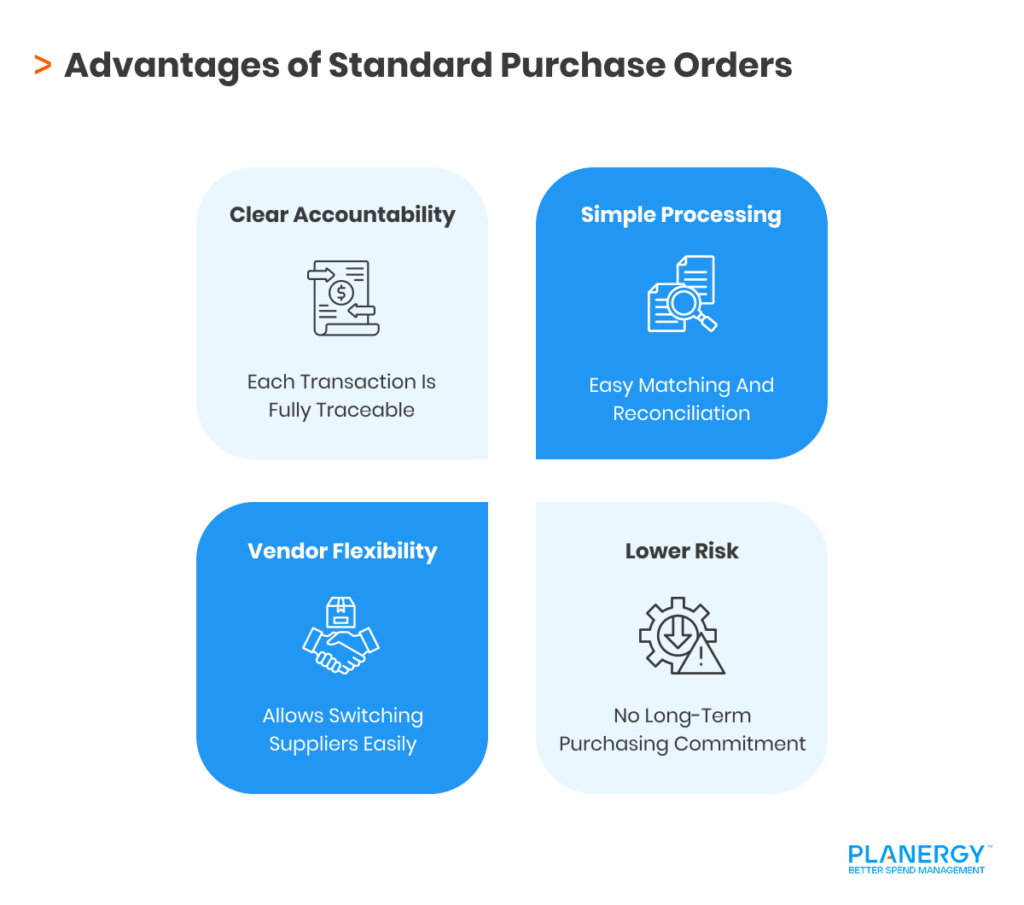
Advantages of Standard Purchase Orders

Crystal-Clear Accountability

Every transaction is distinct and traceable. There’s no ambiguity about what was ordered, when, by whom, and for what purpose. This clarity is invaluable during audits or when investigating discrepancies.

Simpler Financial Management

Standard POs match neatly with individual invoices and receipt documents. Your accounting team can process them quickly without hunting for related transactions or allocating partial amounts across different releases.

Flexibility in Vendor Selection

Since you’re not committing to ongoing purchases, you can evaluate multiple suppliers for each need, choosing the best combination of price, quality, and delivery for every transaction.

Reduced Risk Exposure

With no long-term commitments, you’re free to adjust your purchasing strategy as market conditions or business needs change. If a supplier’s quality declines or a competitor offers better terms, you simply choose differently next time.

The trade-off, of course, is higher per-unit costs and greater administrative overhead when similar purchases happen frequently.

Standard PO vs Blanket POMaking the Strategic Choice for Your Business


The decision between blanket and standard POs shouldn’t be one-size-fits-all. Consider these factors:


Purchase Frequency and Predictability

If you’re ordering similar items from the same supplier at least monthly, a blanket PO probably makes sense. For occasional or unpredictable needs, standard POs keep you flexible.

Volume and Value Thresholds

Blanket POs deliver the best return when aggregate annual spending with a vendor exceeds $10,000-$25,000. Below that threshold, the setup effort may outweigh the benefits.

Vendor Relationship Maturity

Use standard POs when establishing new vendor relationships. Once you’ve confirmed quality and reliability over several transactions, transitioning to a blanket PO can deepen the partnership.

Administrative Capacity

Organizations with manual or paper-based procurement systems may struggle with blanket PO complexity. In these cases, sticking with standard POs—or better yet, investing in procurement automation first—may be wiser.

Compliance and Audit Requirements

Highly regulated industries often need granular transaction trails. Evaluate whether your blanket PO process can meet these documentation standards without excessive manual effort.

Market Volatility

In rapidly changing markets, locking into long-term pricing through blanket POs could work for or against you. Standard POs let you take advantage of price drops, while blanket POs protect against increases.

A practical approach: conduct a spend analysis to identify your top recurring purchases by vendor. These high-frequency, predictable expenditures are your best blanket PO candidates. Use standard POs for everything else.

Documenting these guidelines in a clear purchase order policy helps ensure consistent application across your organization.

Your policy should specify dollar thresholds for blanket POs, approval authority levels, and criteria for choosing between PO types—giving your team a roadmap for making smart procurement decisions.

The Broader Value of Purchase Orders in Procurement

Regardless of which type you choose, using purchase orders systematically delivers organizational benefits that extend beyond individual transactions.

For a comprehensive overview of purchase order fundamentals and best practices, explore our complete guide on everything you need to know about purchase orders.

Budget Control and Spend Visibility

POs create a paper trail before money leaves your account. This pre-commitment visibility lets finance teams track obligations in real-time, preventing overspending and enabling more accurate forecasting.

Fraud Prevention and Internal Controls

By requiring approvals before purchases are authorized, POs create checkpoints that deter unauthorized spending and catch errors before they become costly mistakes.

Vendor Relationship Documentation

POs establish clear expectations and create legally enforceable agreements. When disputes arise about quantities, specifications, or delivery dates, the PO provides an objective reference point.

Data-Driven Decision Making

PO data reveals spending patterns, supplier performance, and procurement efficiency. This intelligence informs strategic decisions about vendor consolidation, contract negotiations, and process improvements.

How Modern Technology Transforms PO Management

Whether you’re using blanket or standard POs—or a mix of both—procurement software makes the difference between chaos and control.

A comprehensive spend management platform like PLANERGY addresses the challenges inherent in purchase order management:

Centralized Data and Visibility

PLANERGY consolidates all procurement data in one environment, giving you real-time visibility into PO status, budget consumption, and vendor performance. Finance teams can see commitments and actuals side by side, eliminating surprises at month-end.

Automated Workflows and Approvals

Requisitions flow through appropriate approval chains automatically based on rules you define. Team members submit requests through simple interfaces, and managers approve or reject with a click.

Purchase order automation eliminates the bottlenecks that plague manual processes, whether you’re managing blanket orders or standard POs. Efficiency gains compound when you’re processing high volumes of transactions.

Intelligent Three-Way Matching

PLANERGY’s artificial intelligence automatically matches purchase orders with receiving documents and invoices, flagging exceptions for review.

This eliminates the manual labor that makes blanket POs administratively burdensome without technology support.

Budget Tracking and Alerts

For blanket POs, the platform tracks releases against total authorized amounts in real-time, sending alerts as budgets approach limits. This prevents overruns and gives procurement teams time to negotiate extensions or amendments.

Supplier Collaboration

Vendors access their own portal where they can view POs, submit invoices, and track payment status. This transparency reduces queries and disputes while accelerating the order-to-cash cycle for your suppliers.

Analytics and Optimization

PLANERGY’s reporting tools analyze your procurement patterns, identifying opportunities for blanket PO implementation, vendor consolidation, and process improvements. What-if scenarios help you model the financial impact of different procurement strategies.

Compliance and Audit Readiness

Every transaction is documented and traceable, with complete audit trails showing who did what when. When auditors or compliance officers come knocking, you can produce requested documentation in minutes rather than days.

Finding Your Procurement Sweet Spot

The blanket PO versus standard PO debate is about building a procurement toolkit that matches your organization’s needs. Most companies benefit from using both types strategically.

Standard POs provide the foundation: clear, traceable, flexible transactions that work for one-off needs, new vendors, and unpredictable purchases.

Blanket POs add efficiency: streamlined processes, cost savings, and stronger vendor relationships for your recurring, predictable needs.

The key is understanding when each tool delivers maximum value and having the systems in place to manage both effectively.

By investing in procurement technology that brings intelligence, automation, and visibility to your purchasing processes, you can leverage the advantages of both standard and blanket POs while minimizing their respective drawbacks.

Start by analyzing your spend data to identify patterns, and you’ll uncover insights that will guide you toward the right purchase order mix for your specific situation.

With the right strategy and tools in place, you’ll transform procurement from a cost center into a strategic function that drives value throughout your organization.

What’s your goal today?

1. Use PLANERGY to manage purchasing and accounts payable

We’ve helped save billions of dollars for our clients through better spend management, process automation in purchasing and finance, and reducing financial risks. To discover how we can help grow your business:

2. Download our guide “Indirect Spend Guide”

Download a free copy of our guide to better manage and make savings on your indirect spend. You’ll also be subscribed to our email newsletter and notified about new articles or if have something interesting to share.

3. Learn best practices for purchasing, finance, and more

Browse hundreds of articles, containing an amazing number of useful tools, techniques, and best practices. Many readers tell us they would have paid consultants for the advice in these articles.

What’s your goal today?

1. Use PLANERGY to manage purchasing and accounts payable

We’ve helped save billions of dollars for our clients through better spend management, process automation in purchasing and finance, and reducing financial risks. To discover how we can help grow your business:

2. Download our guide “Indirect Spend Guide”

Download a free copy of our guide to better manage and make savings on your indirect spend. You’ll also be subscribed to our email newsletter and notified about new articles or if have something interesting to share.

3. Learn best practices for purchasing, finance, and more

Browse hundreds of articles, containing an amazing number of useful tools, techniques, and best practices. Many readers tell us they would have paid consultants for the advice in these articles.

Business is Our Business

Stay up-to-date with news sent straight to your inbox

PLANERGY LOGO

Sign up with your email to receive updates from our blog